

There is a particular kind of exhaustion that comes with severe depression.
Not the kind that disappears after a weekend of rest.
Not the kind that improves with a good night’s sleep.
The kind that settles into everything.
Getting dressed feels harder. Returning texts feels impossible. Making decisions feels overwhelming. Even searching for help can feel like carrying a weight uphill.
If you’re reading this, there is a good chance you’ve reached a point where you know something needs to change.
But another question quickly follows:
“What kind of help do I actually need?”
For many people, that’s when fear enters the conversation.
You start researching treatment options and immediately encounter unfamiliar terms. Some involve staying somewhere full time. Others allow you to return home each day. The differences feel confusing, especially when you’re already struggling to think clearly.
At Bold Steps Behavioral Health, we often speak with people who feel stuck between knowing they need support and feeling terrified of making the wrong decision.
Many begin by learning about structured daytime care because they’re looking for meaningful support without immediately stepping away from every part of their daily life.
If that sounds familiar, you’re not alone.
And you’re asking exactly the right questions.
Depression Often Makes People Doubt Their Own Struggles
One thing we hear repeatedly is:
“Maybe I’m not bad enough yet.”
Depression has a way of minimizing its own impact.
You may be struggling to function, withdrawing from people you care about, sleeping too much or too little, feeling emotionally numb, and still convincing yourself that someone else has it worse.
This kind of thinking keeps many people from seeking help.
The reality is that treatment isn’t reserved for people in absolute crisis.
It’s for people whose lives are being affected by what they’re experiencing.
If depression is making it difficult to function, work, maintain relationships, care for yourself, or feel connected to life, your pain matters.
You don’t have to earn support.
Why This Decision Feels So Intimidating
Most people aren’t just comparing treatment options.
They’re imagining what treatment means about them.
That’s a very different conversation.
Many people worry:
- Does needing more support mean I’m failing?
- Will I have to leave home?
- Will I lose my independence?
- What will people think?
- Am I really struggling enough?
These fears are incredibly common.
But treatment isn’t a judgment about who you are.
It’s a response to what you’re experiencing.
If your leg were broken, you wouldn’t feel ashamed about getting a cast.
Mental health deserves the same compassion.
Understanding the Difference Starts With Safety
One of the biggest factors influencing treatment recommendations is safety.
When someone is experiencing severe psychiatric symptoms, cannot safely care for themselves, is at immediate risk of self-harm, or requires constant monitoring, a more intensive environment may be necessary.
The purpose is stabilization.
The goal is helping someone safely navigate a crisis and regain enough stability to continue healing.
This level of care focuses heavily on immediate protection and support.
It’s important to understand that requiring this level of help does not mean someone has failed.
It means they deserve safety during an exceptionally difficult period.
Many people only need this type of support temporarily.
The Space Between Weekly Therapy and Full-Time Care
Here’s where many people find themselves.
They’re not experiencing an emergency.
But they’re also not doing well.
They’re showing up to work but barely functioning.
They’re attending classes but retaining very little.
They’re maintaining relationships but feeling emotionally disconnected.
They’re surviving rather than living.
This middle ground is more common than most people realize.
And it’s often where intensive daytime support becomes relevant.
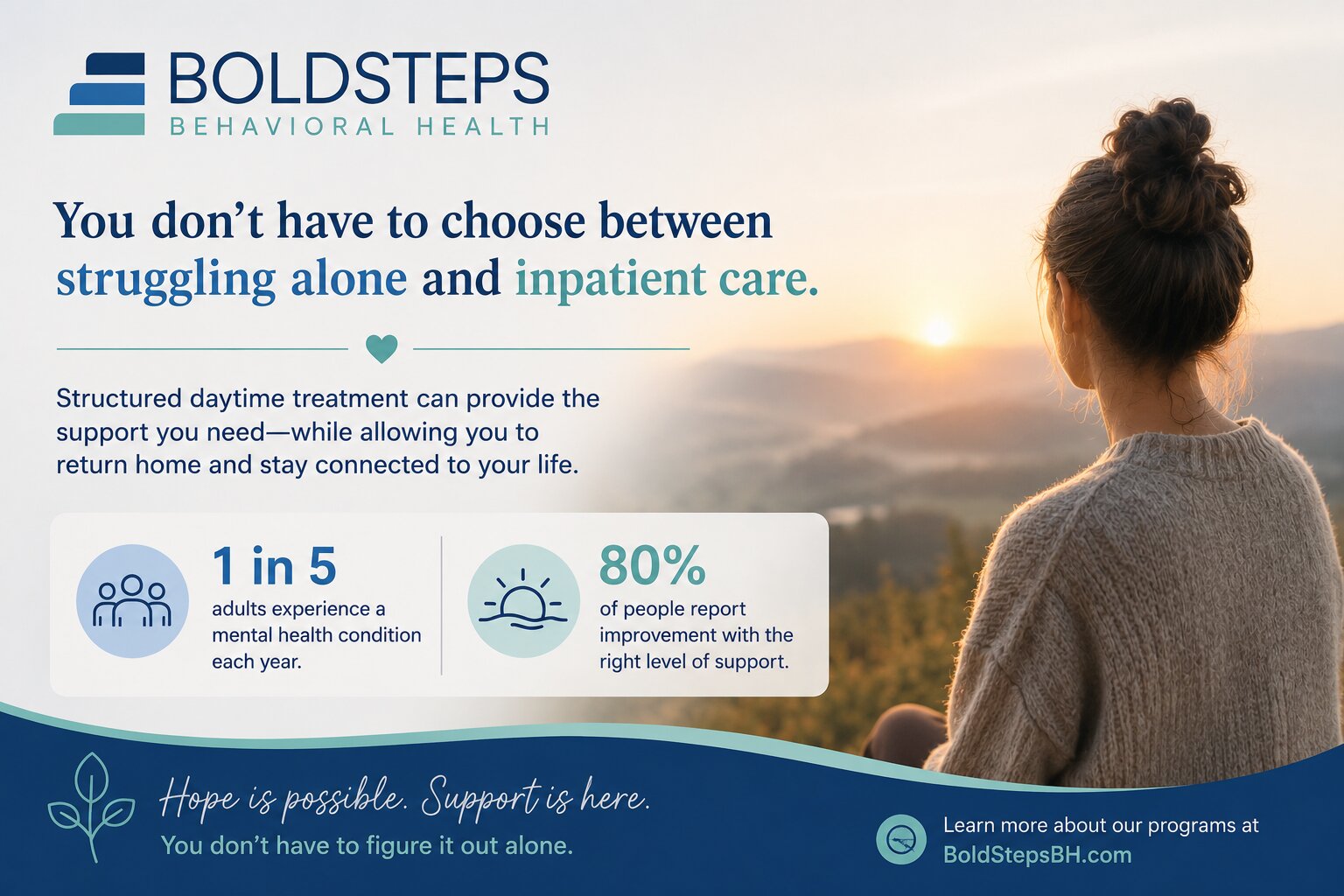
Instead of receiving care for a single hour each week, individuals participate in several hours of treatment throughout the day and then return home afterward.
This allows people to receive meaningful therapeutic support while remaining connected to family, routines, responsibilities, and familiar surroundings.
For many individuals, this balance feels less overwhelming than leaving home entirely.
The Question Beneath the Question
People often search for day treatment vs inpatient because they’re trying to understand logistics.
But after years of working with individuals facing depression, we’ve noticed something.
The real question is usually emotional.
People are asking:
“How serious is my situation?”
“Will I lose my freedom?”
“Am I broken?”
“Can I recover without disappearing from my life?”
These are understandable fears.
Depression often convinces people that seeking help will make life smaller.
In reality, the right support is designed to help life become bigger again.
Bigger than your symptoms.
Bigger than isolation.
Bigger than hopelessness.
Why Staying Connected Matters for Some People
One advantage of receiving intensive support during the day while returning home afterward is the opportunity to practice recovery in real life.
Healing doesn’t happen in isolation.
It happens when new skills meet real-world situations.
You learn healthier coping strategies and then have opportunities to use them at home.
You work on communication and then practice those conversations with loved ones.
You explore emotional regulation and then apply it during everyday stress.
For some people, maintaining those connections becomes an important part of recovery.
Of course, this isn’t the right fit for everyone.
Some individuals need a temporary separation from stressful environments in order to stabilize.
That’s why assessments matter.
Treatment isn’t one-size-fits-all.
It’s about finding the right level of support for the person sitting in front of you.
What Recovery Actually Looks Like
Many people imagine recovery as a dramatic transformation.
One day depressed.
The next day better.
Most healing doesn’t work that way.
Recovery tends to arrive quietly.
It’s noticing that getting out of bed takes less effort.
It’s realizing you answered a text without overthinking it for three hours.
It’s eating a meal because you’re hungry rather than because you know you should.
It’s laughing unexpectedly.
It’s making plans for next week.
It’s feeling curious about the future again.
These moments may seem small.
But they’re often signs of something profound.
They’re signs that depression is no longer controlling every part of your life.
Think of recovery like watching a sunrise.
You don’t notice every second of change.
But eventually, you realize the darkness isn’t as heavy as it was before.
When Mental Health and Substance Use Are Both Present
Many people exploring treatment aren’t dealing solely with depression.
Alcohol, marijuana, prescription medications, or other substances sometimes become part of the picture.
This can create additional confusion.
Some individuals start using substances to manage emotional pain.
Others discover that substance use worsens existing depression.
Over time, the relationship between the two becomes difficult to untangle.
When mental health and substance use collide, treatment often works best when both concerns are addressed together rather than separately.
Ignoring one side of the equation often leaves important issues unresolved.
That’s one reason comprehensive assessments can be so valuable.
They help identify what is really driving someone’s symptoms and what level of support may help most.
You Don’t Need Absolute Certainty
One of the biggest barriers to treatment is the belief that you must know exactly what you need before reaching out.
You don’t.
In fact, most people don’t.
That’s completely normal.
You are not expected to diagnose yourself.
You are not expected to determine the ideal level of care alone.
Your job is simply to ask for guidance.
An assessment isn’t a commitment to any specific program.
It’s a conversation.
An opportunity to better understand your options.
A chance to replace fear with information.
And often, information makes the next step feel much less overwhelming.
The Goal Isn’t the Most Intensive Care
Some people assume that more treatment automatically means better treatment.
That’s not necessarily true.
The goal isn’t finding the most intensive option available.
The goal is finding the right level of support.
Too little support can leave people struggling.
Too much support can feel unnecessary.
The most effective treatment often exists in the middle ground where structure, flexibility, safety, and independence are balanced appropriately.
That balance looks different for every person.
Which is why individualized recommendations matter.
Hope Doesn’t Require Certainty
You don’t have to feel confident today.
You don’t have to feel optimistic.
You don’t even have to believe recovery is possible.
Many people begin treatment carrying doubt, fear, and exhaustion.
Hope often arrives later.
What matters now is willingness.
The willingness to ask questions.
The willingness to learn about your options.
The willingness to imagine that your future could look different than your present.
If you’re looking for additional mental health resources and care in Pennsylvania, exploring available care in Pennsylvania can be a helpful next step.
Because depression is powerful.
But it is not permanent.
And the fact that you’re searching for answers means part of you still believes things can improve.
That part deserves to be heard.
Frequently Asked Questions
How do I know if I need more support than weekly therapy?
If depression is significantly affecting your daily functioning, relationships, work, school performance, or ability to care for yourself, it may be time to explore a higher level of care.
Is severe depression always treated in a hospital setting?
No. Many individuals with severe depression receive intensive treatment while continuing to live at home. The appropriate level of care depends on safety, symptom severity, and individual circumstances.
What if I’m scared of asking for help?
Fear is one of the most common reasons people delay treatment. You don’t need to feel ready. You only need to take the next step.
Can I receive intensive treatment without staying overnight?
Yes. Some treatment options provide several hours of support during the day while allowing individuals to return home in the evenings.
Does needing a higher level of care mean I’ve failed?
Absolutely not. Seeking additional support is often a sign of strength, self-awareness, and a commitment to recovery.
What happens during an assessment?
An assessment typically involves discussing symptoms, safety concerns, treatment history, daily functioning, and goals. The purpose is to identify what level of care may be most beneficial.
What if depression and substance use are both affecting me?
Many people experience both. Addressing mental health concerns and substance use together often creates a stronger foundation for recovery.
Take the Next Step
If severe depression is making everyday life feel overwhelming, you don’t have to figure out the next step on your own.
Call 717-896-1880 or visit our partial hospitalization program services to learn more about our programs, partial hospitalization program services in Harrisburg, PA.