

In early recovery, everything feels new—but not necessarily in a good way.
The silence hits harder. The routine feels empty without the escape. And even when you’re surrounded by people, it can still feel like no one truly sees what you’re carrying.
It’s in that quiet, lonely middle space—after detox, before stability—that a gentle, honest question might surface:
Can my family be part of this? Do they want to be? Would it even help?
At Bold Steps Behavioral Health in Harrisburg, PA, we know that recovery doesn’t happen in isolation. Dual diagnosis treatment—which supports both addiction and mental health healing—often becomes more effective when family is involved. But only if it’s done with care, consent, and emotional safety at the center.
This blog is for anyone newly sober who wonders if letting family in is possible—or worth it.
Yes, family can be part of dual diagnosis treatment
Dual diagnosis treatment is designed for people dealing with both substance use and a mental health condition like anxiety, depression, trauma, or bipolar disorder. But those conditions don’t exist in a vacuum.
They affect—and are affected by—the relationships around you.
When the people closest to you are informed, involved, and supported, the path toward healing can feel less like something you’re dragging yourself through—and more like something you can walk with others, step by step.
At Bold Steps, family involvement isn’t just possible. It’s part of the care model when it makes sense for you.
What family involvement actually looks like
Family involvement doesn’t mean handing over your progress to someone else. It means creating intentional opportunities for communication, education, and—when the time is right—healing.
This can include:
- Family therapy sessions led by a trained clinician
- Educational workshops about addiction, co-occurring disorders, and what recovery actually looks like
- Boundary support—so that both you and your loved ones feel safe
- Optional group check-ins that keep everyone informed without overwhelming you
And if you’re looking for dual diagnosis treatment in Harrisburg & Dauphin County, PA, we offer options for in-person and virtual family sessions, depending on what works for your situation.
This isn’t about fixing the past. It’s about supporting the present—and building toward something better, together.
What if I feel ashamed to include my family?
This is one of the most common—and tender—fears in early recovery.
You might wonder:
- Will they judge me?
- Will they bring up everything I’ve done wrong?
- Will they even want to talk to me?
The shame can feel heavier than the craving. And the thought of reconnecting might make you want to run.
But here’s what we’ve seen:
When family is invited in gently—with the help of a therapist—they often shift from scared or hurt to open and supportive. They don’t have to come in perfectly. Just honestly.
Dual diagnosis treatment doesn’t rush this process. We help you decide if and when you’re ready to involve anyone. And we only do it on your terms.
What if my family doesn’t understand what I’m going through?
Most families don’t.
Not because they don’t care—but because they haven’t been shown how to understand addiction and mental health at the same time. They might try to problem-solve, minimize, or withdraw altogether—not out of cruelty, but out of fear and confusion.
That’s why we teach them.
At Bold Steps, part of dual diagnosis treatment is giving family members tools and language to:
- Understand what co-occurring disorders actually are
- Stop seeing your behavior as a personal failure
- Learn how to offer support without trying to fix you
- Take care of themselves while staying connected to you
If you’re looking for dual diagnosis treatment in York County, PA, this kind of family support is part of what we offer—because understanding is one of the most healing gifts a loved one can give.
Can dual diagnosis treatment help repair broken relationships?
Not always—but it can help begin the process.
You’re not here to perform for your family. You’re not here to earn back love. You’re here to heal. And sometimes, repairing relationships is part of that healing—but it has to be done carefully.
Family therapy sessions are guided, safe, and slow. They’re not about blame. They’re about building—or rebuilding—something more honest.
We’ve seen people:
- Reconnect with a sibling after years of silence
- Learn how to speak to their parent with clarity and self-respect
- Create healthy distance from a family member who wasn’t safe
- Invite someone new into their circle and start their own version of “family”
You don’t need to fix every relationship to feel connected. Just one or two honest, safe ones can anchor you in ways substances never could.
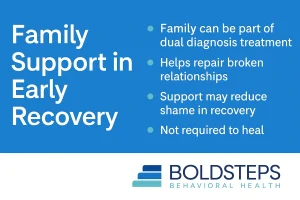
What if I don’t have family—or don’t want them involved?
That’s okay. You are not behind. You are not broken.
Family involvement is never a requirement. Some people choose not to reconnect—and others simply don’t have the option. If that’s you, Bold Steps supports:
- Finding safe community within treatment groups
- Naming and claiming your chosen family
- Developing stable, peer-based support systems
One client once said: “I didn’t have a mom or dad to call. But I had my recovery group, my sponsor, and my neighbor who kept checking on me. That was enough. That was family.”
We believe that too. Healing doesn’t require a traditional family tree. Just roots—somewhere.
What if they hurt me?
This needs to be said clearly:
You do not have to invite anyone into your recovery who has harmed you.
If a family member was abusive, neglectful, unsafe, or continues to be toxic, we will never suggest involving them.
In fact, part of your work in dual diagnosis treatment might be healing from them. And that’s something we hold space for—with compassion, not pressure.
You get to define what safety means. We’ll support you in protecting it.
How does family support help me stay sober?
Because addiction thrives in isolation—and recovery grows in connection.
When someone you trust learns how to show up in healthy ways, everything shifts. You’re no longer alone with the hard days. You’re seen. You’re held accountable—not through fear, but through love.
And when that connection feels steady enough, you begin to believe something quietly radical:
Maybe I’m not just someone in recovery. Maybe I’m someone worth knowing again.
“My mom showed up to my second therapy session. I thought it would be awkward—but she cried the whole time. Not angry tears. Just relief. She finally saw me, not just my addiction. And I saw her, not just her fear.”
— Client, IOP Program, 2023
Real Stories: When Family Shows Up Differently
At Bold Steps, we’ve seen relationships that were shattered by addiction begin to soften through dual diagnosis care. A few moments that still stand out:
- A father who hadn’t spoken to his son in two years showed up to a group session, apologized, and stayed.
- A young woman reconnected with her sister after realizing their silence was rooted in mutual fear, not rejection.
- A grandmother came to every single family night—not to ask questions, but just to listen and hold space.
Healing is slow. But it’s possible. And we’ve seen it begin with just one shared moment of truth.
Ready to feel less alone in this?
If you’re looking for dual diagnosis treatment in Lancaster County, PA or anywhere near Harrisburg, we want you to know: connection is part of the care. And you don’t have to decide today what “family” means to you. You just have to know that you’re not expected to do this alone.
You deserve healing—with or without your family
Call 717-896-1880 to learn more about dual diagnosis treatment in Harrisburg, PA. Whether you’re opening up to connection—or just surviving today—we’ll meet you where you are.