

I didn’t plan to relapse. Most of us don’t.
Ninety days into sobriety, I was starting to feel like maybe I was one of the lucky ones. I had my routine. I had some peace. But it only took one rough week—a funeral, a fight, a night alone—for things to fall apart.
I didn’t tell anyone at first. I told myself it was a one-time thing. That I could control it. But soon I was back in a place I swore I’d never return to—scared, ashamed, and sure that no one would want me now.
I was wrong.
I Expected Shame. I Got a Chair and a Coffee.
Walking back into treatment was one of the hardest things I’ve ever done. I’d already “graduated.” People had clapped for me. I was the one sending encouraging messages in the alumni group chat. And now I was the one who slipped.
But when I walked back into Bold Steps, I didn’t get a scolding. I got a chair. A coffee. A “Hey—it’s good to see you.”
Nobody asked me why I messed up. They just asked me if I was ready to take care of myself again.
That’s what a partial hospitalization program gave me. Not a fresh start that erased the past—but a way forward that respected it.
What PHP Looked Like After Relapse
When I first started PHP months before, everything was new. I was detoxed but shaky. I didn’t trust myself yet. Back then, it was about building foundation.
This time, it was about repair. I already knew the tools. But I had stopped using them when life got loud. In PHP, I got to walk back through those same doors—but with more self-awareness. Less ego. More humility.
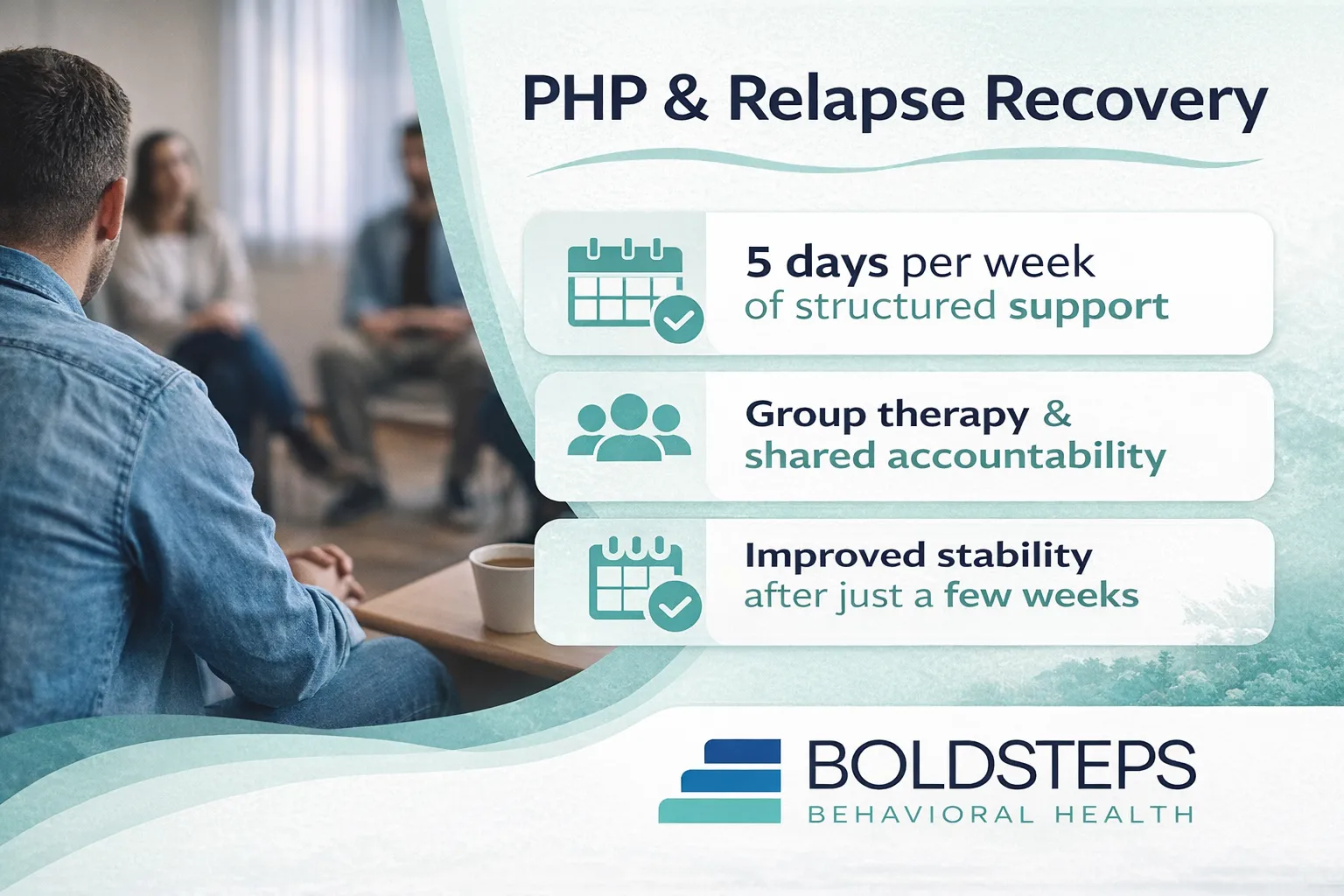
The schedule gave my days shape again: five days a week, therapy, process groups, life skills, meals, accountability. Just enough structure to hold me—but not so much that I felt trapped.
And more than anything, it gave me space to feel human again.
Relapse Doesn’t Cancel Your Progress
Here’s what nobody told me: relapse doesn’t make you a beginner.
Yes, I used again. But I didn’t forget everything I’d learned. I didn’t lose my growth or my insight. I just got disconnected from them. That’s the difference.
In group, I shared things I was too afraid to say the first time around. I admitted the things I’d been hiding. I cried without needing to explain why.
And I listened differently, too. Because now, I knew how easy it was to slip. I had more empathy—for myself and for the guy across the circle who’d just come in after a binge.
You Don’t Have to Earn Your Way Back
There’s this lie we tell ourselves after relapse—that we have to prove we’re serious before we’re “allowed” to get help again.
But recovery isn’t a prize you win. It’s a relationship you come back to. And the door doesn’t lock behind you.
I live in Lancaster County, PA, where recovery communities are strong but stigma still runs deep. When I relapsed, I thought the whispers would follow me. I thought the shame would outpace the support.
Instead, what I found was compassion. Quiet, steady compassion. The kind that shows up without a spotlight and says, “Let’s get you fed. Let’s get you settled. Let’s figure this out.”
That’s what Bold Steps offered. Not perfection—presence.
What Changed in Me the Second Time Around
The first time I got sober, I chased milestones. Clean time. Chips. Textbook answers in group.
The second time, I chased honesty. I sat with discomfort longer. I told on myself faster. I built a relapse prevention plan that didn’t just look good on paper—it actually matched my life.
And PHP gave me the time and space to practice that.
Instead of jumping back into work and pretending everything was fine, I paused. I slowed down. I relearned how to ask for help before things went sideways.
That’s recovery, too—not just staying clean, but staying connected.
You’re Not the Only One Coming Back
I used to think relapse was rare. Like I was the only one who’d fumbled the ball after 90 days. Turns out, I was wrong.
In PHP, I met people who were back after six months sober. A year. Three years. One guy said, “It took me four tries to make nine months. Doesn’t mean I wasted the other ones.”
That line stuck with me.
We don’t erase our past by relapsing—we just get a new chance to respond to it. And this time, I chose differently.
Why PHP Was the Right Fit (Again)
People ask me why I went back to a partial hospitalization program instead of IOP or one-on-one therapy.
For me, it came down to two things: structure and safety.
I wasn’t in full crisis, but I wasn’t stable either. I needed more than just a few sessions a week. I needed eyes on me. I needed a container that held me accountable but didn’t smother me.
In PHP, I could be honest about where I was without fear of being kicked out or labeled. It met me in the middle. Gave me the support of inpatient care with the dignity of outpatient autonomy.
And in York County, PA, where resources can feel thin if you’re not sure where to look, finding that level of care again was a gift.
How I Knew I Was Ready to Try Again
There wasn’t a single moment where I suddenly believed in myself again. But there were small ones.
Like the first time I shared in group and felt seen instead of judged.
Like the day I went 24 hours without hating myself.
Like the morning I woke up, drank coffee, and didn’t feel like a liar.
Recovery isn’t loud. It’s quiet moments stacked on top of each other. PHP gave me space to notice those moments again.
And more than anything—it reminded me that I’m worth the effort. Even after relapse. Especially after relapse.
FAQ: Partial Hospitalization After Relapse
What is a partial hospitalization program?
A partial hospitalization program (PHP) is a structured, intensive level of outpatient care. It usually includes 5 days a week of therapeutic services such as individual counseling, group therapy, and psychiatric support, while allowing you to return home at night.
Do I need PHP if I’ve already completed treatment?
It depends. If you’ve relapsed or feel unstable but don’t need inpatient detox, PHP can offer a strong level of support without requiring a full hospital stay. It’s ideal for those who need more than just a weekly therapist visit but don’t require 24/7 care.
Will people judge me for relapsing?
Not here. Bold Steps meets people where they are, not where they “should” be. The staff and peers in PHP understand that relapse happens—and they treat it with compassion, not shame.
Can I come back to treatment even if I left before?
Yes. Whether you completed treatment or left early, you are always welcome to return. There’s no limit on how many times you can ask for help. Bold Steps believes in keeping the door open.
How long does PHP usually last?
Most partial hospitalization programs last anywhere from 2 to 4 weeks, depending on individual needs and progress. You’ll work with your care team to create a plan that fits your situation.
You’re Not Broken. You’re In Progress.
If you’ve relapsed, you’re not starting from scratch. You’re starting from experience.
And that matters.
Recovery isn’t about being perfect. It’s about being willing. Willing to try again. Willing to accept help. Willing to believe, even a little, that you still deserve support.
If that sounds like you—call. Reach out. Let someone meet you where you are.
Call 717-896-1880 to learn more about our Partial Hospitalization Program in Harrisburg, PA.