

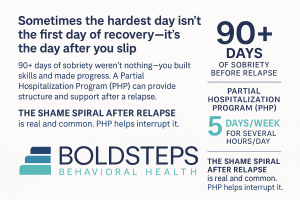
Sometimes the hardest day isn’t the first day of recovery—it’s the day after you slip.
Maybe it was one weekend. One bad decision. Or maybe it stretched into a few weeks you didn’t see coming. You had 90 days, maybe more. You knew what was working. You’d started to feel like yourself again. And now, all of that feels so far away.
If you’re reading this, you’re probably wrestling with more than guilt. There’s grief. Fear. Shame. Questions like: “Did I ruin everything?” or “Will anyone take me seriously again?”
At Bold Steps Behavioral Health, we want you to hear this clearly: You didn’t lose everything. You didn’t fail. And you are absolutely allowed to come back.
Your 90 Days Weren’t Nothing
Relapse doesn’t erase what you’ve built. You still showed up for 90 days. You still learned skills, faced pain, and made progress. Those gains didn’t vanish because you slipped. They’re part of you now—and they’re still accessible.
What often gets lost after relapse isn’t sobriety. It’s confidence. Trust in yourself. That quiet voice that said, “I’m actually doing this.”
A Partial Hospitalization Program (PHP) can help you reconnect with that voice. It’s not about punishing the slip. It’s about giving you space and structure to heal without shame—and to rebuild with support that respects the work you’ve already done.
Why PHP Fits the Relapse Reality
If you’ve relapsed after 90+ days, odds are you’re not in crisis—but you are in need. Maybe you don’t need detox or residential treatment. But trying to go it alone again? It’s not working either.
Partial Hospitalization Programs in Harrisburg, PA. were designed for this middle ground. You attend full-day clinical care—typically five days a week, for several hours each day—but you still go home at night. It’s intensive, but not isolating. Focused, but not rigid.
At Bold Steps, our PHP is tailored to what this chapter requires: clarity, compassion, and a practical way forward. It’s not about starting over. It’s about meeting you where you are now, with everything you’ve learned still in your corner.
The Shame Spiral Is Real—And PHP Interrupts It
Relapse after a solid period of recovery can hit like a gut punch. You thought you were done with this. You told people you were doing well. Now you’re avoiding calls. Canceling plans. Wondering if you even belong in recovery spaces anymore.
We hear this all the time:
“I don’t even know how to face everyone again.”
PHP helps you interrupt that spiral before it builds more damage. With daily structure, professional support, and a space to talk openly—without judgment—you start to steady yourself. You remember: “This isn’t over. I still get to try.”
What’s Different This Time Around?
That’s the question PHP helps you answer. What changed? What snuck past your defenses? Were you triggered, overwhelmed, burned out?
In PHP, you work with therapists and peers to identify where cracks formed—and how to shore them up. You’re not re-learning everything from scratch. You’re building on what worked and strengthening the places that need more care.
You’ll revisit your relapse with clarity, not punishment. You’ll revise your recovery plan with honesty, not shame.
Real Talk: You’re Not the Only One
Relapse after a few months of sobriety is incredibly common—but rarely talked about openly. Too many people return quietly or not at all because they believe relapse disqualifies them.
It doesn’t. In fact, it can deepen your recovery. It can show you what still needs healing. It can lead to stronger boundaries, clearer self-awareness, and a more compassionate relationship with yourself.
Relapse is data, not defeat. PHP gives you the space to study it—and to grow from it.
You Don’t Have to Pretend You’re Okay
After a slip, some people try to minimize: “It was just one time.” Others go silent, afraid to admit what happened. Still others dive headfirst into shame.
PHP makes room for the truth. Whether it was one night or one month, you’re welcome here. You don’t need to prove how sorry you are. You don’t need to have a neat story. You just need to be honest—and ready to reconnect.
If you’re in Harrisburg or Dauphin County, or nearby in Lancaster County or York County, Bold Steps can help you take that next step without delay, drama, or shame.
A Slip Doesn’t Mean You’re Broken
It means you’re human. And that something—stress, grief, old wounds—got the better of you.
That doesn’t make you weak. It makes you someone in need of support. And the truth is, the tools that helped you get 90 days sober still matter. They’re still yours. PHP simply helps you dust them off, sharpen them, and keep moving.
This Can Be the Moment You Come Back—Wiser
You don’t need to be back at day one. You don’t need to convince anyone you’re serious. The fact that you’re reading this is already a step toward healing.
A Partial Hospitalization Program (PHP) can help you hold space for both your success and your stumble. It doesn’t ask for a perfect track record. Just honesty, and a willingness to re-engage.
Whether your relapse was recent or lingering, you’re still allowed to want more. You’re still allowed to come back.
Call 717-896-1880 to learn more about our Partial hospitalization program services in Harrisburg, PA.
FAQ: Partial Hospitalization Program (PHP) After Relapse
Do I have to start from scratch if I come back to PHP?
Not at all. PHP isn’t about repeating the basics. It’s about building on what you already know, identifying what needs more support, and helping you get stable again.
Is PHP only for people with new or severe issues?
No. PHP is ideal for people who have relapsed but don’t require detox or residential care. It’s structured enough to help you get grounded, but flexible enough to let you maintain your life.
What if I’m embarrassed to come back?
That’s normal—and welcome. Many of our alumni return after a slip. We hold space for your embarrassment without letting it define you. You’re not coming back with your head down. You’re coming back to get stronger.
Can I keep my job while doing PHP?
It depends on your schedule. PHP typically runs during the day, so some people take leave or adjust their hours. Our team can help you navigate that.
What’s different between PHP and outpatient therapy?
PHP is more intensive. It offers multiple hours of care each day—including group therapy, individual therapy, and clinical monitoring. It’s a reset for people who need more than a weekly appointment but don’t need inpatient care.