

You don’t forget the first time you hit 90 days.
It’s not just about the chip or the calendar. It’s something deeper. A quiet kind of pride. A morning where you actually wake up rested. A moment where laughter doesn’t feel forced. A life that finally starts to feel like yours again.
So when relapse happens after that… it doesn’t feel like just a slip.
It can feel like grief.
Grief for the version of yourself you thought you’d become. Grief for the trust you were beginning to rebuild—with others, and with yourself. Maybe even grief for the peace you had, however fleeting, before it fell apart.
And then the spiral starts:
“I should’ve known better.”
“I threw everything away.”
“They’re going to be so disappointed.”
This is where many people retreat. But this is also where healing can restart—without shame, without starting over, and without pretending it didn’t happen.
And this is where CBT can make all the difference.
Relapse Doesn’t Erase Progress—But It Can Make You Forget
When you relapse after a few months—or even after a year—it’s not just discouraging. It’s disorienting.
Because you know how much work you’ve done. You remember what life felt like when it was stable. Which makes the fall feel steeper. You don’t just feel pain—you feel betrayed by yourself.
That’s where CBT becomes more than just a clinical tool. It becomes a re-grounding practice. One that can help you quiet the shame and re-engage with the truth:
You didn’t forget everything.
You’re not back at zero.
You still get to be in recovery.
CBT works by helping you catch the thinking patterns that exaggerate your defeat—and replace them with something real, honest, and still hopeful.
What Makes CBT Different for Alumni?
If you’ve been through treatment before, you’ve probably encountered CBT at some level. But what many alumni find helpful after relapse is how CBT changes when you’re not brand new to recovery.
In this phase, CBT focuses less on “what is addiction” and more on:
- Why old beliefs might still linger—even when you thought they were resolved
- How success triggered vulnerability—and maybe some self-sabotage
- What patterns started slipping before the relapse happened
- Where your support structure thinned when things got better
Because sometimes relapse doesn’t happen at your worst.
Sometimes it shows up when you start doing well—when life gets full again, and you stop checking in with yourself. When you feel stable enough to coast, and forget that stability needs maintenance.
CBT doesn’t judge that. It explores it.
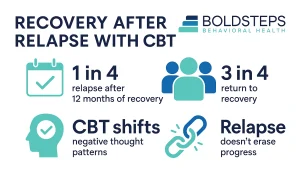
CBT Helps You Rebuild, Not Repeat
After a relapse, it’s common to feel like everything has to be redone. But recovery doesn’t work that way.
You’ve already built internal muscle—emotional awareness, language for your needs, tools for navigating hard moments. What you need now isn’t a reboot. It’s a reconnection.
CBT supports that by helping you:
- Rebuild routines without pressure or performance
- Clarify goals that reflect who you are now, not who you were during your first 90 days
- Restore trust—with yourself and others, through consistency and self-reflection
- Interrupt shame loops that sabotage your willingness to try again
This phase of recovery might be quieter. Less about milestones, more about meaning. CBT meets you there.
How CBT at Bold Steps Supports Alumni
At Bold Steps Behavioral Health, we don’t treat relapse like failure. We treat it like data. And when alumni return to us after a lapse or relapse, we don’t ask why did you fall?—we ask what did you learn?
That shift makes a difference.
Here’s what returning to CBT might look like with us:
- You don’t have to explain yourself. We meet you where you are. If shame is loud, we listen first.
- You set the tone. Want to ease in? We go slow. Want to hit the ground running? We match you.
- We reconnect you with support. Alumni often isolate after relapse. CBT helps rebuild safe connection.
- We make space for the whole story. Not just the substance use, but what was going on underneath it.
Looking for CBT in Harrisburg or Dauphin County, PA? Whether you’re local or returning from Lancaster County or York County, you’ll find care that remembers who you were—and believes in who you still are.
FAQ: What Alumni Ask After Relapsing
Is CBT really helpful after relapse?
Yes. CBT is one of the most effective approaches for understanding what led to a relapse, shifting how you relate to your thoughts, and building new strategies for staying grounded. It’s not just a prevention tool—it’s a healing one.
I already did CBT in treatment. Isn’t it just repeating the same stuff?
Not at all. CBT after relapse is about working from a different vantage point. You’re not learning the basics anymore. You’re refining. Revisiting. Applying it to new, more complex realities. You’ll likely uncover layers you didn’t see the first time around.
Will people judge me if I come back?
Not here. At Bold Steps, alumni are always welcome—without shame, without “I told you so,” and without labels. You’re not the first to come back after relapse. You won’t be the last. The door stays open, always.
How soon should I start therapy again?
As soon as you’re ready to get curious—not just about what happened, but about what you want to rebuild. Some people return the day after a relapse. Others wait until the noise quiets down. Both are okay. There’s no wrong time to re-engage.
What if I’m not sure I want to be sober again?
That’s okay. CBT makes room for that ambivalence. You won’t be pressured or pushed. You’ll be invited into honest reflection—about what matters to you, what’s not working, and what you might want to change. We work from your truth, not a script.
Recovery After Relapse Isn’t Starting Over. It’s Starting From Experience.
You don’t lose everything when you relapse.
You carry forward the growth. The insight. The relationships. The memories of what it felt like when things were working. And now, you add new wisdom—painful, yes, but real.
CBT helps you take that wisdom seriously—without getting swallowed by it.
And you don’t have to do that work alone.
Let’s Reconnect. You’re Still Welcome Here.
Call 717-896-1880 or visit our CBT services page in Harrisburg, PA to learn how CBT can help you reconnect after relapse—with your recovery, with your values, and with yourself.
You didn’t blow it. You hit a bump. You can come back. We’re ready when you are.