

If you’re reading this, there’s a good chance you’ve been replaying the same thought over and over:
I should have stayed.
I shouldn’t have disappeared.
I probably ruined my chance.
Let us say this clearly, before anything else: you did not mess everything up.
At Bold Steps Behavioral Health, we work with people every day who step away from treatment and later wonder if they’re allowed to come back. People who feel embarrassed. Ashamed. Exhausted. Unsure if the door is still open.
It is.
Our intensive outpatient program is built with the understanding that recovery is rarely a straight line. Pauses happen. Disappearances happen. And coming back—especially when you’re worried you failed—is often one of the bravest steps a person takes.
This guide is here to walk you through what returning actually looks like, gently and honestly, so you don’t have to carry that fear alone.
First, Let’s Talk About the Fear That’s Holding You Back
Most people don’t avoid returning to treatment because they don’t want help.
They avoid it because of what they imagine will happen.
They imagine disappointment. Judgment. Awkward conversations. Being “found out.”
They imagine being asked to explain everything perfectly—or being treated like a problem.
That fear can feel paralyzing.
But it’s important to know: treatment teams expect people to leave and come back. This is not a surprise to us. It is part of the work.
You are not the first person to disappear. And you will not be the last.
1. You Are Not Required to Justify Why You Left
One of the biggest misconceptions about returning to an intensive outpatient program is that you’ll need a compelling explanation.
You don’t.
You don’t need a dramatic story.
You don’t need to make it make sense.
You don’t need to apologize.
People leave for many reasons:
- They feel overwhelmed
- They miss sessions and feel embarrassed
- Their mental health dips
- Life gets chaotic
- They weren’t ready yet
When you return, we don’t start with why you left.
We start with how you’re doing now.
If all you can say is, “I think I want to come back,” that’s enough to begin.
2. Leaving Treatment Does Not Erase the Work You Did
A common fear we hear is:
“I probably lost all my progress.”
That’s not how healing works.
The insights you gained.
The coping skills you practiced.
The moments where you were honest, even briefly.
Those things don’t disappear just because you stepped away.
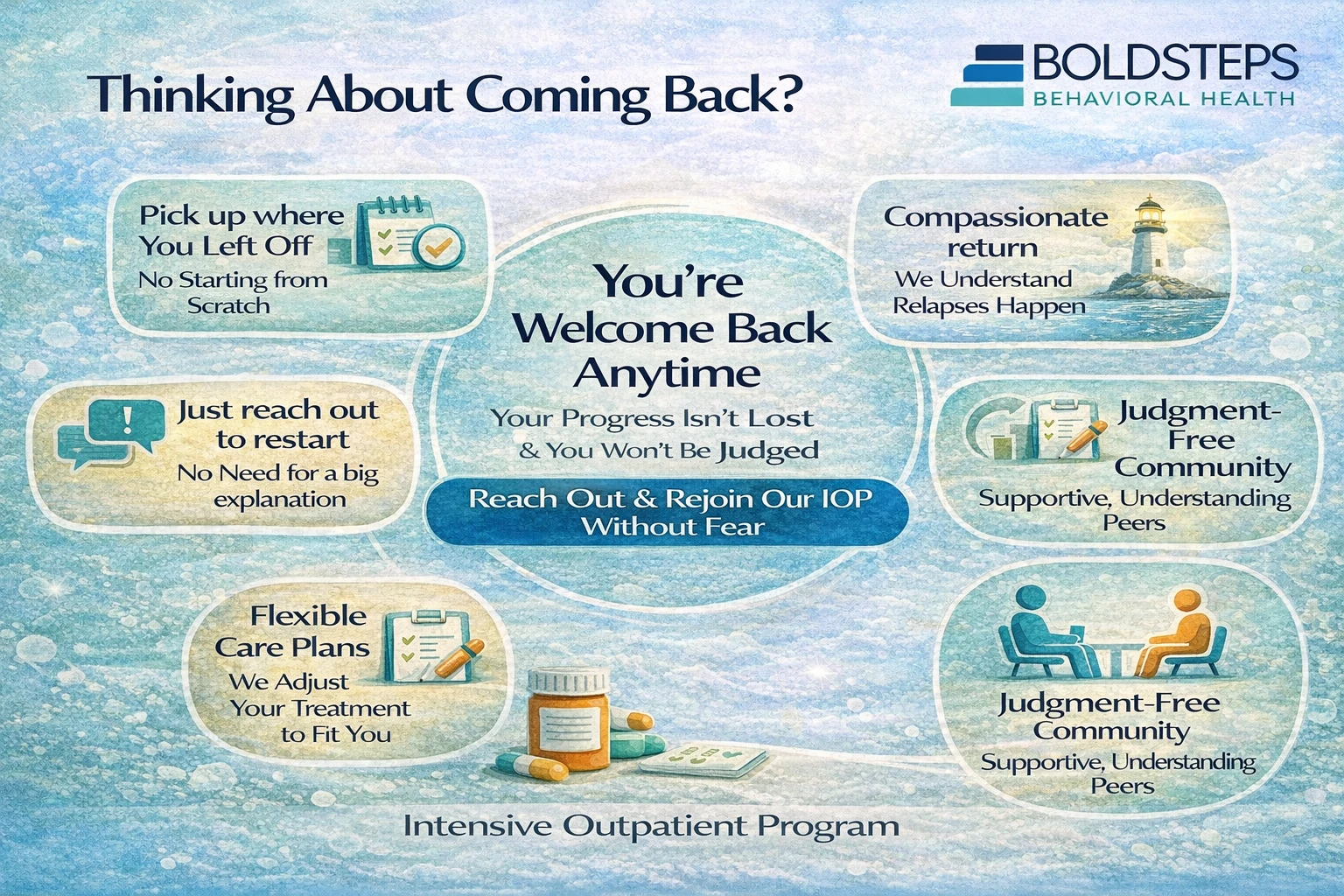
When you return to an intensive outpatient program, we don’t treat you like you’re starting from zero. We recognize that you’ve already done meaningful work—and that work still belongs to you.
Returning isn’t failing.
It’s continuing.
3. You Will Not Be Punished for Needing a Second Chance
Some people worry that returning means stricter rules, more pressure, or less patience.
That fear usually comes from shame—not reality.
At Bold Steps, returning clients are met with care, not consequences. Our role is not to “teach you a lesson.” Our role is to support your health.
If the first structure didn’t work, we adjust.
If the pace was too fast, we slow it down.
If the environment felt overwhelming, we explore what would help.
An intensive outpatient program is meant to be flexible, responsive, and human—not rigid or punitive.
4. It’s Okay If You’re Coming Back With Less Energy
Many people return feeling more depleted than they did the first time.
They may feel:
- Less hopeful
- Less motivated
- More tired
- More unsure
That doesn’t mean treatment won’t work. It means your needs have changed.
We don’t expect you to come back energized or optimistic. We expect you to come back honest.
Low energy is not a disqualifier.
Ambivalence is not a failure.
We build your care plan around the capacity you have now—not the version of you that showed up before.
5. Group Isn’t Waiting to Judge You
Group therapy can be one of the biggest sources of anxiety for returning clients.
People worry:
- “Everyone will notice I’m back.”
- “They’ll wonder where I went.”
- “They’ll think I gave up.”
In reality, group spaces are often the most understanding places to return.
Many people in IOP have their own version of leaving and coming back—whether openly or quietly. When someone returns, the response is usually relief, recognition, and empathy.
You won’t be expected to explain yourself to the group. You won’t be put on the spot. You are allowed to ease back in.
6. You Can Re-Enter Without Rehashing Everything
Another fear is that returning means reopening every wound.
That’s not required.
We don’t force people to retell their story from the beginning. We don’t demand a detailed recap of what happened while you were gone.
Instead, we ask:
- What feels hard right now?
- What support do you need today?
- What would make returning feel safer?
You get to move forward without reliving everything you’ve already shared.
7. Returning Often Leads to Deeper, More Honest Work
One of the quiet truths we see again and again: people who return often engage more deeply than they did the first time.
Not because they “try harder,” but because the pressure to get it right is gone.
When someone comes back, they often bring:
- More self-awareness
- Less pretending
- Fewer expectations
- More honesty
The second round isn’t about proving anything. It’s about allowing the work to meet you where you actually are.
Looking for an intensive outpatient program in Harrisburg?
If you’re in Harrisburg or nearby in Dauphin County or Lancaster County, Bold Steps Behavioral Health offers an intensive outpatient program designed for real life—not perfect attendance or flawless progress.
We welcome people who’ve left.
People who’ve ghosted.
People who are unsure but still hoping.
You don’t have to arrive confident. You just have to reach out.
What Taking the First Step Back Usually Looks Like
Returning doesn’t start with a confrontation.
It starts with a conversation.
Often, it’s a simple phone call or message saying:
“I was here before, and I think I want to come back.”
From there, we:
- Talk through how you’re doing now
- Review what support might look like
- Adjust your plan as needed
- Move at a pace that feels manageable
There’s no ceremony. No spotlight. Just support.
FAQ: Returning to an Intensive Outpatient Program After Dropping Out
What if I stopped coming without telling anyone?
That happens more often than you think. You are still welcome. No explanation required.
Will I have to restart the program completely?
Not necessarily. Your team will assess where you are now and build a plan based on your current needs.
What if I relapsed while I was gone?
You can still return. Relapse does not disqualify you from care. We approach it with compassion, not judgment.
What if I feel embarrassed or ashamed?
Those feelings are common—and they’re not a reason to stay away. We meet shame with gentleness, not criticism.
Can I come back even if I’m not sure I’m ready?
Yes. Readiness is not a requirement. Willingness—even a small amount—is enough to begin.
You Didn’t Ruin Anything by Needing More Time
If there’s one thing we hope you take from this, it’s this:
Needing to step away did not undo your worth or your progress.
Coming back doesn’t mean you failed.
It means you’re still trying.
And that matters more than you know.
When you’re ready to take the next step—quietly, honestly, and on your terms
Call 717-896-1880 to learn more about our intensive outpatient program services in Harrisburg, PA.
The door is open. We’re here. And you’re not too late.