

You left. Maybe it wasn’t planned.
You skipped one day. Then two. Then the thought of showing up again felt heavier than walking away.
Maybe it was life. Maybe it was shame. Maybe it was that quiet voice in your head that said: “They’re probably better off without me.”
We want to say something to that voice—gently, but directly:
You’re not alone. You’re not a failure. And coming back can be easier than you think.
At Bold Steps, we’ve seen how common it is for people to step away from an intensive outpatient program (IOP). We’ve also seen the courage it takes to consider returning.
This blog is for you—the person hovering over the “Contact Us” button, wondering if it’s too late. It’s not.
You Don’t Have to Explain Everything
One of the biggest fears people have about returning to treatment is the conversation they think they have to have.
“I’ll need a reason.”
“They’ll want me to explain.”
“I don’t even know what to say.”
Here’s the truth:
You don’t owe us a breakdown.
We won’t make you relive why you left.
When someone reaches out to re-engage with IOP, our first response isn’t “Why did you leave?” It’s, “We’re so glad to hear from you.”
We Don’t Treat Dropout Like Failure
The idea that walking away from treatment equals failure? That’s shame talking—not reality.
Leaving an intensive outpatient program doesn’t mean you weren’t committed.
It means something got in the way. Pain, fear, life chaos, discomfort. Maybe even a moment of self-sabotage. All of that is part of the human experience.
We’ve built our process around the belief that treatment should expect people to struggle—and make space for them to return without starting over emotionally.
It’s not about erasing what happened.
It’s about meeting you where you are today.
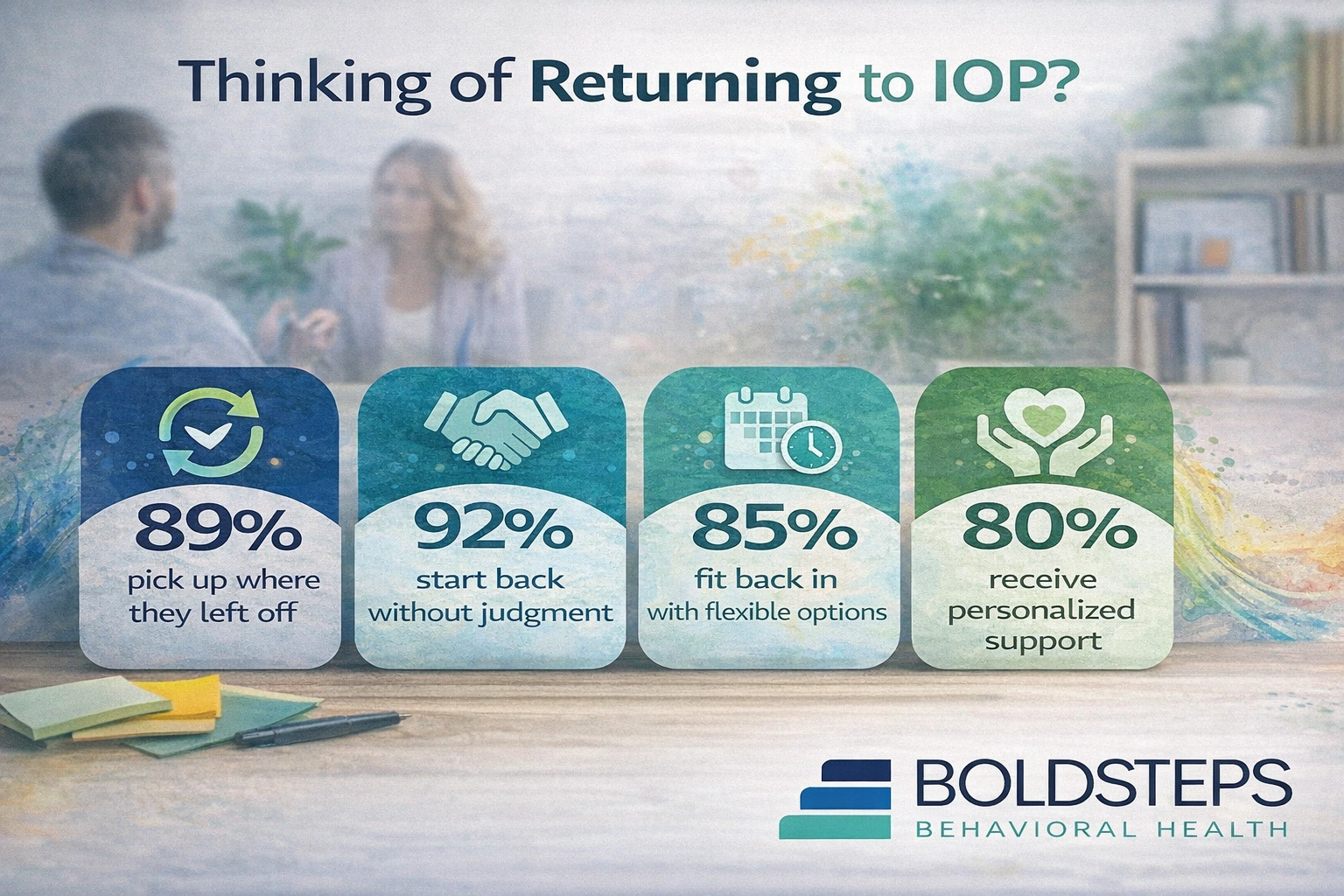
Reentry Is Built Into Our Program Design
At Bold Steps, we know that treatment isn’t always a straight line.
That’s why reentry isn’t an afterthought—it’s something we plan for.
You won’t be treated like a new client unless that’s what feels best to you.
We often offer:
- Re-orientation sessions to ease the transition back
- Flexible scheduling to reduce friction and anxiety
- A check-in, not a re-evaluation—unless you want one
We don’t make you prove yourself. We help you settle in.
You Set the Pace
Some people want to jump back into the group they left. Others want a quieter return—starting with 1:1 support or exploring a different cohort.
Either way, we follow your lead.
When you come back to IOP, you’re not being dropped into a rigid schedule or put under a microscope.
You’re being invited—gently—into something you get to shape with us.
No lectures. No pressure. Just possibility.
Your Past Progress Still Matters
We hear this one a lot:
“I messed it all up.”
“Now I have to start from zero.”
You don’t.
What you learned before, the tools you picked up, the self-awareness you started to build—it’s still yours.
Even if you forgot it. Even if it feels distant. Even if you think it didn’t “stick.”
Returning to IOP often means reconnecting with that earlier momentum—and seeing it with new eyes. You’re not behind. You’re coming back with more than you had before.
You’re Not the Only One
More people step away and come back than you think.
It happens so often that we’ve made it a core part of our group culture.
Not just accepting returners—but welcoming them.
Some of the most engaged, insightful group members today?
They once ghosted.
They once thought they’d burned their bridges.
Now they’re back, stronger—and proud of it.
You’re not an outlier. You’re not a cautionary tale. You’re just a person finding your way back.
We Support Real Life—Not Just Treatment Life
Let’s be honest: one reason people leave IOP is because life gets in the way.
Work hours change.
Transportation becomes a barrier.
Childcare falls through.
Or you hit an emotional wall and don’t feel like you can keep showing up.
That’s why our team is always ready to troubleshoot those challenges with you—not shame you for them.
Whether you’re returning from a three-day break or a three-month gap, we’ll look at what actually works for you now—and adjust together.
We’ve seen this need firsthand in communities like York County, Pennsylvania, where people juggle work shifts, caregiving, and daily survival just to make it to one session. If that’s you, we see you. We’ll help make your return doable.
You Don’t Have to Be Sure—You Just Have to Be Open
Coming back doesn’t mean you’re suddenly 100% ready.
You can be nervous.
Still doubting yourself.
Still wondering if this is “your thing.”
That’s okay.
We’re not looking for certainty.
We’re just here to offer you a next step that doesn’t feel overwhelming.
And if you’re reading this from Lancaster County, Pennsylvania, where recovery options can sometimes feel limited or out of reach, know this: we built our program with accessibility in mind. Not just physically, but emotionally.
FAQs About Returning to an Intensive Outpatient Program
Will I be judged for ghosting or dropping out?
No. We expect that many people will pause or step away at some point. You will be met with compassion, not criticism.
Do I have to reapply or start over?
Not usually. We’ll check in to see what you need, but in most cases, you can resume treatment without restarting your entire intake process.
Will the group know I left?
Only if you want them to. We can reintroduce you with context—or just welcome you back quietly. Your comfort guides the process.
What if my schedule changed since I left?
We’ll work with you to adjust. We offer flexible programming options and can help tailor your return around your new responsibilities.
Is there a time limit on coming back?
Nope. Whether it’s been a week, a season, or a year—you’re still welcome. If your heart says, “Maybe now,” that’s enough.
You Left. That’s Okay. Now What?
At Bold Steps, we believe leaving treatment doesn’t disqualify you from healing. It’s just a pause. A breath. A beat.
And when you’re ready to come back, you won’t be punished for it.
You’ll be welcomed.
Call 717-896-1880 to learn more about our to learn more about our intensive outpatient program in Harrisburg, Pennsylvania. We’ll make your next step easier than your last.