

I didn’t turn down medication assisted treatment because I was strong.
I turned it down because I wasn’t ready to stop needing the chaos. I didn’t know who I was without the edge, the intensity, the emotional whiplash I had built my whole identity around.
The truth is, I didn’t say no to treatment because I didn’t want to feel better. I said no because I wasn’t ready to be okay—and I definitely wasn’t ready for what “okay” might take away from me.
Chaos Felt Like Home
For years, pain felt like my most honest emotion.
I wrote from it. Performed through it. Connected to people by bleeding out my story in real time. I wasn’t faking it—the emotions were real. But so was the exhaustion, the inability to regulate, the nights I couldn’t stop spiraling.
I knew I wasn’t well. But being unwell was familiar. I had no idea what stable looked like. And worse—I was terrified it would make me bland.
When someone mentioned medication assisted treatment as an option, all I heard was, “Let’s take away the thing that makes you interesting.”
I Thought MAT Would Erase Me
The first time I heard “medication,” I pictured blank stares, a flat personality, a zombified version of myself who couldn’t laugh, cry, or write.
That version wasn’t me. I needed my highs. My lows. My emotional crescendo.
Or so I thought.
I was scared of what would happen if the volume got turned down—even slightly. I told myself I was protecting my creativity, my authenticity, my connection to the world.
But deep down, I was just protecting the one version of me I knew how to perform: the suffering one.
I Was More Addicted to the Spiral Than I Realized
I used to say I wasn’t afraid of being sober—I was afraid of being numb.
But I wasn’t numb when I was using. I was frantic. Unstable. Constantly chasing some temporary relief that left me more drained and disconnected.
In reality, I was already numb to the good stuff: sleep, stability, honesty, connection that didn’t involve oversharing in order to be seen.
Living in that kind of survival mode might look passionate from the outside. But inside? It’s lonely as hell.
And it wasn’t just about substances. It was about needing to suffer in order to feel alive.
The Shift Came Quietly
There wasn’t one big moment. Just a collection of small ones.
Waking up with no memory of the night before—again. Cancelling a project I cared about. Ghosting someone who loved me. Losing three hours to a spiral that I disguised as “writing time.”
I started to wonder what my life would look like if I didn’t spend all my energy managing pain I wasn’t even naming anymore.
That’s when I came back to Bold Steps—not because I had it all figured out, but because I couldn’t keep performing the same self-destruction and calling it depth.
MAT Didn’t Dull Me—It Made Room for Me
When I finally gave medication assisted treatment a chance, I was braced for the worst.
Instead, I got clarity.
For the first time in a long time, my thoughts weren’t racing. My body wasn’t in panic mode. I wasn’t riding wave after wave of withdrawal and emotional whiplash. I could sit with a feeling without it swallowing me whole.
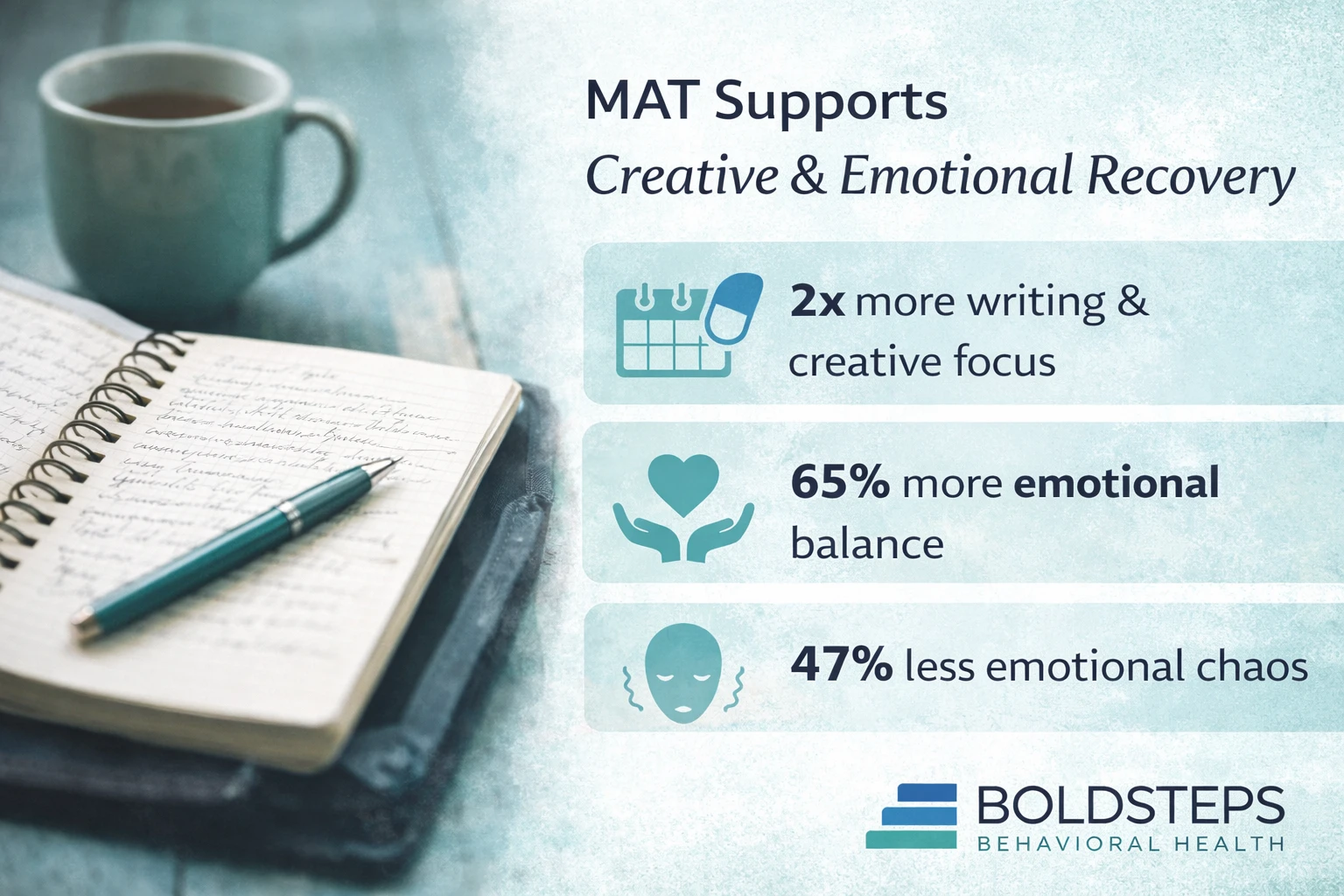
I didn’t lose my creativity. I wrote more. With sharper lines, fuller truths, fewer apologies.
I didn’t lose my sensitivity. I felt more—but with a buffer. Enough space to choose how I responded instead of reacting from fear.
I still had the fire. But now it wasn’t burning down my life just to keep me warm.
Being Okay Didn’t Make Me Less Interesting
I had this fear that if I got better, I’d get boring. That my friends wouldn’t know how to relate to me. That I wouldn’t know how to relate to myself.
But you know what’s actually boring?
Apologizing for the same thing over and over. Flaking on people. Canceling plans you were excited about because you can’t get out of bed—or because you’ve been up for 48 hours.
There’s nothing boring about clarity. Or laughter you remember. Or getting to finish the projects you care about.
I see that now. So do others—people I trust, who reflect back the version of me that’s honest, not just intense.
In Lancaster County, PA, I’ve met more than a few people who held back from MAT for the same reasons I did. I get it. But I also see the difference in them now—more grounded, more connected, still deeply themselves.
MAT Isn’t a Shortcut—It’s a Lifeline
This isn’t the part where I say medication fixed everything.
It didn’t.
But it gave me a floor to stand on. It slowed the internal chaos enough that I could do real work in therapy. Rebuild relationships. Show up for group. Stop sabotaging every time something started to feel stable.
And no, it hasn’t erased my identity. It’s helped me claim it—without having to pay for it with my peace.
I live in York County, PA, where access to thoughtful, creative-friendly recovery options isn’t always obvious. But Bold Steps made space for my fears, not just my symptoms. That mattered.
FAQ: Medication Assisted Treatment and the Fear of Losing Yourself
Will I still feel like myself on MAT?
Yes—and possibly more than you have in a long time. MAT doesn’t rewrite your personality. It supports your nervous system so you can access who you are beneath the crisis.
What if medication makes me feel flat?
That’s a common fear. But when properly prescribed and monitored, MAT doesn’t flatten emotions—it reduces chaos. Many people report clearer emotions, not fewer.
Can I still create, perform, or write?
Absolutely. Many find their creativity improves once the exhaustion of instability lifts. The fog clears. The spirals slow. You can think, feel, and finish things again.
Is MAT forever?
Not necessarily. Some people use it short-term as a bridge to stability. Others stay longer. It’s not about permanence—it’s about support that works.
What if I’m afraid of being “too normal”?
You get to define your normal. Being stable doesn’t make you basic. It makes you free.
You Don’t Have to Earn the Right to Feel Better
If you’re scared to get better because you think it’ll make you disappear, hear this:
You are still you when you’re okay.
You don’t have to be in pieces to be profound. You don’t have to suffer to matter. And you don’t have to stay in survival mode to be worthy of care.
Call 717-896-1880 to learn more about our medication assisted treatment in Harrisburg, PA.