

If you’re finally ready to get help—but still unsure what help looks like—you’re not alone.
Maybe you’ve been quietly researching for weeks. Maybe this is your first serious step. Either way, if you’re dealing with both substance use and mental health struggles, the path forward can feel like a maze. You want relief—but not numbing. Clarity—but not judgment.
And somewhere in the back of your mind, you’re wondering: Will I need medication? What would that mean for my recovery?
At Bold Steps Behavioral Health, we work with clients who carry both pain and possibility. Our medication management therapy is part of a holistic, dual diagnosis treatment approach—meaning we support your mental health and substance use recovery together, not in isolation.
What Is Dual Diagnosis?
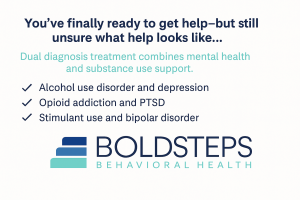
Dual diagnosis refers to having both a substance use disorder and a mental health condition. This might include:
- Alcohol use disorder and depression
- Opioid addiction and PTSD
- Cannabis dependency and anxiety
- Stimulant use and bipolar disorder
These combinations are common—and they’re treatable. But here’s the key: they need to be treated together. You can’t address only one side of the story and expect long-term progress.
That’s why dual diagnosis care matters. It doesn’t separate “addiction” from “mental health”—because real life doesn’t either.
What Role Does Medication Play?
In dual diagnosis care, medication isn’t a magic fix or a quick escape. It’s a clinical tool that, for some, can help regulate a brain that’s been out of balance for a long time.
Some people in early recovery face overwhelming symptoms:
- Anxiety that won’t let them sleep or sit still
- Depression that flattens motivation and joy
- Trauma responses that hijack their body and mind
- Mood swings that feel out of control
- Racing thoughts, flashbacks, or paranoia
These symptoms aren’t weakness. They’re signals. And when they get in the way of your ability to engage in treatment—or life—medication management therapy might be part of the support you need.
Not Everyone Needs Medication—But When You Do, It Matters Who You Trust
Let’s be honest: some people do fine without medication. With therapy, support, and structure, they stabilize and grow.
But for others, no matter how hard they work, something doesn’t shift. That’s when it’s time to consider whether clinical support—including psychiatric medication—might help.
At Bold Steps, we don’t assume everyone needs medication. But when you do, you deserve care from someone who understands both your mental health and your history with substances.
Our medication providers specialize in dual diagnosis treatment in Harrisburg, PA. That means:
- They avoid medications that could trigger relapse
- They monitor your responses closely
- They listen to your concerns about addiction, identity, or past misuse
- They treat the whole person—not just the diagnosis
What Is Medication Management Therapy?
Medication management therapy is more than writing prescriptions. It’s a therapeutic, team-based approach to determining if, when, and how medication fits into your recovery.
This includes:
- Careful psychiatric evaluation of your symptoms
- A detailed review of your history, current challenges, and goals
- Trialing non-addictive medications (often SSRIs, mood stabilizers, or anti-anxiety medications)
- Ongoing check-ins to adjust dosage, monitor side effects, and track benefits
- Coordination with your therapist or treatment team
You’re never just handed a pill. You’re walked through the process, step by step, with someone who knows recovery is fragile—and precious.
This Isn’t About Taking Away Your Agency
Many people fear that saying “yes” to medication means giving up control. That once you start, you can’t stop. Or that you’ll become someone else—numbed out, distant, or less “you.”
We hear that fear. And we honor it.
Here’s what we believe: Medication should never override your identity—it should support your ability to access it more fully.
You’re still in the driver’s seat. This is your recovery. We’re just offering you tools that can make the ride a little smoother, a little safer, and a lot more possible.
Dual Diagnosis Needs Dual Compassion
One of the hardest parts of seeking treatment is feeling like no one understands the full picture. That if you talk about your anxiety, the addiction part gets ignored. Or if you admit to substance use, the emotional pain behind it gets overlooked.
That’s why dual diagnosis—and the medication management therapy that often supports it—is so vital. It means you don’t have to fragment your story. You don’t have to choose which part of your pain gets taken seriously.
At Bold Steps, we take all of it seriously. And we hold space for healing that’s as complex as you are.
You Deserve the Full Range of Support
If your mind feels too fast, your emotions too big, or your body too tired—don’t let shame or stigma keep you from exploring what might help.
Medication management therapy isn’t a failure. It’s a step forward. A way to access the version of yourself that you’ve glimpsed—but haven’t been able to sustain.
And if you’re seeking help for the first time, we want you to know: this is a safe place to begin.
Call 717-896-1880 to learn more about our medication management therapy services in Harrisburg, PA.
FAQ: Medication Management Therapy & Dual Diagnosis
Will medication hurt my recovery or make me relapse?
Not when it’s handled by trained professionals. We use non-addictive medications that support mental health without compromising sobriety. Our team monitors for any side effects or cravings.
What if I’m afraid of being overmedicated or numbed out?
That fear is valid. We go slow, start with the lowest effective dose, and make changes based on how you feel—not just what’s “standard.” You’re included in every decision.
Can I say no to medication if I’m not ready?
Absolutely. Medication management therapy is always an option—not a requirement. You can start with other supports and revisit the idea if your symptoms persist.
How long would I need to stay on medication?
That depends on your needs and goals. Some people use medication short-term to stabilize. Others benefit from long-term support. We reassess regularly and with your input.
What if I’ve misused psychiatric meds in the past?
We take that into account and build a plan around your history. We can choose safer alternatives and create safeguards that help you feel confident and in control.