

You’ve been sober for a while now. You did the work. You survived the early days, got past the cravings, rebuilt your life.
By all external accounts—you “made it.”
You’re the success story. The alumni. The one who stuck with it.
But something inside feels…off. Not chaotic. Not crisis. Just a slow, quiet ache that you can’t quite name.
You’re not thinking about drinking. Not really.
But you’re also not exactly connected anymore. You’re showing up to life—but you’re not in it.
This is the version of disconnection we rarely talk about in recovery. And it’s one of the most common reasons people re-enter alcohol addiction treatment—not because they failed, but because healing has chapters.
If you’re feeling emotionally flat, spiritually stuck, or quietly slipping from the life you worked so hard to rebuild—this is for you.
Sobriety Isn’t the Same as Emotional Health
One of the most misleading messages in recovery is that if you stay sober long enough, you’ll feel free.
But what happens when you’re sober… and you still feel numb?
You’re not drinking. You’re keeping up with work, maybe still hitting a meeting here and there. But that sense of aliveness—the fire you had in early recovery—is flickering.
And you start to wonder:
- Is this all there is?
- Am I broken if I still feel hollow?
- Shouldn’t I be past this by now?
Here’s what we’ll tell you at Bold Steps:
Sobriety without connection isn’t recovery. It’s survival.
And you deserve better than white-knuckling your way through a life that’s technically “fine,” but spiritually empty.
You’re Not in Crisis—But You’re Not Quite Okay Either
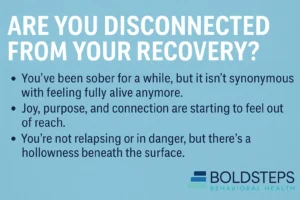
You’re not using. You’re not wrecking your life. But the joy is gone. The color has faded.
We see this all the time, especially in clients 1–5 years sober. Somewhere after the chaos clears and the structure fades, a quiet drift sets in.
It might look like:
- Skipping meetings, but calling it “self-care”
- Isolating while convincing yourself you’re just “busy”
- Losing interest in hobbies, friends, or partners you used to love
- Saying “I’m fine” while something inside you quietly disagrees
These aren’t dramatic signs. They’re not “proof” of relapse. But they are indicators of disconnection—possibly the early signals that your recovery needs more support.
Growth Plateaus Aren’t Failure—They’re an Invitation
Most of us know what relapse looks like. But emotional relapse? That’s trickier.
It can look like:
- Going through the motions in your recovery community
- Feeling unmotivated but unable to rest
- Starting to romanticize your drinking days—not because you miss the chaos, but because you miss feeling something
None of this makes you weak. It makes you human.
What you’re experiencing might not require a full reboot—but it might require a realignment. That’s where coming back to alcohol addiction treatment can offer more than just a reset. It can offer depth.
Sometimes it’s not about starting over.
It’s about starting deeper.
Treatment Isn’t Just for “Beginners”
Let’s be blunt: some alumni don’t come back because they’re afraid they’ll be treated like they never got sober in the first place.
They don’t want to sit through Step One again. They don’t want to explain themselves. And they definitely don’t want to feel like they’ve “failed.”
At Bold Steps, we get that.
That’s why our programming for returning clients is tailored to where you are now—not where you started. It’s not about going backwards. It’s about accessing the kind of care that matches your current growth edge.
That might mean:
- Joining a group focused on emotional connection or trauma healing
- Working with a therapist to navigate post-sobriety identity shifts
- Engaging in mindfulness or integrative recovery practices
- Exploring grief, boredom, or existential flatness that can follow long-term abstinence
If you’re in Harrisburg or nearby in Dauphin, Lancaster, or York County, we’re here to support your next chapter.
The Hardest Part Isn’t Admitting You Need Help Again—It’s Believing You’re Allowed To
When you’ve been the strong one—the sober sibling, the sponsor, the trusted friend—it’s hard to admit you’re struggling again.
Maybe no one knows. Maybe they still come to you for support. Maybe you still smile when people say, “You’re doing so well.”
But inside, you feel like a ghost. Like a person who worked so hard to build a better life—and now feels disconnected from it.
Here’s the truth: your recovery doesn’t expire, but it evolves.
You don’t need to crash to course-correct. You just need to trust that tuning in before things unravel is a sign of strength—not failure.
At Bold Steps, We Get It—Because We’ve Seen It
We don’t expect every alumni to stay permanently plugged in. Life pulls people in different directions. But when you feel like you’ve drifted too far—when the tools that used to help no longer do—it might be time to return.
That’s why we offer alcohol addiction treatment options that honor your experience and meet you where you are now.
Whether that’s a group track for long-term alumni, one-on-one sessions to recalibrate, or a short-term re-engagement to get unstuck, you’ll never be talked down to here.
You’ll be welcomed back with clarity, respect, and the belief that healing happens in layers.
Frequently Asked Questions from Alumni
Isn’t returning to treatment a step backward?
Not at all. Coming back isn’t a restart—it’s a next step. Many long-term clients return for deeper work or support during difficult seasons.
What if I’m not drinking, but I feel emotionally off?
That’s valid. Emotional relapse or flatness can occur even without substance use. Treatment can help reconnect you to purpose, presence, and peace.
Will I be in a group with new clients?
Not necessarily. We offer options specifically for returning clients and alumni who want deeper, more nuanced support.
I don’t want to go back to Step One. Do I have to?
No. Our clinicians will meet you at your current stage and tailor your care accordingly. This is about depth, not repetition.
Is this available near me?
If you’re looking for alcohol addiction treatment in Harrisburg or Dauphin County, or nearby in Lancaster or York County, Bold Steps offers a range of local and flexible options.
If You’re Feeling the Drift, Let’s Talk
You didn’t work this hard to feel stuck again.
If your sobriety feels like a shell, if joy is hard to access, if your life feels more gray than grounded—it might be time to reconnect.
We’re not here to judge. We’re here to support your next evolution in recovery.
Call 717-896-1880 to learn more about our Alcohol Addiction Treatment services in Harrisburg, PA.
We’ll meet you where you are—and walk with you to where you want to be.