
There’s a quiet fear I see in many clients’ eyes—especially the ones who are deeply expressive, artistic, intense, or simply used to feeling life with a kind of rawness that doesn’t quite fit inside the usual clinical checkboxes.
It’s not just a fear of getting sober.
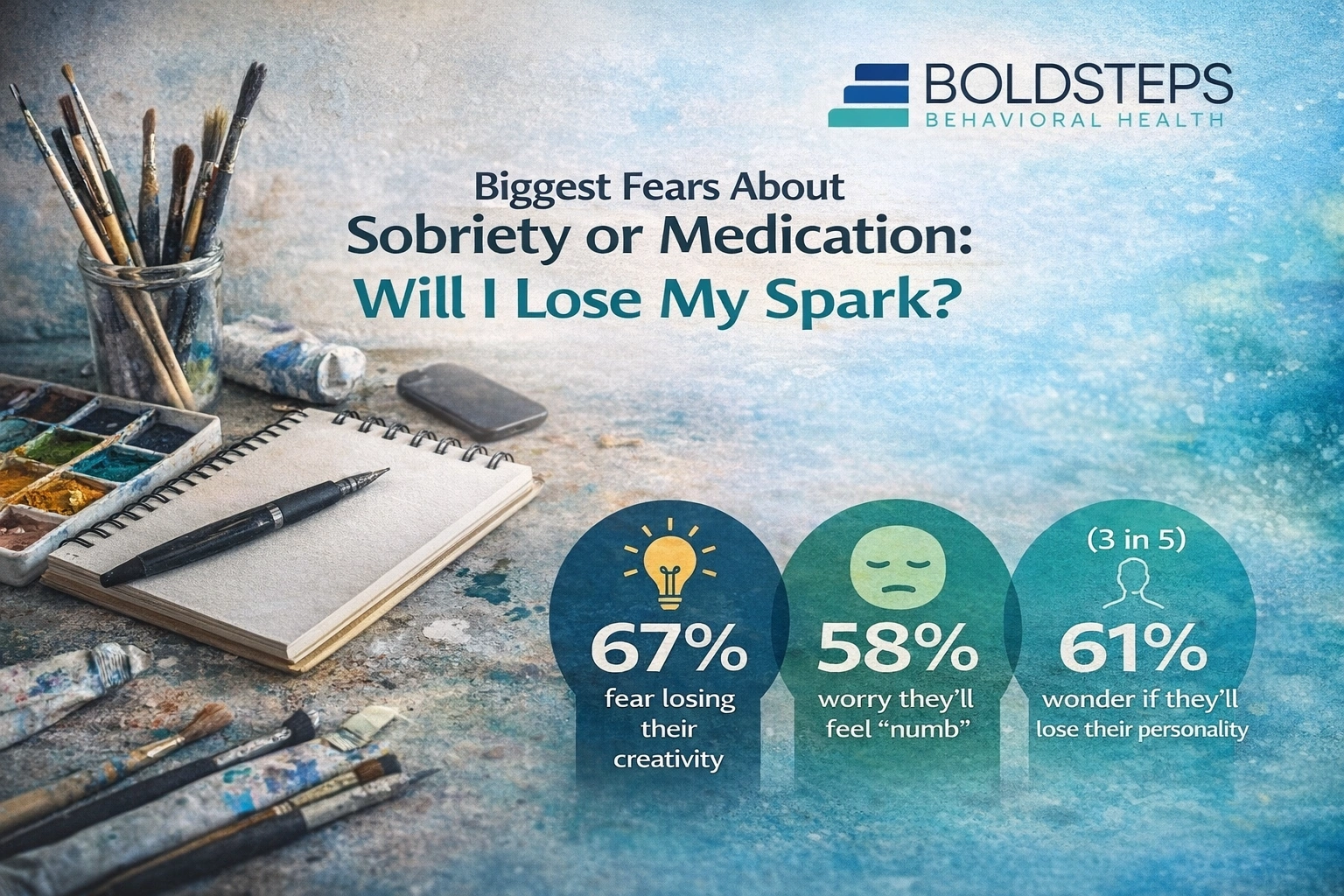
It’s the fear that if they stop using, or if they start taking medication, they’ll lose something sacred. Their creativity. Their personality. Their spark. The thing that makes them them.
If that’s you, I want you to know this: I’ve had this conversation many times. And it’s not a silly fear. It’s not a sign that you’re not ready. It’s exactly the kind of fear that deserves a safe space to be heard, unpacked, and gently explored—without pressure, without pushback, and without anyone trying to sell you a solution.
We hear you. And more than that—we respect the weight of what you’re carrying.
The Fear of Losing Your Spark Isn’t Selfish—It’s Honest
You might feel caught between two impossible choices.
On one hand, continuing to use or self-medicate feels unsustainable. Maybe you’re tired. Maybe it’s starting to cost you more than it gives. Maybe it just isn’t working anymore.
On the other hand, the idea of giving it up—of stepping into treatment, or considering medication—feels like standing at the edge of a cliff.
“What if I can’t write anymore?”
“What if I stop feeling things as deeply?”
“What if sobriety makes me boring?”
“What if I lose the edge that people connect with?”
These questions aren’t superficial. They speak to something profoundly human: the desire to stay connected to your own essence. And that desire doesn’t disappear just because life has gotten hard.
At Bold Steps, we don’t ask you to trade your identity for stability. We don’t see treatment as a way to tame you. We see it as a way to support you—so you can access every part of yourself more clearly, more fully, and more safely.
You’re Not Imagining the Role Substances Have Played
Let’s be real: sometimes, substances have helped. They’ve opened emotional floodgates. They’ve quieted the background noise. They’ve made connection feel easier, or intensity feel bearable, or silence feel less terrifying.
Of course you’re afraid of what life will feel like without them.
But over time, that same doorway can become a cage. The thing that used to connect you to the world can start to isolate you from it. You begin to wonder: Am I feeling this, or is it the substance? Is this real joy, or just a high? Is this connection—or just chemical relief?
One client told us, “I didn’t want to give up the pain because it’s where all my poems came from.” But a few months into treatment, they said something else:
“The poems didn’t stop. They just changed. And now, they’re coming from a place that doesn’t leave me wrecked afterward.”
That’s the shift. Not a loss of depth—but a recovery of ownership over your depth.
Medication Doesn’t Have to Mean Numbness
Many clients have deeply valid concerns about medication. Especially if you’re sensitive, intuitive, or artistic, the thought of taking something that might change your emotional texture is terrifying.
We get that. And we talk about it.
Here’s the truth: good psychiatric care isn’t about numbing you out or making you easier to manage. It’s about finding tools that help you function in ways you want—without compromising the parts of yourself you value most.
Medication assisted treatment is often misunderstood. It doesn’t mean we slap a prescription on top of your fear and send you on your way. It means we work with you, one careful step at a time, to explore whether medication might support your recovery—not erase you.
And we reevaluate as we go. You’re not stuck. You’re not locked in. You’re part of the process. Always.
Sobriety Isn’t the End of Feeling—It’s the Start of Feeling Fully
If you’ve been relying on substances to access emotions, performance, or connection, it can feel like sobriety is going to pull the rug out from under you.
What many people don’t expect is what shows up once the fog lifts.
We’ve seen it again and again: people rediscovering their emotional clarity. Reclaiming their intuition. Feeling things with more nuance, more steadiness, and more power—not less.
Early sobriety can feel strange, even muted. That’s normal. But as your body and mind begin to heal, a different kind of intensity returns—one that doesn’t swing as wildly, but still runs deep. It’s like finally having both feet on the ground while still being able to dance.
And in places like Lancaster County, Pennsylvania, where community, family ties, and creativity are interwoven into the daily rhythm of life, we’ve watched people step into recovery without losing their artistry or their identity. They reclaim it.
When Depression and Substance Use Overlap, Compassion Matters More Than Ever
So many people who seek our help are facing both depression and addiction. And when those two collide, the fear of flattening gets even louder.
Depression can already make you feel like a shell of yourself. The idea of taking medication on top of that—or letting go of the one thing that seems to “help”—can feel impossible.
But here’s what we tell our clients in Dauphin County, Pennsylvania, and beyond: You don’t have to choose between safety and identity. You can get help without losing yourself. And you don’t have to walk into that decision alone.
Our team understands the nuances of treating both depression and substance use. We take your fears seriously. And we walk slowly enough to make sure you feel seen—not rushed.
What Recovery Might Actually Feel Like
We won’t lie to you. Recovery isn’t always a straight line. It doesn’t always feel magical or inspiring.
But here’s what it often does feel like:
- Waking up with a clear head and realizing your thoughts are your own.
- Feeling grief that you’d numbed for years—and realizing you’re strong enough to face it.
- Laughing in a way that doesn’t feel manic or hollow.
- Writing something raw and beautiful that came from you—not a substance.
- Being able to be present in a conversation without performing.
- Looking in the mirror and thinking, “There I am.”
Not a replacement. Not a version. You.
FAQs: Identity, Sobriety, and Medication Concerns
Will I still be creative if I stop using?
Most likely—yes. Many clients find their creativity improves in recovery. It may shift in tone or process, but it often becomes more sustainable, clearer, and even more powerful. The emotional range is still there—just not hijacked.
I’ve tried meds before and hated how they made me feel. What if that happens again?
That’s valid. Not every medication works for every person. That’s why we take time to get to know you and your goals before suggesting options. You’ll never be forced into something you’re not comfortable with. And we can always adjust or explore alternatives.
Is it possible to do treatment without meds?
Absolutely. Medication is one tool—not the whole toolbox. Some clients thrive with therapy, community support, structured care, and lifestyle changes. Others benefit from carefully selected medication as part of a broader support plan. You’ll never be pressured into a one-size-fits-all path.
I’m scared sobriety will make me boring or dull. Is that normal?
Completely normal. But in our experience, sobriety doesn’t flatten you—it frees you. The “boring” fear usually comes from a lack of novelty that substances used to create. Once you settle into recovery, you often rediscover wonder, depth, and meaning in ways that feel even more vivid.
Can I talk to someone without committing to anything?
Yes. Reaching out doesn’t mean you’re locked into a program. It just means you’re open to a conversation. Our team is here to listen, not to pressure you. You get to move at your own pace.
You Deserve a Path That Honors Who You Are
If you’ve ever whispered to yourself, “What if I disappear if I get sober?”—you’re not alone. But what if the opposite is true?
What if the version of you that’s been waiting beneath the noise and chaos is still right there—intact, vibrant, and ready to breathe?
That’s the possibility we hold onto for every client. Not because we’re trying to sell hope, but because we’ve seen it.
We’ve watched artists rediscover their fire. Parents reconnect with their kids without shame. Quiet souls find their voice. And vibrant personalities reclaim their energy, humor, and magic—without substances in the driver’s seat.
You can, too.
Ready to talk with someone who gets it? Call us at 717-896-1880. Our team is here to help you feel safe, supported, and clear about what comes next. Or explore our medication management in Harrisburg, Pennsylvania to see if this path feels right for you.