

It doesn’t always look like a crisis.
You might be months—or even years—into recovery. Life is stable. You’re not using. People say you’re doing great. But internally, something feels…off. Not dangerous. Just disconnected. Like you’re going through the motions.
That feeling isn’t failure. It’s not even uncommon. At Bold Steps, we talk with alumni all the time who feel emotionally flat in long-term recovery. They’re not struggling the way they once were—but they’re not thriving, either.
This is where deeper work often begins. And many of the tools taught in our partial hospitalization program (PHP) aren’t just for the beginning. They’re meant for right now—when the big chaos is over, and you’re wondering what comes next.
The Emotional “Gray Zone” of Long-Term Recovery
There’s a name for this phase, though it’s rarely talked about: the gray zone.
It’s when the emergency has passed, but joy hasn’t fully returned. When staying sober is no longer the daily battle—but meaning still feels out of reach.
Clients often ask us, “Why do I feel like this? I should be happy.”
Our answer: Emotional distance is common after stabilization. It’s not a sign you did something wrong. It’s a sign you’re ready for something deeper.
PHP Tools Aren’t Just Early Recovery Tools
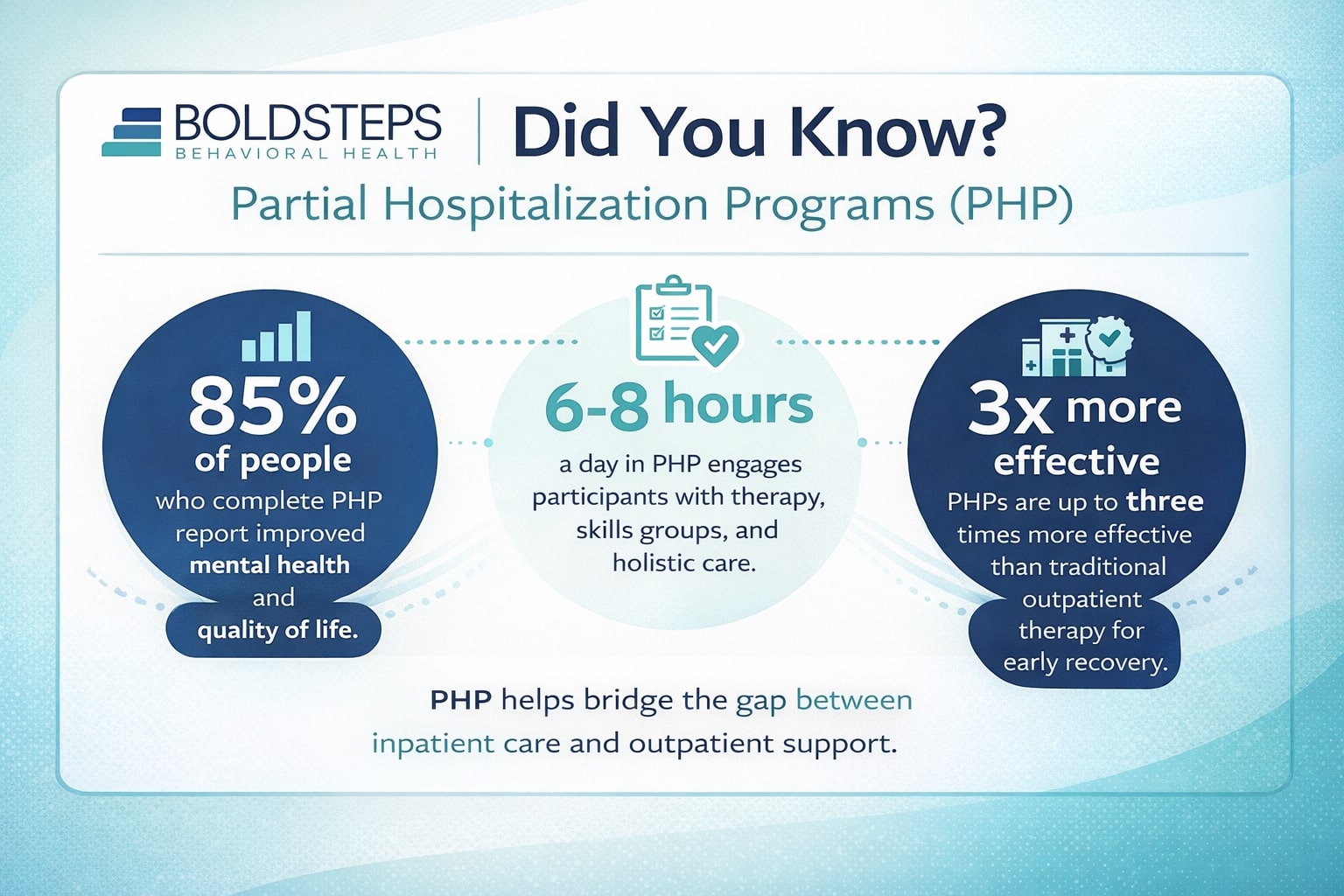
Partial hospitalization programs are designed to stabilize people in acute distress. But the skills taught in PHP are not limited to crisis management.
In fact, many of the most enduring strategies are designed to support lifelong emotional resilience. They were never meant to expire at discharge. Here’s what that can look like in practice:
Skill 1: Emotional Regulation Is a Lifelong Practice
In early treatment, emotional regulation is often a matter of survival—learning to pause instead of react, to ride out urges, to stay grounded.
But years later, emotional regulation becomes something quieter: the ability to sit with your own experience when it’s boring, numb, or quietly sad.
If you’ve stopped checking in with your emotional temperature, consider revisiting skills like:
- HALT check-ins (Hungry, Angry, Lonely, Tired)
- Name-it-to-tame-it: giving words to vague emotional states
- DBT emotion labeling: learning the difference between sadness and shame, for example
These aren’t “crisis skills.” They’re intimacy skills—for staying close to yourself when the noise dies down.
Skill 2: Structure Isn’t Controlling—It’s Stabilizing
In PHP, structure is built into your day. There are check-ins, group times, meals, breaks, therapy blocks. At first, it can feel rigid. But structure is one of the most loving things we can offer the nervous system.
Many people in long-term recovery drift away from this rhythm. That’s normal—but it can also contribute to emotional flatness.
Reclaiming even light structure—like a weekly therapy session, a morning ritual, or an evening reflection practice—can reawaken clarity and stability.
Skill 3: Being Seen Still Matters
Group process work isn’t always everyone’s favorite part of PHP. But for many, it’s the first time they feel truly seen.
That moment when someone across the room says, “I feel that too”—it’s powerful. And it teaches you something: You don’t have to carry the weight alone.
In long-term recovery, it’s easy to isolate. Especially when people assume you’ve “made it.” But the need to be witnessed doesn’t disappear. Whether through a support group, therapy, or honest friendships, connection is still medicine.
Skill 4: You’re Allowed to Relearn Self-Compassion
Early recovery may have introduced you to the idea of self-compassion—but practicing it years later is a whole different thing.
It’s not about affirmations. It’s about letting yourself feel bored, lost, or unmotivated without spiraling into shame. It’s about noticing your own suffering and responding with gentleness.
If you find yourself thinking, “I shouldn’t feel this way,”—that’s your cue. The part of you that’s hurting needs less judgment, not more discipline.
Skill 5: Values Work Still Guides Direction
Most PHPs include some form of values clarification—what matters to you, what do you want your life to stand for. But values aren’t fixed.
If you’ve never re-asked yourself those questions post-treatment, you might be living by a framework that no longer fits.
Ask again:
- What lights me up now?
- What kind of relationships am I craving?
- Where do I want to grow?
Recovery gave you a foundation. Values give you direction.
Recovery Can Feel Hollow—That Doesn’t Mean You’re Lost
Sometimes the most honest thing a long-term alumni can say is: I feel hollow.
And here’s what we want you to hear: You’re not broken. You’re not missing something. You might just be in an emotional winter.
In early sobriety, everything feels intense. Later, the world softens—and sometimes flattens. That’s not the end of your story. That’s an invitation to grow roots.
“I stayed sober for over two years and still felt numb. What helped me wasn’t going back to day one—it was remembering that feeling isn’t failure. It means I’m alive.”
– Bold Steps Alumni, 2022
FAQ: Long-Term Recovery and PHP Skills
Do I need to go back to treatment if I feel emotionally disconnected?
Not necessarily. Emotional distance doesn’t always mean you need a higher level of care. But it does mean your support system may need tuning. Consider therapy, support groups, or revisiting recovery tools before assuming a full reset.
Can alumni revisit parts of the PHP curriculum?
Yes. Many programs, including ours, offer alumni support, booster sessions, or community events. Reach out—there’s often more continuity available than people realize.
Is it normal to feel this way even after years of being sober?
Completely. Recovery is not a fixed emotional state. It evolves—and sometimes stalls. Feeling flat, lost, or emotionally stuck doesn’t erase your progress. It signals your readiness for the next layer of growth.
What if the people around me don’t get it?
That’s common, especially if you’ve been the “success story” for a while. Consider seeking connection with others in long-term recovery who understand the complexity of where you are now.
You’re Allowed to Come Back to the Basics
If you’re in a quiet rut, not a loud relapse… it still matters. Emotional stagnation can wear you down in ways even acute crisis can’t.
The skills you learned in PHP weren’t just for early recovery. They were designed to sustain you—quietly, steadily, through all seasons.
Whether you’re in Pennsylvania or somewhere else entirely, your experience is valid. And help is still available. If you’re craving reconnection, meaning, or just some honest reflection with people who understand, don’t wait for it to get worse. Come back to the center of yourself.
📞 Still growing? Let us walk with you.
Call 717-896-1880 or visit to learn more about our partial hospitalization program services in Harrisburg, PA. Easily accessible from anywhere in Harrisburg & Dauphin County, Lancaster County, York County and beyond.
Explore renewed care in Pennsylvania—you don’t have to start over. You just have to start again.