

You’ve already admitted something most people avoid for a long time:
I can’t keep doing this on my own.
But knowing that… and actually reaching out?
Those are two very different things.
Because now your mind is filled with questions you can’t quite answer:
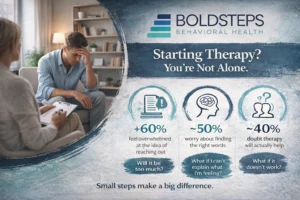
Will it be overwhelming? Will I have to explain everything? What if it doesn’t work?
If that’s where you are, let’s slow this down together.
Not into a checklist. Not into a clinical breakdown.
Just into what this really looks like—human to human.
The First Step Is Smaller (and More Human) Than You Expect
Most people imagine the first step as something dramatic.
A big decision. A commitment. A moment where everything shifts.
But in reality, it’s much quieter.
It often looks like:
- Sitting with your phone longer than you expected before making a call
- Opening a message and rewriting it three times
- Showing up unsure of what to say
There’s no script you need to follow.
You don’t have to be confident.
You don’t even have to be ready.
You just have to be willing to not do this alone for one moment.
That’s it.
You Don’t Need to Explain Yourself Perfectly
One of the biggest fears people carry is this:
What if I can’t explain what’s going on?
The truth is—most people can’t at first.
You might say:
- “I feel off, but I don’t know why.”
- “Everything feels like too much lately.”
- “I’m tired, but not physically.”
That’s enough.
You don’t need the right words.
Because part of the process is helping you find them.
It Won’t Feel Like Being “Analyzed”
A lot of people expect to feel studied. Judged. Picked apart.
That’s not what this is.
Good support doesn’t feel like someone trying to figure you out.
It feels like someone sitting with you while you figure yourself out.
There’s a difference.
You’re not being evaluated.
You’re being understood—slowly, over time.
The Pace Is Slower Than Your Fear Tells You
There’s this quiet pressure people carry:
If I start this, everything is going to change all at once.
It won’t.
In fact, it’s the opposite.
The pace is intentional. Gradual. Grounded.
You might not even notice changes at first.
But then something small happens:
- You handle a stressful moment differently
- You pause instead of spiraling
- You notice a thought instead of getting pulled into it
That’s progress.
Not loud. Not dramatic.
But real.
You Might Feel Uncomfortable—But Not Unsafe
Let’s be honest.
There will be moments that feel uncomfortable.
But not in the way you’re imagining.
Not because you’re being pushed or judged.
But because you’re paying attention to things you’ve been avoiding.
And that can feel unfamiliar at first.
The difference is—you’re not alone inside that experience anymore.
And that changes everything.
You Don’t Have to Be “All In” Right Away
Another fear:
What if I start this and then realize I can’t handle it?
You’re allowed to take this one step at a time.
You’re allowed to:
- Ask questions
- Take breaks
- Move at your own pace
There’s no contract with your feelings.
There’s just space to explore them safely.
What Support Actually Feels Like (When It’s Right)
When it’s the right kind of support, something shifts.
Not immediately—but noticeably.
You feel:
- Less alone in your thoughts
- Less pressure to “figure it all out”
- More clarity about what’s actually happening inside you
It doesn’t fix everything overnight.
But it makes things feel possible again.
The Part Most People Don’t Expect
There’s a moment that tends to catch people off guard.
It usually comes after a few honest conversations.
It sounds like this:
“I thought something was wrong with me… but now I understand what I’ve been dealing with.”
That moment matters.
Because confusion creates fear.
But understanding creates space.
And space is where change begins.
Why Waiting Often Feels Safer (But Isn’t)
It makes sense that you’ve waited.
Most people do.
Because staying where you are—even if it’s uncomfortable—is familiar.
And the unknown feels bigger than the struggle.
But here’s the quiet truth:
Staying stuck is its own kind of risk.
Not dramatic. Not urgent.
Just slowly exhausting.
You’re Allowed to Need Help Before Things Get Worse
You don’t have to hit a breaking point.
You don’t have to prove anything.
If something feels off… if your thoughts feel heavier than they should… if you’re tired of carrying this internally—
That’s enough.
If you want to better understand what’s happening beneath the surface, exploring anxiety-related care can give you a clearer sense of what you’ve been feeling.
And if you’re looking for grounded, real support, options for support in Pennsylvania exist for people who are exactly where you are—aware something needs to change, but unsure how to start.
For individuals near Dauphin County, Pennsylvania, taking that first step often feels less overwhelming once you realize you don’t have to have everything figured out ahead of time.
What This Could Look Like a Few Weeks From Now
Not perfect.
Not completely different.
But lighter.
More clarity.
Less constant tension.
A better understanding of your own mind.
And maybe—just maybe—a sense that you’re not fighting yourself as much anymore.
FAQs
What if I’m scared to start?
That’s completely normal. Fear doesn’t mean you’re not ready—it means you care about what happens next.
Do I need to know exactly what’s wrong?
No. Many people start without clear answers. The process helps you figure that out over time.
What if I’ve tried something before and it didn’t help?
That doesn’t mean nothing will help. The right support, timing, and approach can make a big difference.
Will I be judged for how I’m feeling?
No. The goal is understanding—not judgment.
How long does it take to feel a difference?
Some people notice small shifts early on. Deeper changes take time, but they build in a steady, lasting way.
What if I stop halfway through?
You’re allowed to move at your own pace. Starting doesn’t mean you’re locked into anything.
You Don’t Have to Stay in This Uncertainty
You’ve already done something important.
You’ve stopped ignoring what you’re feeling.
Now the next step isn’t about having all the answers.
It’s about letting yourself not do this alone anymore.
Call 717-896-1880 to learn more about our mental health, Anxiety Disorder Treatment In Pennsylvania.