

You don’t have to hit rock bottom to wonder if things could be better.
Maybe you’ve cut back. Maybe you’re just tired of how alcohol makes you feel the next morning. Or maybe you’ve Googled “treatment” and immediately closed the tab.
If the idea of rehab sounds too intense, too final, or just not “you”—you’re not alone. Most people carry assumptions about what treatment looks like, and too often, those assumptions come from outdated images: disappearing for 30 days, dramatic life collapse, or being labeled forever.
But not all support looks like an emergency. And not all treatment asks you to give up everything at once. An Intensive Outpatient Program (IOP) is often one of the most flexible, grounded, and accessible ways to get support—especially if you’re curious, cautious, or quietly wondering if you’ve been relying on substances more than you’d like.
Let’s clear up the most common misconceptions so you can make choices based on truth—not fear.
Myth #1: “IOP is basically rehab lite.”
Truth:
An Intensive Outpatient Program isn’t a stripped-down version of inpatient rehab—it’s a completely different format with a different goal.
While residential treatment removes you from your everyday life, IOP partners with it. You continue to live at home, go to work, take care of your family, and attend structured group and individual therapy a few times per week.
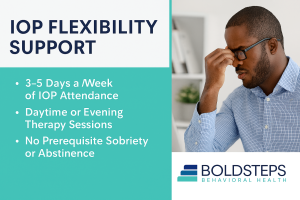
Most IOP programs—including ours at Bold Steps in Harrisburg—offer both daytime and evening options, typically 3–5 days a week for around three hours per session. It’s not “lite.” It’s “liveable.”
This kind of flexibility is intentional. Because the goal isn’t to unplug from your life—it’s to plug into your values while still showing up for your responsibilities.
Myth #2: “IOP is only for people with a serious addiction.”
Truth:
IOP is for people seeking meaningful change, not just those in crisis.
Plenty of IOP participants are exploring early intervention, are sober curious, or are in a gray area with alcohol or other substances. They’re not crashing. They’re asking better questions.
Questions like:
- “Why do I keep needing this to relax?”
- “Is this still working for me?”
- “What would my life feel like with more clarity?”
You don’t have to wait until your world falls apart to get support. IOP meets you at the moment of awareness, not collapse.
Myth #3: “If I go to IOP, everyone will know.”
Truth:
Confidentiality is a fundamental part of how IOP works.
Worried about your job, your community, or even your partner finding out? You’re not alone—and your privacy matters. At Bold Steps, your participation in our IOP is completely confidential. We never notify employers or outside parties unless you request it.
And if in-person attendance feels vulnerable, we offer virtual IOP for Harrisburg residents. You can attend from home, on a secure platform, on your own time.
Your healing doesn’t need an audience.
Myth #4: “I have to be ready to quit everything cold turkey.”
Truth:
You don’t need to be sober to start. You just need to be curious enough to explore.
Plenty of people begin IOP unsure of what “recovery” will mean for them. They’re not sure if they want to stop completely, or if they’re just tired of needing it to get through the week. That’s okay.
IOP helps you ask those questions in a safe, supportive environment—without pressure.
It’s not about forcing you into abstinence. It’s about offering tools, insight, and space to understand what’s working, what isn’t, and what you want next.
Myth #5: “It’ll take over my life.”
Truth:
IOP is built to fit into your life—not take it over.
You won’t have to quit your job, cancel your obligations, or move into a facility. Most clients attend IOP for three hours per session, three to five times per week. You can choose a schedule that fits with your work hours, parenting duties, or other commitments.
We’ve worked with business owners, teachers, shift workers, students, and caregivers—every schedule is unique. And we work with you to make it manageable.
This isn’t about overhauling your life. It’s about making space for one part of it to start healing.
Myth #6: “IOP means I’m officially in treatment.”
Truth:
IOP is a starting point, not a sentence.
You’re not committing to a life-long identity or locking into a clinical path. You’re choosing to try something structured—nothing more, nothing less.
Some people do IOP for 6–8 weeks and move on. Others use it as a stepping stone to longer-term therapy or community support. And some discover that the experience shifts how they view themselves, even if they never use the word “addiction.”
You don’t have to know your whole path to take the first step. And you can always change direction. That’s not failure. That’s clarity.
Myth #7: “IOP is only for people who’ve already ‘messed up.’”
Truth:
IOP is also for people who want to prevent harm—not just recover from it.
The media often portrays treatment as something people are forced into after losing everything. But that doesn’t reflect reality. Many IOP clients are proactive thinkers. They’ve noticed a pattern, a feeling, a loss of control—and they want to get ahead of it.
That’s courage. Not crisis.
And it’s one of the healthiest times to begin.
Ready to Explore IOP Without the Pressure?
At Bold Steps Behavioral Health in Harrisburg, our Intensive Outpatient Program is designed for people like you—curious, intelligent, and not interested in black-and-white thinking.
You don’t need to hit a crisis to ask, “Could this help me feel better?”
We’re here for that question. And whatever comes next.
Call 717-896-1880 to learn more about our Intensive Outpatient Program services in Harrisburg, PA.
FAQ: Common Questions About IOP for the Sober Curious
Do I need to be sober before starting IOP?
No. You can begin IOP while still using. The program is designed to help you explore your relationship with substances and decide what level of change you want to make.
Will I have to talk about things I’m not ready for?
No. You control how much you share. IOP is about trust and safety. You won’t be pushed to disclose beyond your comfort zone.
Can I just try IOP without making a big commitment?
Yes. Many people begin with a trial mindset. You can start and reassess weekly with your therapist.
Is this going to be awkward?
Probably not in the way you expect. Most clients find that IOP is more human and less clinical than they thought. And if you’re nervous at first, that’s totally normal.
Do I have to call myself an alcoholic or addict?
No. Labels aren’t required. All you need is curiosity and a willingness to explore change.
Can I attend IOP after work?
Yes. We offer flexible scheduling, including evening options and virtual sessions. We’ll work with your availability.