

The first time I tried CBT, I left more frustrated than helped.
I remember thinking, Is this really it? Writing down my thoughts felt pointless. Reframing felt fake. Every worksheet made me feel like I was doing therapy wrong. I wanted it to work—I just didn’t feel anything change.
I told myself CBT didn’t work. What I didn’t realize was: I hadn’t actually experienced CBT at its best.
Years later, I gave it another try. And what I discovered changed everything.
CBT wasn’t the problem. I just didn’t get the full picture the first time.
Here’s what I missed—and why I’m glad I didn’t give up on it completely.
1. I Expected CBT to Fix Me Fast
Back then, I was in survival mode. I came to therapy hoping for relief—immediate, visible, and permanent.
I thought CBT would give me quick answers. Instead, I got assignments and cognitive models. And I remember thinking, This is too surface-level. I didn’t want logic. I wanted feeling.
But CBT isn’t about rushing you to feel better. It’s about helping you understand how your thoughts and beliefs shape your emotional world—so you can create sustainable change.
The second time I tried, my therapist explained CBT as “building muscle memory for your brain.” And that clicked. I didn’t need to feel different overnight—I needed a different way of relating to my thoughts. The relief came slowly, but it came.
2. I Wasn’t Ready to Challenge My Own Mind
CBT works by helping you spot unhelpful thoughts—and then question them. That sounds simple. But when you’re deep in anxiety or depression, those thoughts feel like truth.
My brain told me I was a failure, a burden, too much. When someone asked me to challenge those thoughts, I felt exposed—like they didn’t get it.
The first time around, I wasn’t emotionally safe enough to explore my thinking. The second time, my therapist met me differently. She let me be with the pain first. She didn’t push. That made all the difference.
3. My First Therapist Only Knew CBT—Not Me
CBT is a powerful tool. But like any tool, it depends on who’s using it.
My first therapist seemed like they were following a script. The sessions felt mechanical. I didn’t feel seen—just analyzed.
When I finally worked with someone who understood that therapy is a relationship, not just a method, everything shifted. They used CBT—but with warmth, curiosity, and respect. They asked how the tools felt in my body. They slowed down when I looked overwhelmed. They stayed human.
That’s what I needed. Not just CBT. A therapist who knew how to use it with me.
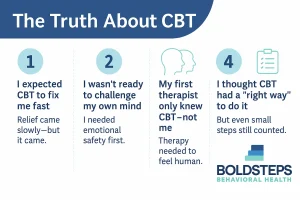
4. I Thought CBT Had a “Right Way” to Do It
I’m a perfectionist. So when CBT gave me homework, I treated it like school. If I didn’t finish every thought log, I felt like I was failing therapy.
But CBT isn’t a test. It’s not about doing it “right.” It’s about noticing patterns, catching mental spirals, and slowly rewiring how you respond.
Some days I didn’t write anything down. Some weeks, all I did was remember one thought that used to wreck me—and realize it didn’t have as much power.
That’s still progress.
5. I Didn’t Know I Could Try Again—Differently
For a long time, I believed my first experience with therapy was my only experience. If it didn’t work, maybe I just wasn’t “built” for therapy.
I hear that from other people, too:
“I already tried. It didn’t help.”
But now I know: One try isn’t the whole story. The first time might be the wrong fit, the wrong time, or the wrong pace. That doesn’t mean the method is wrong for you.
Trying CBT again—with a different therapist, with more readiness, with fewer expectations—was one of the best choices I’ve made.
Looking for CBT in Harrisburg or nearby?
If you’re in central PA, CBT services in Harrisburg and surrounding areas like Lancaster County or York County are available through providers who know that therapy should feel like a human experience—not a clinical checkbox.
FAQ: Cognitive Behavioral Therapy (CBT)
What is CBT, really?
Cognitive Behavioral Therapy (CBT) is a type of therapy that helps you notice and change patterns in your thinking that negatively affect your emotions and behaviors. It’s structured, goal-oriented, and often short-term—but when done with the right support, it can go deep.
What if CBT didn’t help me before?
You’re not alone. Many people have mixed experiences with therapy—especially when it feels rushed or impersonal. If CBT didn’t work for you the first time, it might have been the fit, the timing, or the way it was delivered. Therapy is allowed to be a second-chance kind of thing.
How do I know if CBT is right for me?
CBT can be helpful for anxiety, depression, trauma, and more. If you find yourself stuck in mental loops or reacting in ways you don’t fully understand, CBT might help you explore and shift those patterns. But the best way to know? Talk to a provider who listens—not just prescribes.
Is CBT just “positive thinking”?
No. CBT isn’t about pretending everything is fine. It’s about understanding how your thoughts affect your emotions—and learning skills to challenge distortions, not ignore reality. It’s more “What’s another way to see this?” than “Just think happy thoughts.”
Can CBT be gentle? Or is it always structured?
CBT can be both. While it has structure, a good therapist will adjust the pace to your needs. You don’t have to rush. You don’t have to force insights. You’re allowed to go slow—and CBT can still work that way.
CBT isn’t about being perfect—it’s about being real with your mind.
If your first experience didn’t land, that’s okay. It might not have been the right therapist, the right moment, or the right method for that version of you.
But if you’re curious again—even just a little—don’t rule it out.
📞 Call Bold Steps Behavioral Health
Ready to explore CBT with someone who meets you where you are?
Call 717-896-1880 or visit to learn more about CBT services in Harrisburg, PA.