

I didn’t plan to ghost my IOP.
At first, I just needed to miss one group—bad day, low energy, nothing serious. Then another. And then it got harder to come back. Harder to explain. Harder to even look at the reminders on my phone.
It wasn’t that I didn’t care about recovery. I did. Still do.
But something in me whispered: They’re probably disappointed. You were doing so well… now look at you.
If you’re reading this because you’re thinking about rejoining your Intensive Outpatient Program, but that same whisper is sitting heavy in your chest—I want you to know this:
You’re not alone. And the door is still open.
At Bold Steps Behavioral Health, we’ve seen people return to IOP after one missed session, after three months of silence, after relapse, after grief, after burnout. And we don’t ask why did you leave? We ask, how can we support you now?
So if you’re wondering how to come back when you’re sure you let everyone down, keep reading. This is for you.
1. Know That You’re Not the Only One Who Stepped Away
Let’s get something out of the way: disappearing for a while isn’t rare. It’s actually incredibly common.
People step back from IOP for all kinds of reasons:
- Emotional overwhelm
- Life stress
- Shame after relapse
- Burnout from trying too hard too fast
- Disconnection from the group
- Internal fear that maybe recovery isn’t “working”
None of those make you a failure. They make you human.
You may be picturing a group that kept meeting without you, talking about how you vanished. In reality, most folks are just trying to keep their own heads above water. And when you come back, they won’t be judging you—they’ll be nodding in recognition. Because many of them have been exactly where you are.
2. You Don’t Need a Grand Apology to Return
The shame voice might tell you that if you’re going to return, you need to show up with a big emotional explanation—tears, clarity, accountability. That voice is lying.
You don’t need a script. You don’t need to perform your regret.
You don’t even need to have figured out why you left.
You’re allowed to just say:
“Hey. I want to come back.”
That sentence carries more strength than you realize. And when you say it to someone on our team, the response will be something like:
“We’re so glad to hear from you. Let’s make a plan that feels good for where you are now.”
No guilt. No lectures. Just support.
If you’re looking for an Intensive Outpatient Program in Harrisburg & Dauphin County, PA, we’re here to help you reenter gently—whether it’s your first return or your fifth.
3. Expect to Be Welcomed, Not Judged
This is one of the most healing surprises for people who return:
Nobody is mad at you.
Not the staff. Not the other clients. Not the counselor you were worried about disappointing.
In fact, the most common response is something like:
“I’ve been there.”
“I wondered how you were doing.”
“Glad you’re back.”
Because we don’t expect perfection here. We expect struggle. We’re prepared for people to need time, space, and multiple tries. That’s why the structure exists—to support your return as many times as needed.
And if you’re worried you won’t be remembered at all? That’s okay too. Rejoining IOP doesn’t require some grand re-entry scene. You can slip in quietly. You can observe for a few sessions. You can just exist in the room until you feel safe again.
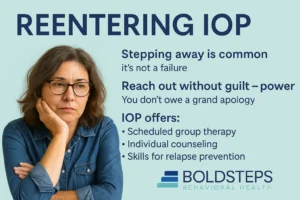
4. Give Yourself Permission to Start Where You Are
You don’t have to “make up” for the time you missed. You don’t have to restart from the beginning unless that feels helpful to you.
At Bold Steps, our Intensive Outpatient Program is designed to meet people where they are:
- In relapse
- In confusion
- In mid-progress
- In survival mode
Our team will check in about what you need now—not what you missed or failed to complete.
Whether you were gone for one week or one season, your healing gets to resume from today, not from some imaginary version of you who “should have done better.”
5. Let the Structure of IOP Help Rebuild Your Stability
One of the things IOP gives us—especially when we’re feeling fragile—is structure.
And when shame is spinning, or life feels chaotic, or motivation is thin, structure can be a lifeline.
At Bold Steps, our IOP includes:
- Scheduled group therapy (multiple times per week)
- One-on-one counseling with a consistent therapist
- Relapse prevention tools and skill building
- Space to talk about mental health, trauma, or family dynamics
- A mix of education, support, and peer connection
If you’re looking for an Intensive Outpatient Program in Lancaster County, PA or York County, PA, our program is also available to you.
The structure isn’t about control—it’s about giving you something reliable to lean on while you steady yourself again.
6. Let Your Shame Shrink in the Presence of People Who Get It
Shame thrives in isolation. It grows when you hide. It gets louder when you stop talking.
The fastest way to quiet it? Let someone see you.
When you rejoin your group, when you sit in that chair and just exist without trying to prove anything—shame loses oxygen.
And when someone else in the room says,
“I left for a while too,”
you realize you’re not some outlier. You’re just another person doing recovery in real time.
You might still feel awkward at first. You might not talk much. That’s okay.
Just being there is an act of resistance against the shame that told you not to come back.
7. You’re Not Broken—You Just Paused
One of the hardest parts about rejoining treatment is believing that it still counts.
Like maybe you had your shot, and now you’re just… too behind.
But you’re not. You’re not behind. You’re not ruined. You didn’t miss your window.
You just paused.
Recovery is not linear. It is not performance-based. It is not reserved for people who never waver.
You’re allowed to pause. And you’re allowed to come back.
FAQs: Returning to IOP After Ghosting
What if I feel too ashamed to return?
That’s completely normal. Most people feel awkward or guilty after stepping away. But those feelings don’t disqualify you—they’re part of what makes your return meaningful.
Do I have to explain why I left?
Only if you want to. You’re welcome to share what happened, but you’re not required to relive or justify anything.
Will the group remember me? Will it be weird?
They might remember you—but they won’t make it weird. Group members are often the most welcoming part of the return process.
What if I relapsed while I was gone?
That’s okay. IOP is built to help people regain footing after slips or full relapses. You’re not starting over. You’re continuing.
Can I return even if I only attended once or twice before?
Yes. Even if you barely got started, it’s never too late to rejoin. Every seat in the room belongs to someone who kept trying.
If You’re Still Thinking About Coming Back, That’s a Sign You Should
You wouldn’t still be here—reading this—if part of you didn’t want to return.
That part of you matters.
You don’t have to feel ready. You don’t have to feel brave. You just have to show up.
And if showing up today looks like sending a quiet message or making a 2-minute phone call, that counts. It all counts.
Ready to Rejoin?
Call 717-896-1880 or visit to learn more about our Intensive Outpatient Program services in Harrisburg, PA.
You didn’t lose your spot.
You didn’t lose your right to heal.
We’re still here—and your seat is still open.