

You’re not unraveling, but you are tired. You haven’t hit rock bottom, but the idea of keeping everything together—every feeling, every expectation, every mask—makes your jaw clench before your feet hit the floor.
Maybe you’re holding down a job, smiling at brunch, hitting the gym. Maybe you’re also crying in the car after social plans and Googling “am I broken or just burned out?”
If you’re wondering whether your pain “counts” enough to ask for real help, I want you to know: It does. Especially if you’re curious about sobriety, healing, or just feeling something real again.
Let’s talk about what it looks like to ask for more support—without waiting for a crisis to make the choice for you. Specifically? Let’s talk about how a Partial Hospitalization Program (PHP) can be a wise, empowering next step—not a last resort.
1. You Don’t Need to Collapse to Get Care
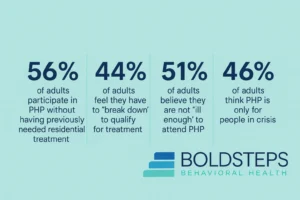
There’s a myth floating around that says people only go to PHP if they’re coming out of the hospital or about to be admitted.
Here’s what I’ve learned: You don’t need to break to deserve help.
You might be:
- Sober-curious and trying to hold onto it without support
- Over-functioning at work and under-functioning in private
- In therapy, but once a week isn’t touching the depth of what you’re carrying
- Not using substances, but still feeling disconnected, anxious, or numb
PHP isn’t just for emergencies. It’s for people who are ready to move out of survival mode and into something steadier.
2. What Is a Partial Hospitalization Program, Really?
A Partial Hospitalization Program is a structured mental health treatment option that runs during the day—usually Monday through Friday, around 9 AM to 3 PM.
At Bold Steps Behavioral Health in Harrisburg, PA, PHP includes:
- Daily group therapy focused on skills, support, and emotional safety
- Individual therapy once a week with your dedicated clinician
- Medication management with a psychiatric provider (if needed)
- Skill-building sessions in emotional regulation, communication, mindfulness, and more
- A safe space to process what’s happening without pretending everything is fine
It’s not inpatient. You sleep at home. You still have your phone, your freedom, your life. But you also have structure, clarity, and a team walking with you.
3. You’re Not Too “High Functioning” for PHP
Here’s a real thing I said before starting:
“I feel like I’m too okay for this—but not okay enough without it.”
Sound familiar?
If your internal dialogue includes phrases like:
- “I can still go to work, so I’m fine.”
- “Other people have it worse.”
- “It’s probably not serious enough for treatment.”
…then this is your permission slip.
You are allowed to seek support before your world implodes. In fact, that’s one of the healthiest things you can do.
At Bold Steps, we’ve welcomed clients into our Partial Hospitalization Program in Harrisburg, PA who were working full-time, taking care of kids, or even doing “well” by outside standards—while inside, they felt like ghosts of themselves.
PHP helped them reconnect to real feelings, real support, and a real path forward.
4. PHP Isn’t Just a Safety Net—It’s a Launchpad
Let’s reframe it.
A lot of people think of PHP as the thing you do when you’re on the verge of collapse. But in truth? PHP is proactive.
It’s where you:
- Interrupt the cycles that keep you stuck
- Learn how to feel your feelings without spiraling
- Get to the why behind the coping behaviors that don’t serve you
- Practice being honest—in a room full of people doing the same
It’s not about “fixing” you. It’s about supporting the version of you that’s already trying—and helping them stop doing it alone.
Whether you’re managing sobriety, anxiety, burnout, trauma, or all of the above, PHP offers more than a lifeline. It offers lift.
5. What If I’m Not Sure I’m “Sick Enough”?
That question haunted me.
I spent weeks reading articles like this one, trying to decide if my struggles were “serious enough” to warrant a program. I wasn’t suicidal. I hadn’t relapsed. I still answered emails.
But I was hurting.
Here’s what I wish someone had said back then: The fact that you’re asking this question is the answer.
It means you’re self-aware. It means you care. And it means you’re not waiting for collapse to finally prioritize yourself.
That’s not weakness. That’s emotional intelligence.
If you’re in Lancaster County, York County, or right here in Dauphin County, Bold Steps offers a team that will hear your “I don’t know if I belong here” and respond with: Let’s find out together.
6. How Do You Even Start This Conversation?
If you’ve never been to treatment—or you’ve only done weekly therapy—it can feel weird to ask for more. Here’s how to begin, even if you’re nervous.
Say this to your therapist:
“I’m doing my best, but I think I need more structure than this. What do you know about PHP?”
Say this to your doctor:
“I’m struggling, but I’m functioning. I don’t want to wait until I’m not. Can we talk about Partial Hospitalization?”
Say this to Bold Steps:
“I’m not in a crisis, but I’m not okay. I’ve heard about your PHP and want to know if it’s right for me.”
That’s all it takes. You don’t need the perfect words. Just honesty.
7. You Deserve a Program That Sees the Whole You
There’s nothing worse than asking for help and feeling like you’re treated as a checklist.
At Bold Steps, we take the time to understand what’s underneath the question, “Do I need PHP?”
Because the truth is, people enter our Partial Hospitalization Program in Harrisburg, PA for all kinds of reasons:
- A quiet feeling of disconnection
- Grief they can’t name
- Burnout that won’t go away
- Curiosity about sobriety that’s starting to look like truth
Our approach is personalized, stigma-free, and grounded in the belief that you’re already doing something brave by asking.
FAQs for the Sober Curious Considering PHP
Do I have to be 100% sober to join PHP?
No. You don’t need to arrive “perfect.” Whether you’re sober curious, recently cut back, or exploring your patterns—you’re welcome here.
What if I’ve never been to therapy or treatment before?
That’s okay. PHP can be a first step. Our team will help you understand what to expect and walk with you every step of the way.
Will I have to take medication?
Not necessarily. If you’re interested in psychiatric support, it’s available—but medication is not required to participate in PHP.
Can I keep working or going to school during PHP?
PHP is typically a weekday daytime program, so some schedule adjustments may be needed. But this is a short-term investment in long-term wellbeing. We’ll work with you.
How long does PHP usually last?
Most people attend for 2–4 weeks, depending on goals and progress. You and your team decide together when you’re ready for the next step.
You Don’t Have to Wait for Permission
If you’ve read this far, your gut is already telling you something.
You might not feel like you’re falling apart—but you also know you’re not okay. That’s reason enough to reach out. That’s reason enough to ask for more.
Call 717-896-1880 or visit our Partial Hospitalization Program page to find out what support could look like—without shame, without waiting, without needing to crash first.
This is your sign. Not to start over. But to start better.