

The first time I walked into treatment, I was terrified. I was also kind of hopeful. I thought this would be it—the thing that helped me feel normal, balanced, fixed.
It wasn’t.
The second time, I was angrier. I blamed the first place for “doing it wrong.” I thought a different facility would magically change everything. Spoiler: it didn’t.
By the third time, I was numb. Just going through the motions. I didn’t expect it to work. I barely expected to stay.
I don’t remember how many times I’ve done this now. Five? Six?
But here’s what I do remember: the last time, something finally stuck. And it wasn’t because I suddenly got my act together. It was because I landed in a Partial Hospitalization Program (PHP) that didn’t try to push me into healing.
Instead, it gave me enough space—and just enough structure—for things to actually shift.
This is a story for anyone who thinks treatment “just doesn’t work” for people like them.
Because I thought the same thing.
Until I didn’t.
I Didn’t Need Another Pep Talk—I Needed Something Different
Let’s start here: I wasn’t in a full-blown crisis.
I wasn’t drinking every day anymore. I hadn’t relapsed. I was going to therapy. Technically, I was doing “okay.”
But I wasn’t okay.
I felt like I was managing my mental health the same way someone tries to keep a cheap tent from blowing over in the wind—frantically adjusting, hoping no one saw the panic underneath.
So when my therapist suggested a Partial Hospitalization Program in Harrisburg, I laughed. Not because I thought it was funny, but because I thought: Isn’t that for people in crisis? Isn’t that too intense?
Turns out, I didn’t need to be falling apart to need more help. I just needed to stop trying to white-knuckle my way through life.
What Made PHP Different? I Was Treated Like a Person, Not a Project
This wasn’t my first program. I’d been in outpatient. I’d done IOP. I’d sat in fluorescent-lit rooms trying to force myself to “open up.”
Bold Steps was different from the start.
No one rushed my story. No one sold me a “breakthrough” or pushed the whole “you have to want it” speech.
They just met me where I was—worn out, guarded, but still showing up.
That alone made it feel different.
At Bold Steps Behavioral Health, I didn’t feel like a number or a failure or a checklist. I felt like someone who still had a shot.
I Didn’t Trust Group at First—But It Gave Me What I Didn’t Know I Needed
If I’m honest, group therapy has always made me cringe.
In the past, it felt like a mix of vague advice, oversharing, and awkward silences. I hated pretending to be “engaged” when I was dissociating the whole time.
But in PHP, it finally felt grounded.
The clinicians kept it real. They didn’t let things spiral. There were actual takeaways—coping strategies, communication tools, ways to regulate when I felt like my brain was on fire.
Even more important? The other people there weren’t trying to impress anyone. No one was putting on a recovery costume. We could just be tired, raw, and honest.
It made me want to come back. That was new.
The Schedule Gave My Days Meaning Again
PHP runs about five to six hours a day, five days a week. At first, I thought: Who has time for this?
But the truth is, I wasn’t really using my time well before.
I was spending my days spiraling in silence, doomscrolling, self-isolating, pretending to work.
Suddenly, I had somewhere to be—somewhere I didn’t have to perform, but I also couldn’t completely check out.
The structure grounded me. The repetition made me feel human again. And the daily contact gave me the thing I’d been missing most: consistency.
They Didn’t Treat Me Like a Blank Slate—They Respected My History
This was huge for me.
A lot of programs make you feel like every time you start over, you have to erase everything that came before.
Not here.
At Bold Steps, they asked what I’d already tried. What hadn’t worked. What I hated about past treatment. What helped, even a little.
And instead of trying to “convert” me to a new model or approach, they built a plan with me—not for me.
That might sound small, but when you’ve spent years feeling like a problem to be solved, being treated like a partner in your own care is massive.
If you’re looking for a Partial Hospitalization Program in York County or Lancaster County, know this: Bold Steps builds care around you, not despite you.
The Change Was Quiet—But Real
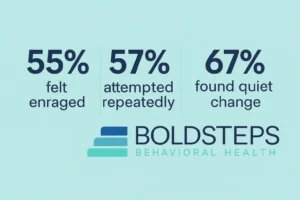
There wasn’t some dramatic transformation.
No “aha” moment. No tears on the floor.
Just this slow, subtle recalibration.
- I stopped dodging my therapist’s calls.
- I started sleeping through the night again.
- I laughed at something—really laughed—and realized I hadn’t done that in weeks.
- I made it through a bad day without defaulting to self-destruction.
These weren’t milestones anyone else would clap for.
But they were mine. And they mattered.
Leaving Didn’t Feel Like an Ending—It Felt Like a Hand-Off
When I finished the program, I didn’t feel like I was being pushed out of the nest.
I felt ready.
I had a plan for what came next: continued therapy, maybe stepping down to IOP if needed, support in the community.
More importantly, I didn’t feel afraid of crashing again. Because I knew where to go if I started to slip. I knew who’d pick up the phone if I called.
That’s not just discharge planning. That’s continuity of care.
FAQ: For the Treatment Skeptic Who’s Still Curious
What is a Partial Hospitalization Program, exactly?
PHP is a day program—typically 5 days a week, 5–6 hours a day. You live at home but get intensive support, including group therapy, individual sessions, medication management, and real-time skill building.
Is PHP only for people in crisis?
Not at all. Many people enter PHP because weekly therapy isn’t enough—but they don’t need or want inpatient care. It’s a middle path with powerful results.
What if I’ve tried treatment before and it didn’t work?
That’s common. Bold Steps works with many people who’ve done multiple programs. Your past attempts don’t disqualify you—they inform the care you get now.
Will I be judged if I’m not excited about being there?
Nope. You don’t need to fake motivation. You just need to show up. That’s enough to start.
How do I know if Bold Steps is the right fit?
You won’t until you talk to someone. But if you’re near Harrisburg or Dauphin County, calling costs nothing—and could be the start of something that actually works.
Treatment Didn’t Work—Until It Did
I spent years thinking I was the problem. That I wasn’t trying hard enough, or ready enough, or deserving enough.
But maybe it wasn’t about me.
Maybe I just hadn’t found the kind of treatment that fit the version of me that exists now—cautious, burned out, but not done trying.
At Bold Steps Behavioral Health, the Partial Hospitalization Program in Harrisburg, PA didn’t save my life in a cinematic way.
It just gave it back to me piece by piece.
Call 717-896-1880 or visit our PHP page to see if it might finally be your time, too—even if it’s not your first try.