

There’s a specific kind of ache that shows up around the holidays.
It’s not just about missing someone. It’s about missing yourself. The version of you who used to be “on” at parties, who felt things deeply, who could throw on a playlist and melt into the moment—lit up, emotional, expressive, full of color.
And now, if you’re trying to get sober or stay sober, that version of you feels… distant.
Or worse—gone.
At Bold Steps Behavioral Health, we work with people who don’t just fear relapse—they fear disappearance. Not because they don’t want to heal, but because healing sounds suspiciously like erasing. Erasing the spark. The art. The personality. The fire.
If that’s where your head is at—especially during the holidays when everything is loud, blurry, and overwhelming—please know this:
You are not wrong for being scared. And you don’t have to choose between healing and being yourself.
The Holidays Make Everything Louder—Even the Doubt
From the outside, it looks like warmth and nostalgia. Hot chocolate. Movies. Lights. Laughing with friends. But for many in early recovery, the holidays are a minefield.
Old rituals are soaked in alcohol or drug use. Parties are full of people who don’t know what you’re going through. Even family gatherings can feel like you’re pretending to be present when all you want to do is run.
For creative, identity-driven people, this season often stirs up fears like:
- Will I ever be fun again?
- Was the “real me” only real when I was high?
- Am I about to be some dull, gray version of myself forever?
These questions don’t make you weak. They make you honest. And that honesty is a sign you care deeply about who you are becoming.
Substance Use Was Never Just About Escape—It Was Expression
At Bold Steps, we don’t minimize what substances gave you.
For many, they were more than relief. They were access. Access to big feelings. To ideas. To social energy. To vulnerability. To sex. To humor. To art.
That’s why sobriety feels so terrifying at first—it can feel like locking yourself out of your own creative life.
But here’s the painful irony: over time, substances also steal the very things they seemed to enhance. They turn connection into chaos. Presence into paranoia. Creativity into crash cycles. And the more you chase the high, the less of you is actually there to enjoy it.
That’s where medication assisted treatment can come in—not as a dulling agent, but as a stabilizer. A way to stop spinning and start staying.
What Medication Assisted Treatment Actually Does
Medication assisted treatment (MAT) is a medical approach that combines approved medications (like buprenorphine, methadone, or naltrexone) with therapeutic support to help you reduce cravings, avoid relapse, and stabilize your system during recovery.
But MAT isn’t just about chemistry—it’s about capacity.
Capacity to show up to your life. To your art. To your people. To your feelings.
When the body is constantly flooded with withdrawal signals or emotional dysregulation, your creativity can’t breathe. Your sensitivity becomes chaos. Your inspiration feels like a threat.
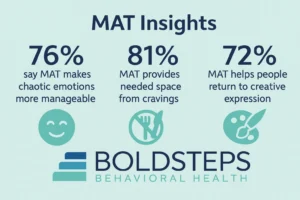
MAT helps soften that internal war—not to erase you, but to clear the static so your actual voice can come through again.
MAT Doesn’t Erase Your Spark—It Grounds It
We’ve worked with musicians who feared they’d never write sober.
Painters who thought their creativity came from suffering.
Comedians who didn’t know how to be funny without a buzz.
But something beautiful happens when the right support is in place.
They start creating again—not because they’re forced to, but because they finally feel safe enough to explore what’s inside them without getting swallowed by it.
One client told us, “I didn’t feel less like myself. I felt like I could finally hold myself still long enough to see what was really there.”
Medication assisted treatment isn’t about “fixing” you. It’s about stabilizing the stage so you can perform, create, love, cry, and exist—without constantly being at risk of falling off the edge.
You Can Still Be Intense, Emotional, Bold—Just Not Broken
Here’s the thing many people in recovery wrestle with:
“Was the broken version of me the most honest one?”
The one who stayed up writing until 4AM? The one who spoke without filter? The one who felt everything and nothing at the same time?
It’s okay to miss that version of you. Even the chaotic one. Especially during the holidays, when there’s pressure to smile, reflect, show up, be better.
MAT doesn’t rob you of that intensity. It helps you hold it without being crushed by it.
You don’t lose your fire. You just stop burning yourself down with it.
You’re Still You—Even If Your Rituals Are Changing
Maybe you used to drink while you wrapped gifts. Smoke before family dinner. Use to get through the silence. Those rituals carried meaning—even if they also carried harm.
This year might be your first trying it differently. Or just thinking about trying.
That’s where MAT can help.
It gives you a buffer—not to block emotion, but to give you time. To slow down the panic spiral. To help you stay in the room. To choose you in moments when your brain still screams for escape.
And when you’re not fighting cravings all day? That’s when real rituals can form. Ones you actually remember.
Bold Steps Offers MAT That Respects Your Identity
If you’re looking for medication assisted treatment in Harrisburg or nearby, you don’t have to settle for cold, clinical, one-size-fits-all care. At Bold Steps, we know that people in recovery are not broken machines. You’re layered, brilliant, and deeply human.
Whether you live in Dauphin County, Lancaster County, or York County, PA, our MAT services are tailored with care, not judgment.
We meet you where you are. Scared. Creative. Uncertain. Curious. Still healing.
And we walk from there.
FAQ: MAT & Identity in Recovery
Will MAT make me feel numb or flat?
Most people report the opposite. When MAT is properly prescribed, it reduces emotional chaos—not expression. It helps you feel more present, not less.
Can I still feel things deeply on MAT?
Yes. MAT doesn’t dull your emotions—it helps you regulate them. You’ll still feel sadness, joy, creativity—but you’ll have more space to handle them.
Is MAT a forever thing?
Not necessarily. Some people use MAT short-term during high-risk phases. Others stay on it longer. The timeline is personal and guided by your goals, not pressure.
What if I’m afraid of becoming dependent on another substance?
That’s a valid fear. But MAT medications are used under medical supervision, with the goal of reducing harm and increasing stability. It’s a treatment tool—not a trap.
Do I need to already be sober to start MAT?
Not always. Some forms of MAT can be started during early withdrawal. We’ll help you assess where you are and what your body needs to begin safely.
Is MAT only for opioid use?
No. While MAT is often used in opioid recovery, there are medication supports for alcohol, cravings, and mood stabilization as well. Our team will walk you through all options.
Ready to Come Back to Yourself?
Call 717-896-1880 to learn more about our medication assisted treatment services in Harrisburg, PA.
You don’t have to vanish this holiday season.
You don’t have to perform your recovery or fake your peace.
You can be real—and still heal.
We’re here to help you do both.