

I didn’t think I’d need help again.
Ninety days sober, I was doing everything right. Meetings. Gratitude lists. Journaling. I said the affirmations. I texted my sponsor. I even smiled when people said, “You look great.”
And I meant it—until I didn’t.
Because under all that good recovery behavior, the same fog I thought I left behind came creeping back in. I couldn’t shake the sadness. I couldn’t name the pressure in my chest. I couldn’t sit still without feeling like I might unravel.
But I kept going. Because I thought I had to.
And then I relapsed.
Not dramatically. Not in flames. Quietly. Shamefully. Predictably.
I thought I could outrun my depression.
Turns out, you can’t outrun what lives in you.
I Thought Sobriety Would Fix My Brain
When I first got clean, I expected hard days—but I also expected things to get better.
And they did, at first.
The fog lifted. My skin looked clearer. My texts made more sense. I reconnected with people I’d pushed away. For the first time in years, I didn’t feel like I was dying inside.
But underneath the surface… the old feelings were still there.
- The mood swings that made no sense.
- The hollow feeling that showed up after every high.
- The intrusive thoughts I thought sobriety would silence.
No one tells you this part: sometimes sobriety exposes pain you used to numb. Sometimes you don’t relapse because you don’t care—you relapse because the pain is still too much.
When I Slipped, I Almost Didn’t Tell Anyone
The shame was instant.
I didn’t spiral into chaos. I didn’t disappear for days. I just drank. One night. And then another. And then I told myself it was “just stress.” Just a bad week.
But the hardest part wasn’t the drink—it was the silence after.
I didn’t want to raise my hand and say “I relapsed.” I didn’t want the looks. The disappointed nods. The feeling that I’d failed a test I thought I’d already passed.
I almost kept pretending.
But someone I trusted said, “This doesn’t mean you’re broken. It means something still hurts.”
That’s when I found out about dual diagnosis treatment.
What Dual Diagnosis Treatment Actually Is
Let me say this clearly: this isn’t just another program.
Dual diagnosis treatment is for people like me—people whose addiction didn’t happen in a vacuum. People with:
- Depression that lingers, even in sobriety
- Anxiety that doesn’t shut off
- Trauma that echoes in silence
- Mental health struggles that no amount of willpower can fix
I thought I just had to “try harder.” What I actually needed was to understand myself better—to heal both the addiction and the pain underneath.
Dual diagnosis treatment didn’t just ask, “Why did you relapse?”
It asked, “What are you still carrying?”
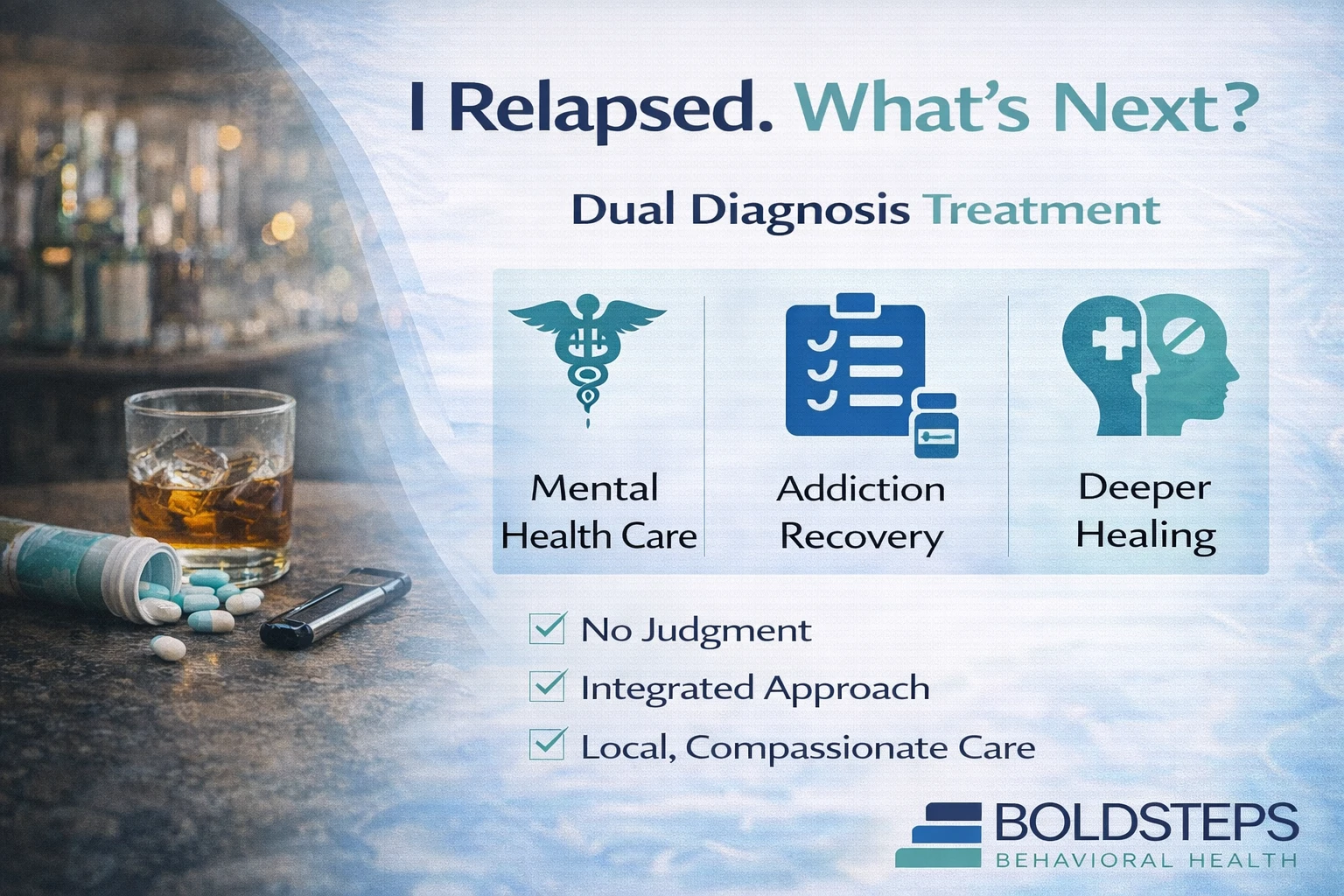
At Bold Steps, I Didn’t Start Over—I Started Deeper
I walked into Bold Steps with my head down. I felt like a fraud—an alumni who didn’t “stick the landing.”
But they didn’t treat me like a failure.
They treated me like someone who needed more.
More clarity. More support. More honest space to say, “I’m still struggling.”
And the care was different:
- My therapist wasn’t just checking for cravings—she was tracking my depressive patterns.
- My group didn’t just talk about triggers—they talked about trauma and shame and grief.
- I learned that relapse wasn’t my moral weakness—it was my mental health trying to self-soothe in the only way it remembered.
Dual diagnosis care gave me tools I didn’t know I needed.
Recovery Without Mental Health Support Isn’t Enough
When we talk about recovery, we often center around abstinence. “Day counts.” “Chips.” “Milestones.”
But I needed more than sobriety. I needed to understand why my brain felt the way it did.
And dual diagnosis treatment gave me that:
- I learned to spot depressive spirals before they dragged me down.
- I stopped gaslighting myself with “I’m fine.”
- I started to accept that it’s okay to need help even after you “graduate.”
My recovery didn’t fall apart because I didn’t care. It cracked because I wasn’t caring for all of me.
You’re Not Back at Day One
If you’ve slipped, listen to me: you don’t need to go back to the beginning.
You’re not starting over. You’re continuing—with more insight, more support, and more self-compassion than you had before.
Dual diagnosis treatment isn’t about stripping your progress—it’s about deepening it. Honoring it. Building on it with truth, not just effort.
And if you’re in or around Dauphin County, Lancaster County, or York County, you can access this kind of care right here, locally. Bold Steps sees beyond the slip. They see you.
What Dual Diagnosis Treatment Looked Like for Me
At Bold Steps, my care plan included:
- Individual therapy that addressed both my substance use and depression
- Group therapy with others who understood the double-layered struggle
- Skills sessions that taught real emotional regulation—not just “stay busy”
- Optional medication support for the first time in my recovery (scary, but helpful)
- A case manager who helped me set boundaries at work and with family
No judgment. No lectures. Just steady, real support that helped me feel human again.
What I Learned (That I Wish I’d Known Sooner)
Here’s what stuck with me:
- You can be sober and still be sick.
- You can relapse and still be worthy of care.
- You can start again—not because you failed, but because you’re still healing.
Dual diagnosis treatment didn’t give me a fresh start. It gave me an honest one.
And I’m still sober today—not because I got stronger, but because I finally got the right kind of help.
FAQs: If You’ve Slipped or Are Struggling Right Now
Is dual diagnosis only for people with severe mental illness?
No. It’s for anyone who deals with both substance use and any mental health challenge—whether that’s depression, anxiety, trauma, or anything else.
Do I have to be sober to start?
No. They meet you where you are—even if you’re mid-relapse. There’s no punishment. Just support.
Will they treat me differently if I’ve relapsed after being an alumni?
No. Bold Steps understands that relapse is part of many people’s path. You’ll be welcomed back with respect, not shame.
Will this reset my recovery progress?
No. It adds to it. You’re not starting over—you’re getting stronger.
Is it confidential?
Yes. 100%. Your job, family, or legal situation won’t be impacted unless you choose to share.
Can I still work or go to school while in treatment?
Yes. Programs like Bold Steps’ IOP are designed to work around your life, not replace it.
You’re Not the Only One
If you’ve slipped, you’re not weak. You’re not hopeless. You’re not back at square one.
You’re just human. Still healing. Still learning. Still here.
And dual diagnosis treatment might be the piece you didn’t know was missing. It doesn’t erase your past. It builds from it.
Call 717-896-1880 to learn more about our dual diagnosis treatment services in Harrisburg, PA.
Your recovery story isn’t over—it’s just getting real.