

You can feel it happening again.
Maybe it’s subtle at first—missed responsibilities, withdrawn behavior, the same patterns you thought they were moving past. And then it becomes undeniable.
They’re struggling again.
And this time, it feels heavier… because you’ve already been through this once.
If you’re a parent standing in that space—confused, worried, quietly asking what am I not seeing?—you’re not alone.
And more importantly, you’re not powerless here.
What Looks Like “Bad Choices” Is Often Something Much Deeper
From the outside, it can feel like your child is making decisions that don’t make sense.
Avoiding commitments.
Shutting down conversations.
Returning to the same habits that seem to hold them back.
It’s easy—understandably—to interpret this as resistance or even indifference.
But in many cases, especially around this age, what you’re witnessing isn’t about not caring.
It’s about not coping.
There’s often an internal experience they don’t fully understand, let alone know how to explain.
And when that internal pressure builds, their behavior starts to reflect it.
The Pattern That Keeps Repeating (Even When They Want It to Stop)
There’s a cycle we see often in young adults who appear stuck:
They feel overwhelmed—sometimes by things that seem small from the outside.
They don’t know how to process or express that overwhelm.
They begin to avoid the source of discomfort.
Avoidance gives them short-term relief.
That relief reinforces the behavior.
And the cycle repeats.
It’s not intentional. It’s not planned.
But it becomes familiar.
And familiarity—even when it’s unhealthy—can feel safer than the unknown.
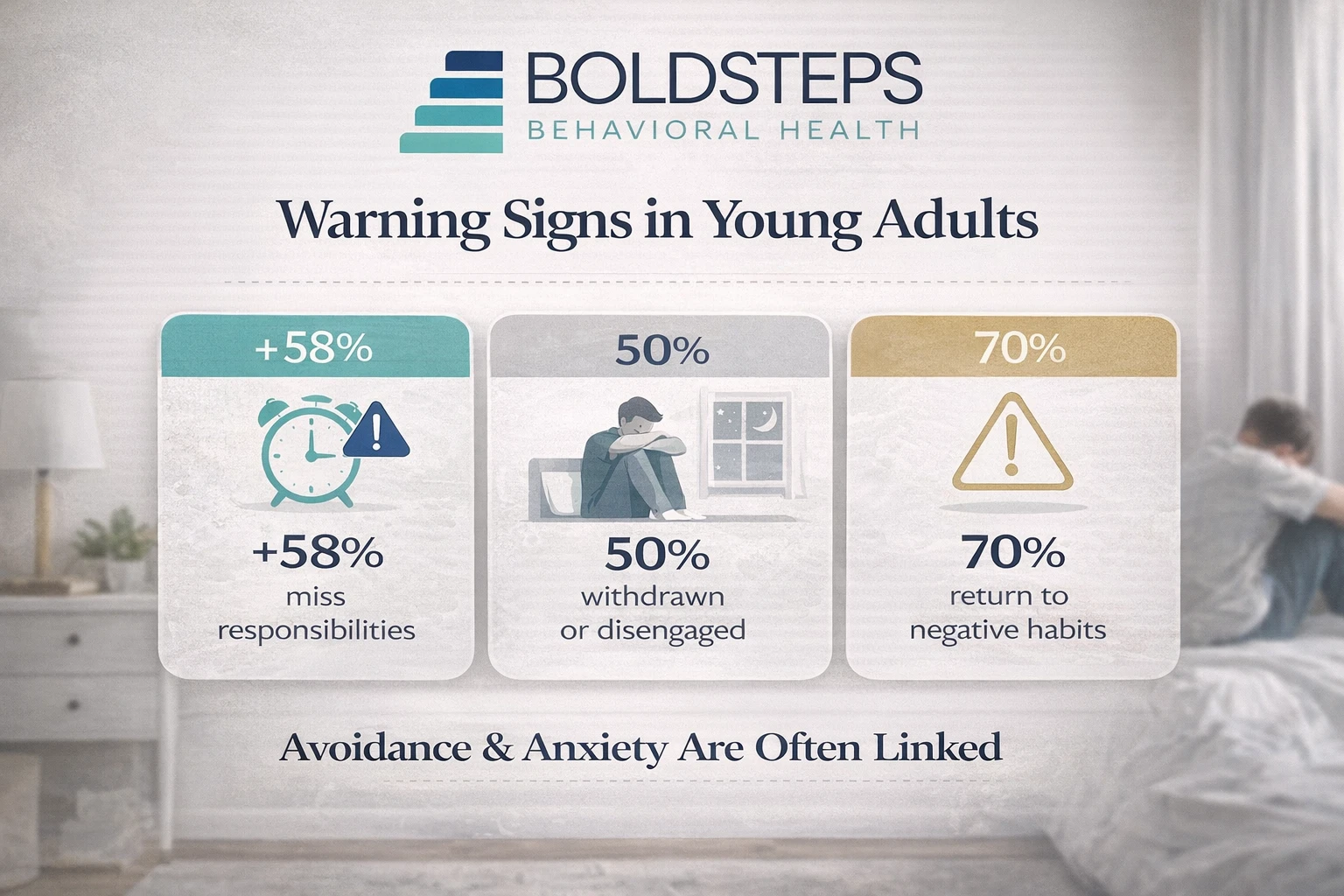
Why Avoidance Becomes So Powerful at This Age
Avoidance doesn’t come from laziness.
It comes from protection.
At this stage of life, expectations are rising—independence, decisions, identity, responsibility.
For some young adults, especially those quietly dealing with anxiety disorder patterns, these expectations don’t just feel challenging.
They feel overwhelming in a way that’s hard to articulate.
So instead of stepping forward, they step back.
They delay.
They disconnect.
They retreat into what feels manageable.
And in that moment, it works.
But over time, avoidance doesn’t just solve nothing—it quietly shrinks their world.
The Part Parents Feel But Can’t Always Explain
You’re not just watching behavior.
You’re feeling the distance.
The version of your child you remember—the one who felt more present, more engaged—feels just out of reach.
And that creates a specific kind of grief that’s hard to put into words.
Because they’re still here.
But not fully.
And that space in between can feel unbearable.
This Isn’t About Effort—It’s About Emotional Capacity
One of the hardest shifts for parents is realizing this:
Your child might already be trying.
It just doesn’t look like effort in the way you expect.
When someone’s internal system is overwhelmed, their capacity shrinks.
Tasks that seem simple—answering a message, showing up on time, making a decision—can feel disproportionately heavy.
So instead of pushing through, they shut down.
Not because they don’t care.
Because they can’t carry it in that moment.
What Happens When Pressure Increases
When a young adult is already overwhelmed, increased pressure—no matter how well-intentioned—can have the opposite effect.
They may:
- Withdraw further
- Become defensive
- Avoid communication
- Double down on coping behaviors
This isn’t defiance.
It’s a nervous system trying to protect itself from overload.
And while boundaries still matter, the way they’re delivered matters just as much.
The Shift That Helps More Than You’d Expect
There’s a subtle shift that can change the dynamic over time.
Moving from:
- “Why are you doing this?”
to - “Help me understand what this feels like for you.”
It doesn’t fix everything overnight.
But it lowers the emotional temperature.
It creates space for honesty.
And sometimes, that’s the first step toward change.
What Support Looks Like at This Stage
At this point, support often needs to go beyond motivation or discipline.
It needs to meet your child where they are—not where you wish they were.
That might look like:
- Conversations that focus on understanding, not correcting
- Structure that feels supportive, not suffocating
- Guidance that helps them build capacity, not just expectations
If you’re trying to understand what might be happening beneath the surface, exploring anxiety-related challenges can provide insight into patterns that don’t always show up clearly from the outside.
And if you’re looking for meaningful, grounded support in Pennsylvania, there are care options designed specifically for young adults navigating this exact stage—where things aren’t falling apart, but they’re not fully okay either.
For families near York County, Pennsylvania, this pattern shows up more often than people realize—and many parents silently carry the same questions you’re asking right now.
You Haven’t Lost Your Child
This might be the most important part.
Because it can feel like you’re watching them disappear into something you can’t reach.
But they’re still there.
Underneath the avoidance.
Underneath the shutdown.
Underneath the patterns that don’t make sense from the outside.
They’re still trying to navigate something they don’t fully understand.
And your presence—steady, even when it’s imperfect—still matters more than you think.
What Hope Actually Looks Like Right Now
Hope at this stage isn’t dramatic.
It’s quiet.
It shows up in:
- A slightly more open conversation
- A moment where they don’t shut down completely
- A small willingness to consider something different
Those moments can feel small.
But they’re not.
They’re signals.
And signals mean something is still moving underneath the surface.
The Part No One Tells Parents
You don’t have to get this perfect.
You don’t have to say the exact right thing every time.
What matters most is consistency.
Staying present.
Staying open.
Staying willing to understand—even when it’s frustrating, even when it’s unclear.
Because this isn’t about one conversation.
It’s about the environment you create over time.
FAQs
Why does my child keep repeating the same patterns?
Because those patterns provide temporary relief from something deeper. Even if they’re harmful long-term, they reduce immediate discomfort, which reinforces the behavior.
Is this just a phase or something more serious?
It can be a transitional phase—but repeated avoidance and emotional distress often signal underlying challenges that may need support.
How can I help without making things worse?
Focus on connection first. Understanding your child’s internal experience can reduce resistance and open the door to change.
Should I push them harder to take responsibility?
Structure is important—but pushing too hard without addressing what’s underneath can increase avoidance. Balance matters.
What if they won’t talk to me?
That’s common. Sometimes creating a less pressured environment over time helps rebuild communication. Patience plays a bigger role than force here.
When should we consider outside help?
If the pattern is ongoing, impacting daily functioning, or creating tension at home, it may be time to explore additional support options.
You’re Not Alone in This
It may feel isolating.
Like other families have it figured out.
Like you’re the only one walking this tightrope between concern and hope.
But you’re not.
And the fact that you’re here—trying to understand instead of just react—says more about your support than anything else.
Call 717-896-1880 to learn more about our mental health, Anxiety Disorder Treatment In Pennsylvania.