

Medically reviewed by Lara Slimmer, Clinical Director
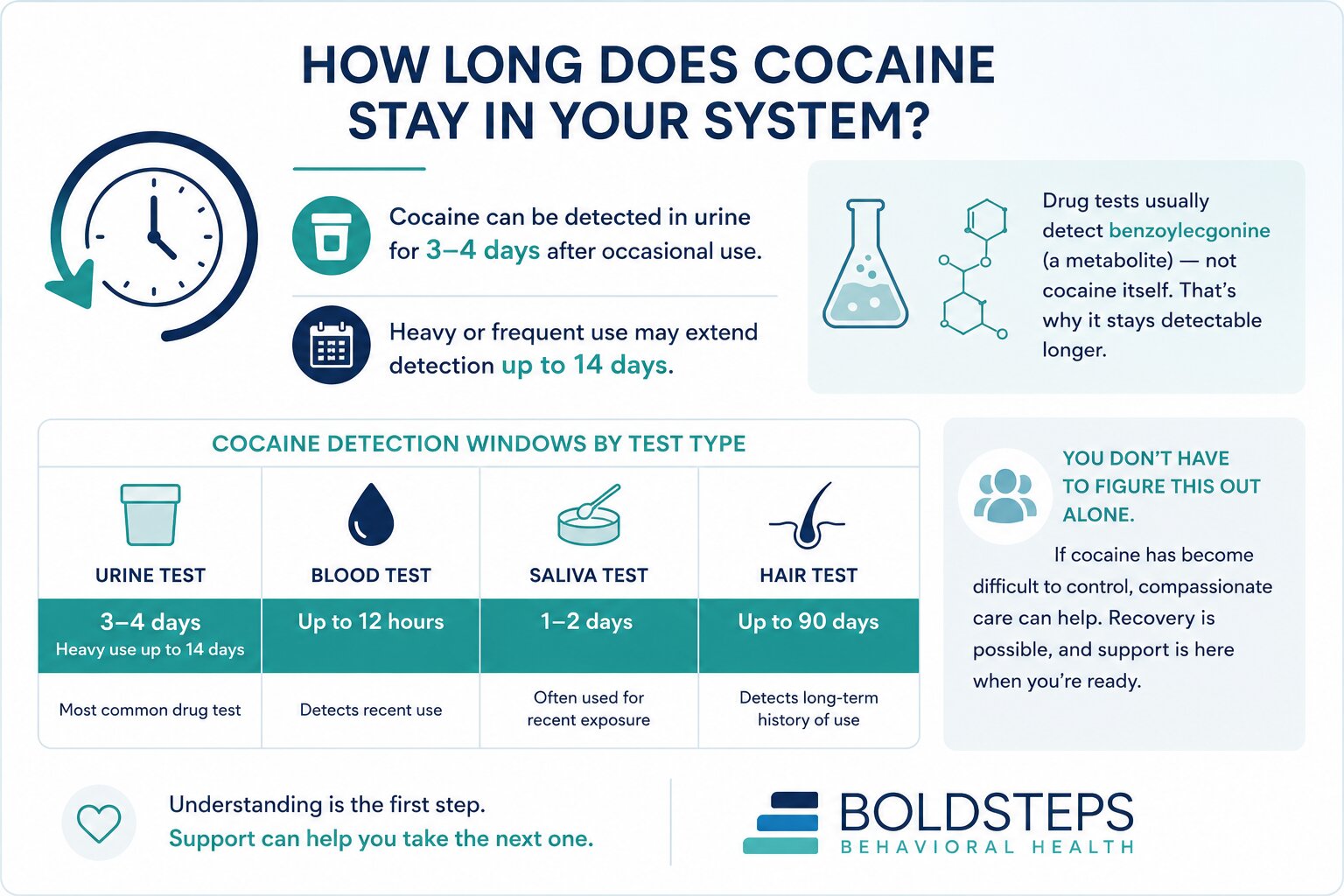
If you’re wondering how long does cocaine stay in your system, the short answer is that cocaine itself leaves the body relatively quickly, but its breakdown products remain detectable much longer. In general, cocaine can be detected in urine for 3–4 days after occasional use, though heavy or frequent use may extend detection to up to 14 days. Detection windows also vary depending on whether the test uses urine, blood, saliva, or hair.
If you’re looking beyond detection times and want to understand your options, learning about cocaine addiction treatment can help you understand what professional care may look like if cocaine has become difficult to stop.
The important thing to remember is that drug tests usually detect benzoylecgonine, cocaine’s primary metabolite—not cocaine itself. That’s why someone may no longer feel the effects of cocaine while still testing positive days later.
How Long Does Cocaine Stay in Your System?
The exact cocaine detection time depends on the type of drug test, how often cocaine is used, and individual factors such as metabolism and overall health.
Drug Test |
Detection Window |
Notes |
|---|---|---|
| Urine | 3–4 days after occasional use; up to 14 days with heavy use | Most common drug test |
| Blood | Up to 12 hours | Detects recent use |
| Saliva | 1–2 days | Often used for recent exposure |
| Hair | Up to 90 days | Detects long-term history of use |
These detection windows are averages rather than guarantees. Individual results vary.
Cocaine Detection Windows by Test Type
Urine Test
Urine testing is the most common method used for workplace drug screening, treatment programs, and many medical settings.
If you’re asking how long does cocaine stay in urine, the answer depends largely on how often it has been used.
For occasional use:
- Usually about 3–4 days
For repeated or heavy use:
- Detection may extend to approximately 10–14 days because metabolites accumulate before being eliminated.
Urine testing detects benzoylecgonine, which remains in the body much longer than cocaine itself.
Blood Test
Blood testing has one of the shortest detection windows.
Cocaine is generally detectable in blood for:
- Up to 12 hours
Because cocaine leaves the bloodstream quickly, blood tests are most useful when determining very recent exposure, such as during emergency medical evaluation.
Saliva Test
Saliva testing generally detects cocaine for:
- About 1–2 days
Although less common than urine testing, saliva tests are sometimes used because they can identify relatively recent drug use.
Hair Follicle Test
Hair testing has the longest detection period.
Small amounts of cocaine metabolites become incorporated into growing hair and may remain detectable for:
- Up to 90 days
Hair tests are designed to identify patterns of previous use rather than determine whether someone is currently impaired.
Cocaine Half-Life: How the Body Clears It
Understanding cocaine half-life helps explain why cocaine disappears quickly while drug tests stay positive much longer.
A drug’s half-life is the amount of time it takes for half of the drug to be eliminated from the bloodstream.
Cocaine has a relatively short half-life of about one hour.
That means the active drug itself is removed fairly rapidly.
However, the liver quickly breaks cocaine down into several metabolites, the most important being benzoylecgonine.
Unlike cocaine, benzoylecgonine remains in the body for several days and is the substance most drug tests are designed to detect.
In other words:
- Cocaine produces its effects relatively quickly.
- The body metabolizes it soon afterward.
- Benzoylecgonine continues circulating long after the drug’s effects have worn off.
That’s why someone may feel completely normal while still having a positive drug test.
What Affects How Long Cocaine Stays in Your System?
No two people eliminate cocaine at exactly the same rate.
Several factors influence detection times.
Frequency of Use
Repeated cocaine use generally produces longer detection windows than occasional use because metabolites accumulate before being fully eliminated.
Metabolism
People naturally metabolize drugs at different speeds.
Age, genetics, physical health, and other medications can all influence how quickly cocaine is processed.
Body Composition
Although cocaine does not accumulate in fat tissue to the same extent as some other drugs, overall body composition can still influence metabolism and elimination.
Liver Function
Because the liver breaks cocaine down into metabolites, reduced liver function may slow clearance.
Hydration
Many people believe drinking large amounts of water will quickly eliminate cocaine.
Hydration supports normal kidney function, but it does not meaningfully speed the body’s metabolism of cocaine or benzoylecgonine.
Purity and Other Substances
Illicit cocaine frequently contains other substances that may affect metabolism, toxicity, or overall health.
The purity of the cocaine itself can also vary significantly, making exact detection times difficult to predict.
Can You Speed Up Clearing Cocaine?
This is one of the most common questions people ask before a drug test.
The honest answer is:
There is no scientifically proven way to rapidly eliminate cocaine from your body.
Many products claim to “flush” drugs from your system, including:
- Detox drinks
- Cleanses
- Supplements
- Special diets
These products have not been shown to reliably remove cocaine metabolites or guarantee a negative drug test.
Similarly, common internet advice—such as drinking excessive amounts of water, exercising intensely, or taking certain vitamins—does not significantly change how quickly your liver metabolizes cocaine.
Your body clears cocaine according to its own biological processes.
Time remains the primary factor.
When Detection Questions Signal a Bigger Picture
Sometimes the question isn’t really about the drug test.
Sometimes it’s about wondering whether cocaine has started taking up more space in your life than you expected.
Many people continue working, caring for their families, and meeting responsibilities while quietly worrying about how often they’re using cocaine.
From the outside, everything may appear fine.
Inside, you may find yourself thinking about when you’ll use next, planning around recovery from a weekend binge, or repeatedly searching questions like “how long does coke stay in your system.”
Those moments don’t automatically mean you have an addiction.
But they may be worth paying attention to.
If cocaine has become difficult to control, professional support can help you understand your options without judgment or pressure. Treatment is designed to meet people where they are—not where they think they “should” be.
Frequently Asked Questions
How long does cocaine stay in urine?
For occasional use, cocaine metabolites are usually detectable in urine for about 3–4 days. Heavy or repeated use may extend detection to approximately 10–14 days.
Does cocaine show on a hair follicle test?
Yes. Hair follicle tests can detect cocaine use for up to 90 days because metabolites become incorporated into growing hair over time.
What speeds up cocaine clearance?
There is no proven method to significantly speed cocaine clearance. Drinking extra water, detox products, or supplements cannot reliably eliminate cocaine metabolites more quickly. The body needs time to naturally metabolize and eliminate the drug.
Compassionate Support for Cocaine Recovery
Whether you’re researching detection windows because of a drug test or because you’re beginning to question your relationship with cocaine, you don’t have to figure it out alone. Compassionate, evidence-based care can help you take the next step when you’re ready.
Call (717) 896-1880 or explore cocaine addiction treatment at Bold Steps. Easily accessible from anywhere in Harrisburg, Lancaster County, York County and beyond.