

Something feels different. It’s not just a rough week or normal teenage moodiness. Your child—once social, curious, or at least communicative—now seems unreachable. You’ve tried talking. Maybe you’ve even tried therapy. But you’re still left watching from the sidelines as things get worse. And you’re not sure what else to do.
For many parents, this is the moment when a partial hospitalization program (PHP) becomes not just a possibility—but a real lifeline. PHP offers structured mental health treatment for young people who need more than outpatient therapy but aren’t in immediate crisis requiring overnight care.
If you’re in Harrisburg or surrounding areas and wondering whether PHP might be right for your teen or young adult, here are six signs to look for—plus guidance on what this level of care can actually offer.
1. Daily functioning is breaking down—even outside of school
When someone is struggling, it often shows up in the basics. If your teen isn’t getting out of bed, is barely eating, or has stopped caring about hygiene, it’s more than just burnout. It’s a sign their emotional bandwidth is maxed out.
Maybe they’ve dropped out of activities, failed assignments, or given up on goals they used to care about. These losses hurt—but they also help signal when professional support is urgently needed.
What PHP can do: Provide a structured daily schedule, therapeutic engagement, and real-world accountability to help restore function.
2. Emotions are running high—and feel totally unmanageable
Every young person has emotional ups and downs. But persistent, intense feelings—especially those that seem disproportionate or unexplainable—can be overwhelming. You might see:
- Explosive anger
- Sudden tearfulness or shutdowns
- Panic attacks
- Periods of emotional numbness or disconnection
These aren’t just “bad moods.” They can be signs of underlying mood disorders, trauma responses, or anxiety disorders.
What PHP can do: Offer daily emotional regulation work, skills groups, and trauma-informed care to help your child understand and process their emotions.
3. Therapy hasn’t been enough—or they’re refusing to go
You may have tried therapy already—and seen minimal progress. That doesn’t mean therapy “didn’t work.” It often means the level of care wasn’t high enough for their needs.
In some cases, your teen may have shut down altogether and stopped attending therapy. Or maybe they just nod through sessions and leave unchanged.
What PHP can do: Build therapeutic momentum through more frequent contact—usually 5 days a week, several hours a day—creating space for more trust, depth, and change.
4. Risky behaviors are starting—or escalating
When young people are in pain, it often shows up in ways that scare us:
- Self-harm
- Substance use
- Unsafe sex
- Impulsive decisions with real-world consequences
These behaviors aren’t “rebellion”—they’re signals. And they rarely improve without intervention.
What PHP can do: Create a safe space to explore what’s underneath the behavior while providing tools to reduce harm, build safety plans, and make different choices.
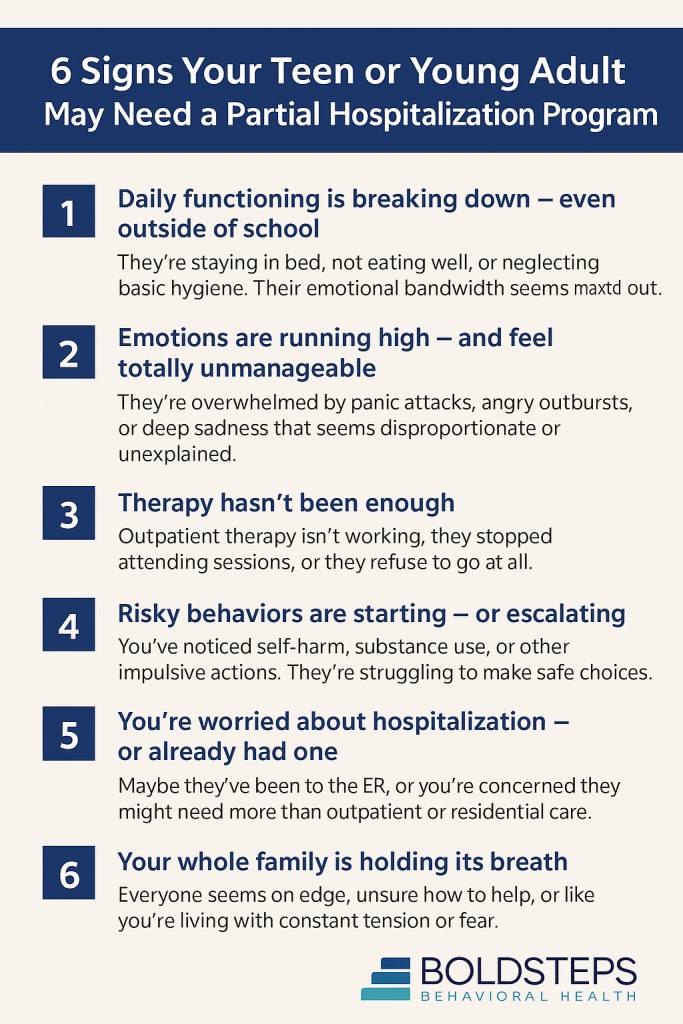
5. You’re worried about hospitalization—or already had one
Maybe you’ve already gone through a psychiatric ER visit. Maybe you’ve been up all night watching them, scared they might hurt themselves. Or maybe a provider told you they’re “not sick enough” for inpatient—but you know things are getting worse.
PHP is designed for this middle ground. It can function as a step-down after a hospital stay or a step-up to prevent one.
What PHP can do: Stabilize symptoms in a safe, supportive environment without the stress of full inpatient admission.
6. Your whole family is holding its breath
When one child is in crisis, the ripple effect touches everyone. Siblings withdraw. Parents start walking on eggshells. Marriages strain under the stress. It’s not that you don’t want to help—it’s that you don’t know how anymore.
You may feel like you’ve tried everything. And in many ways, you have.
What PHP can do: Offer daily support that’s no longer all on you. Many programs also offer family sessions or parent education, helping you reclaim peace in your home.
Frequently Asked Questions About PHP
What is a partial hospitalization program, exactly?
A PHP is a structured mental health treatment program that runs during the day—usually five days a week, several hours per day. It includes individual therapy, group therapy, psychiatric care, and often family support. Participants return home in the evenings.
Is PHP only for teens with severe mental illness?
Not necessarily. PHP is for individuals who are struggling significantly but don’t require 24/7 care. It’s often used for those dealing with depression, anxiety, trauma, mood instability, or a recent mental health crisis.
How is PHP different from inpatient treatment?
Inpatient treatment involves overnight stays and 24-hour monitoring. PHP offers intensive care during the day but allows participants to sleep at home. It’s often less disruptive to school, work, and family life.
Will my child fall behind in school?
Many PHPs coordinate with schools or include academic support. While there may be short-term disruption, PHP can actually help students return to learning more successfully once their mental health stabilizes.
Is PHP available in Harrisburg, PA?
Yes. At Bold Steps Behavioral Health, we offer a comprehensive partial hospitalization program in Harrisburg designed specifically for teens and young adults.
Why Harrisburg Families Choose Bold Steps
At Bold Steps Behavioral Health, we know that finding the right help at the right time can feel overwhelming. That’s why our PHP is designed to be both clinically effective and emotionally safe—for your child, and for you.
We serve families across Harrisburg and the surrounding region with:
- A trauma-informed, evidence-based approach
- Experienced clinicians who specialize in young adult mental health
- A safe, welcoming environment that respects each person’s pace and voice
📞 Talk to Someone Who Understands
You don’t have to navigate this alone. If your child is struggling—and you’re not sure what comes next—we’re here to talk it through.
📞 Call Bold Steps Behavioral Health at (717) 896-1880 Or explore our partial hospitalization program
Let’s find the next right step together.