

Medically reviewed by Lara Slimmer, Clinical Director
You may know that something about your experiences doesn’t feel fully explained by the word “PTSD.”
Perhaps you’ve lived through years of emotional abuse, childhood neglect, domestic violence, or repeated trauma, yet you’ve been told your symptoms don’t quite fit—or that they’re something else entirely. If you’ve been researching complex PTSD vs PTSD, you’re asking a question many people struggle with, including some healthcare professionals.
If you’re looking for support, learning about trauma treatment can help you understand the evidence-based approaches available for trauma-related conditions.
The confusion is understandable. PTSD and complex PTSD (CPTSD) share many symptoms, and the conditions can look remarkably similar. At the same time, there are meaningful differences in how they develop, how they affect daily life, and how treatment is often approached.
Understanding those differences isn’t about putting a more serious label on your experiences. It’s about making sure your symptoms are understood accurately so your care can be tailored to your needs.
Complex PTSD vs PTSD: At a Glance
Feature |
PTSD |
Complex PTSD (CPTSD) |
|---|---|---|
| Typical Cause | Single traumatic event or short-term trauma | Repeated, prolonged, or ongoing trauma |
| Examples | Car accident, assault, natural disaster, military combat | Childhood abuse, domestic violence, captivity, chronic neglect |
| Core Symptoms | Intrusion, avoidance, negative mood/cognition changes, hyperarousal | Includes all PTSD symptoms plus additional disturbances in self-organization |
| Identity Impact | May affect self-esteem but not typically identity | Persistent shame, guilt, or damaged sense of self |
| Relationship Patterns | Relationships may be affected by trauma symptoms | Ongoing difficulty trusting others and maintaining relationships |
| Diagnosis Pathway | Recognized in the DSM-5 and ICD-11 | Recognized in ICD-11 but not as a separate diagnosis in the DSM-5 |
What Is PTSD?
Post-traumatic stress disorder (PTSD) is a mental health condition that can develop after experiencing or witnessing a traumatic event. It is formally recognized in the Diagnostic and Statistical Manual of Mental Disorders (DSM-5).
PTSD symptoms generally fall into four broad categories:
- Intrusive memories or flashbacks
- Avoidance of trauma reminders
- Negative changes in mood and thinking
- Increased arousal, such as hypervigilance or irritability
Although PTSD is often associated with a single traumatic event, it can also develop after multiple traumatic experiences that occur over a relatively limited period.
If you’d like to learn more about trauma-related conditions and available therapies, visit our trauma treatment page.
What Is Complex PTSD?
Complex PTSD (CPTSD) develops after prolonged or repeated trauma, particularly when the person has little opportunity to escape or feel safe.
Common examples include:
- Childhood abuse or neglect
- Long-term domestic violence
- Human trafficking
- Captivity
- Repeated interpersonal violence
- Chronic emotional abuse
Unlike PTSD, complex PTSD is recognized in the International Classification of Diseases (ICD-11) but is not currently listed as a separate diagnosis in the DSM-5 used in the United States.
CPTSD includes all of the core PTSD symptoms while adding three additional areas of difficulty known as disturbances in self-organization:
- Persistent emotional dysregulation
- Negative self-concept
- Ongoing relationship difficulties
These additional symptoms often shape how someone sees themselves and relates to the world long after the traumatic experiences have ended.
Key Differences Between CPTSD and PTSD
Understanding the difference between complex PTSD and PTSD starts with recognizing that the conditions overlap significantly while affecting people’s lives in different ways.
Trauma History
One of the clearest distinctions involves the nature of the trauma itself.
PTSD often develops after:
- A serious accident
- Sexual assault
- Combat
- Natural disasters
- Medical emergencies
Complex PTSD is more commonly associated with trauma that occurs repeatedly over months or years, especially during childhood or within relationships where the individual cannot easily leave.
The repeated nature of the trauma shapes not only stress responses but also identity, relationships, and emotional regulation.
Sense of Self
Many people with PTSD continue to see themselves much the same way they did before the trauma, even if they struggle with distressing symptoms.
With CPTSD, the trauma often becomes intertwined with identity.
Someone may experience:
- Deep shame
- Persistent self-blame
- Feelings of worthlessness
- Beliefs that they are permanently damaged
- Difficulty believing they deserve safety or care
These patterns often reflect years of surviving environments where harmful messages became deeply internalized.
Relationships
Both PTSD and CPTSD can affect relationships.
However, relational difficulties are often much more central to complex PTSD.
People with CPTSD may struggle with:
- Trusting others
- Maintaining healthy boundaries
- Fear of abandonment
- Difficulty feeling emotionally safe
- Alternating between withdrawing from others and becoming overly attached
These challenges often reflect adaptations developed in unsafe or unpredictable relationships rather than personal shortcomings.
Emotional Regulation
Emotional dysregulation can occur in both conditions.
In CPTSD, however, it is typically more persistent.
Someone might experience:
- Intense emotional reactions
- Emotional numbness
- Rapid shifts between emotions
- Difficulty calming after distress
- Feeling overwhelmed by relatively small triggers
These reactions often make everyday situations feel exhausting, even when the original trauma occurred years earlier.
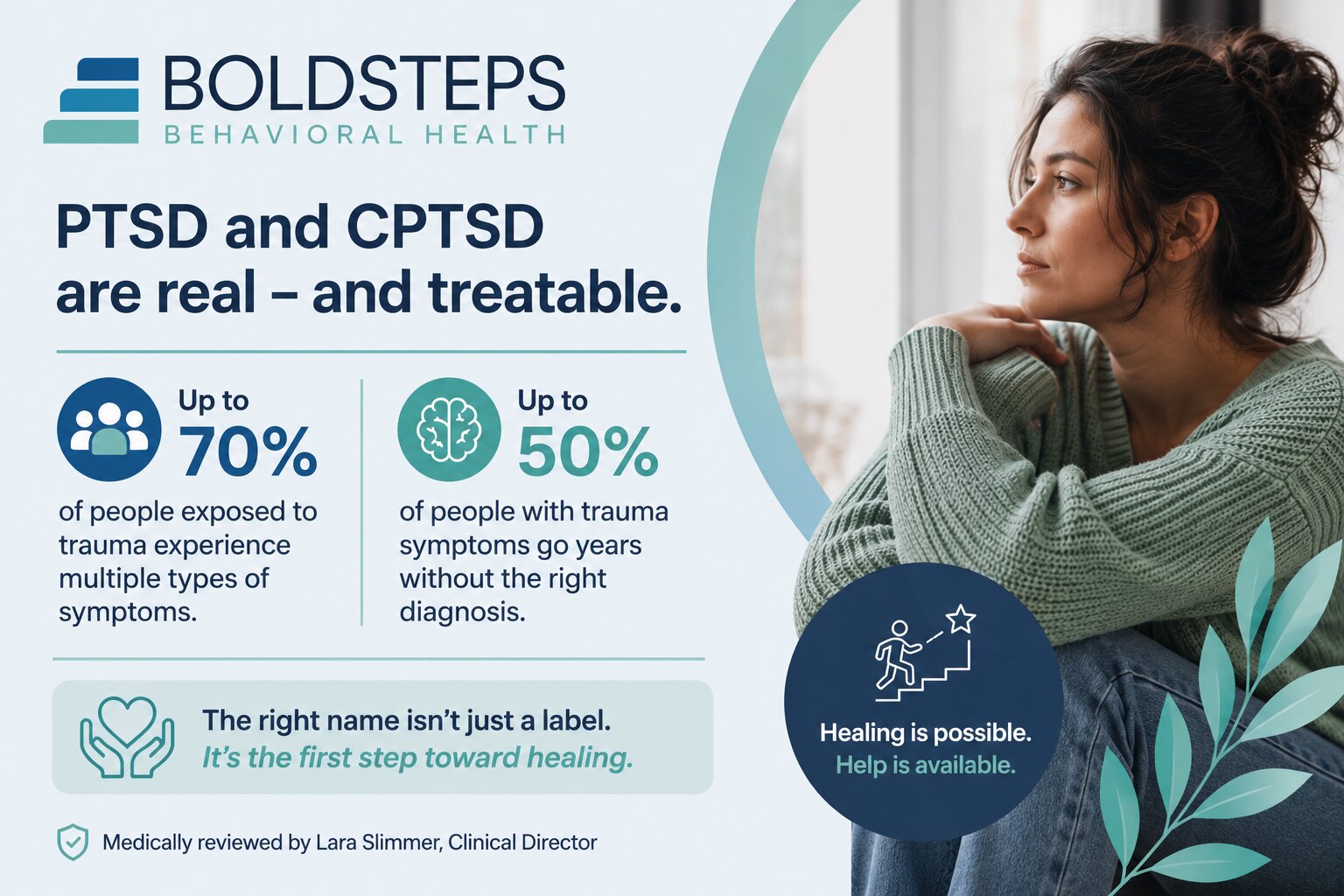
Why CPTSD Is Often Missed or Misdiagnosed
One reason the CPTSD vs PTSD conversation matters is that complex PTSD isn’t always recognized immediately.
Some people spend years receiving different diagnoses before anyone identifies the role of prolonged trauma.
Overlapping Symptoms
Complex PTSD shares features with several mental health conditions, including anxiety disorders, depression, dissociative disorders, and borderline personality disorder (BPD).
Because of these overlaps, clinicians must carefully evaluate the person’s history, symptoms, and overall pattern of functioning rather than relying on one symptom alone.
Importantly, CPTSD and BPD are not the same condition.
While both can involve emotional dysregulation and relationship difficulties, they differ in important ways, including their diagnostic criteria, developmental patterns, and treatment considerations.
Some individuals meet criteria for one condition, some for the other, and some may meet criteria for both. A thorough assessment is essential rather than assuming one diagnosis based on overlapping symptoms.
DSM-5 and ICD-11 Differences
Another reason CPTSD misdiagnosis can occur is that diagnostic systems differ.
In many countries, clinicians use the ICD-11, which recognizes Complex PTSD as a separate diagnosis.
In the United States, many clinicians primarily use the DSM-5, which does not include CPTSD as its own diagnostic category.
That doesn’t mean clinicians ignore prolonged trauma.
Instead, they may diagnose PTSD while also identifying additional symptoms related to emotional regulation, relationships, or personality functioning.
This difference in diagnostic systems can sometimes make it seem like someone has received conflicting answers when, in reality, clinicians are working within different frameworks.
Advocating for the Right Assessment
If you feel your experiences haven’t been fully understood, it’s reasonable to ask questions.
You might ask your provider:
- How does my trauma history influence my symptoms?
- Do my symptoms suggest prolonged trauma?
- How will my treatment address emotional regulation and relationships?
- Would a trauma-focused assessment be helpful?
A good assessment should consider not only what symptoms you experience but also how your life experiences have shaped them.
How Treatment Differs
The encouraging news is that both PTSD and complex PTSD are treatable.
Many evidence-based therapies used for PTSD can also help people with CPTSD, although treatment may be paced differently.
For PTSD, commonly recommended therapies include:
- Cognitive Processing Therapy (CPT)
- Eye Movement Desensitization and Reprocessing (EMDR)
- Prolonged Exposure (PE)
For complex PTSD, these same therapies may still be appropriate, but treatment often follows a phase-based approach.
Rather than beginning immediately with trauma processing, therapy may first focus on:
- Building emotional regulation skills
- Developing coping strategies
- Increasing feelings of safety
- Strengthening relationships and boundaries
Once greater stability has been established, trauma processing can move forward at a pace that feels manageable.
This approach isn’t because CPTSD is “worse.”
It’s because prolonged trauma often affects multiple areas of life that benefit from a gradual, individualized treatment plan.
At Bold Steps, trauma treatment is tailored to each person’s history, symptoms, and goals. Therapy focuses on helping individuals process traumatic experiences while developing the skills needed to feel safer, more connected, and more confident in daily life.
Frequently Asked Questions
What is the difference between CPTSD and PTSD?
PTSD usually develops after a single traumatic event or a limited period of trauma and includes symptoms such as intrusive memories, avoidance, mood changes, and hyperarousal. Complex PTSD includes those symptoms but also involves persistent difficulties with emotional regulation, self-esteem, and relationships following prolonged or repeated trauma.
Is complex PTSD worse than PTSD?
Neither condition is inherently “worse.” Both can significantly affect daily functioning and quality of life. Complex PTSD typically involves additional challenges related to identity, emotions, and relationships, but each person’s experience is unique.
Can complex PTSD be misdiagnosed as BPD?
Yes, because the conditions share some overlapping symptoms, such as emotional dysregulation and relationship difficulties. However, CPTSD and borderline personality disorder are distinct diagnoses with different diagnostic criteria. A comprehensive trauma-informed assessment can help clarify the differences.
Getting the Right Name Can Be the First Step Toward Healing
If you’ve spent years wondering why your symptoms don’t seem to fit neatly into one diagnosis, you’re not alone. Many people living with prolonged trauma feel misunderstood before receiving a thorough, trauma-informed assessment.
Whether your symptoms are best explained by PTSD, complex PTSD, or another trauma-related condition, the goal isn’t simply finding the right label—it’s finding treatment that reflects your experiences and supports your recovery. Easily accessible from anywhere in Harrisburg, Lancaster County, York County and beyond.
Call (717) 896-1880 or learn about trauma treatment at Bold Steps.