

There’s a moment in long-term recovery that nobody really prepares you for.
You’ve put in the work. You’re showing up. You’re sober. By all accounts, you’ve made it. And still—something feels flat. Not broken. Not in crisis. Just…off.
You might go through the motions—meetings, routines, doing what’s worked before—but the spark that kept you engaged early on has dulled.
At Bold Steps Behavioral Health in Harrisburg, PA, we see this in alumni who are years into sobriety. And for many, the answer isn’t to start over. It’s to go deeper—with dual diagnosis treatment.
Emotional Recovery Doesn’t End With Sobriety
Sobriety stops the bleeding. But it doesn’t always heal the wound.
Long-term recovery often reveals emotional layers that early sobriety masked. Maybe you stayed busy to avoid the grief. Or leaned hard into structure to quiet the anxiety. Those strategies worked. But now, years in, they’re not enough.
You’re sober, but not satisfied. Safe, but not connected. Alive, but not fully living.
This doesn’t mean something’s wrong with your recovery. It means your recovery is evolving—and you’re ready for what comes next.
What Is Dual Diagnosis Treatment—and Why Might You Need It Now?
Dual diagnosis treatment is a clinical approach that treats both mental health conditions and substance use disorders together. For many people, these issues overlap.
In early sobriety, your focus was likely on stability. But once that’s in place, emotional needs rise to the surface—needs like:
- Persistent depression
- Ongoing anxiety
- Trauma responses that were once numbed
- Emotional disconnection or numbness
Dual diagnosis care looks at the whole picture, not just the sober part. And at Bold Steps, that means creating a plan that respects your recovery and your emotional reality.
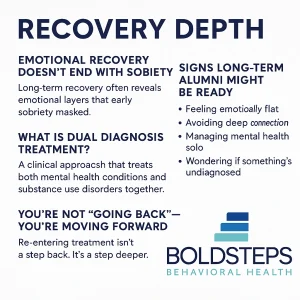
You’re Not “Going Back”—You’re Moving Forward
There’s a common fear among long-term alumni: “If I return to treatment, am I regressing?”
The answer? No.
Re-entering care through a dual diagnosis lens isn’t a step back. It’s a step deeper. It’s choosing to explore the things that stayed quiet in early recovery.
At Bold Steps, we’ve worked with many alumni who come back for:
- Grief support (especially if loss hit during sobriety)
- Trauma work they couldn’t do early on
- Emotional numbness that meds or meetings haven’t addressed
- A sense of spiritual or emotional “stuckness”
If you’re looking for dual diagnosis treatment in Harrisburg or Dauphin County, PA, our programs meet you where you are—with no judgment and full respect for the work you’ve already done.
Signs You Might Be Ready for This Next Layer of Work
You don’t need to be in relapse or crisis to benefit from dual diagnosis care. Here are some gentle indicators that deeper healing might be calling:
- You feel emotionally flat, even though you’re “doing the right things”
- You avoid deep connection because it feels unsafe or unfamiliar
- You’ve been managing your mental health solo, but it’s not enough anymore
- You’re curious if something’s been undiagnosed (like trauma or a mood disorder)
- You want to feel more than just okay—you want to feel alive
These aren’t signs of failure. They’re signs of readiness.
What Does Dual Diagnosis Treatment Look Like for Alumni?
At Bold Steps, dual diagnosis treatment for alumni isn’t one-size-fits-all. You’re not starting from scratch. You’re building on a foundation.
Here’s what it might include:
1. Personalized Mental Health Assessment
We revisit your history—not to question your progress, but to explore what’s next. This might mean:
- Updating your clinical diagnosis
- Exploring missed or masked symptoms
- Looking at your current medication and emotional symptoms together
2. Integrated Therapy
You’ll work with clinicians who specialize in treating substance use and mental health. This often includes:
- Individual therapy
- Group sessions that respect your recovery experience
- Emotional processing that goes beyond relapse prevention
3. Focused Emotional Work
We make space for what’s rising now—grief, disconnection, unprocessed trauma—not just what you dealt with early on.
4. Stability With Flexibility
You may attend sessions part-time (IOP) while still working or caring for your family. It’s care that integrates into your life—not takes it over.
If you’re looking for dual diagnosis treatment in Lancaster County, PA, we offer accessible outpatient options for alumni ready to re-engage.
“I came back because I wanted more. I didn’t want to coast through recovery. I wanted depth. Dual diagnosis treatment gave me that—it let me be whole, not just sober.”
— Alumni, 2023
This Isn’t Just About Diagnosis—It’s About Depth
Some alumni hesitate because they don’t think they have a “formal” mental health condition. That’s okay. Dual diagnosis care isn’t just about labels.
It’s about understanding the emotional terrain that’s been left unspoken. It’s about:
- Naming your needs without shame
- Creating space to be seen fully
- Trusting that your recovery can expand, not just maintain
You don’t need a new diagnosis to deserve deeper care. You just need the desire to feel more grounded, connected, and real.
FAQ: Dual Diagnosis Treatment for Alumni
Can I attend dual diagnosis treatment if I haven’t relapsed?
Absolutely. Many alumni seek support while still sober. The focus here is emotional health—not just relapse prevention.
What if I already have a therapist or psychiatrist?
That’s great. We can collaborate or supplement existing care, especially if you’re noticing gaps between your mental health and recovery support.
Is this the same kind of treatment I did before?
Not quite. Early recovery treatment is often about stabilization. This is about expansion—exploring identity, trauma, and long-term mental health needs.
Will this be outpatient or inpatient?
For most alumni, Intensive Outpatient (IOP) is a good fit. It offers structure without requiring a full-time stay. We’ll assess what’s best based on your current needs.
What if I feel ashamed to need help again?
That’s common. But returning to care isn’t a sign of failure. It’s a sign of maturity in recovery. You’re recognizing that sobriety alone isn’t the whole picture—and that takes courage.
It’s Time to Reclaim More Than Just Your Sobriety
You did the hard part. You survived. You built a life without substances. But you deserve more than just survival. You deserve depth. Joy. Connection.
And that’s what dual diagnosis treatment can offer. Not as a restart—but as a return. A return to your full self.
If you’re looking for dual diagnosis treatment in York County, PA or nearby, Bold Steps is here when you’re ready to step forward again.
Ready to feel more than just sober?
Call 717-896-1880 to learn more about dual diagnosis treatment services in Harrisburg, PA. Whether it’s your first step back—or just your next step forward—we’re here to walk it with you.