

You already know what’s not working.
The late-night drinking that used to “take the edge off” now leaves you hollow. The anxiety meds don’t touch the real fear. The weed helps you sleep—until it doesn’t. What started as stress relief has become something harder to explain. Harder to hide. Harder to stop.
You’ve tried managing it. You’ve tried telling yourself it’s just a rough patch. But if you’re here, something inside you knows: this isn’t just stress. It’s deeper than that. And trying to handle it alone isn’t helping anymore.
At Bold Steps Behavioral Health, we work with people who’ve been quietly trying to fix their own pain—until they realize they can’t. Our dual diagnosis treatment in Harrisburg, PA is designed for those who are finally ready to face both the mental health struggles and the substance use they’ve been using to cope.
You don’t need a crisis to start healing. You just need a door.
What Is Dual Diagnosis, and Why Does It Matter?
Dual diagnosis is when someone experiences both a mental health condition and a substance use disorder. It’s incredibly common—and often overlooked.
Here’s what it can look like:
- Drinking to take the edge off anxiety that never seems to fade
- Using pills to sleep, to slow down, or to care a little less
- Avoiding people, places, or emotions that feel too overwhelming
- Feeling like your moods shift too fast or stay low too long
- Knowing something’s off—but feeling too ashamed or unsure to ask
Dual diagnosis treatment matters because it stops the cycle at the source. If you only treat the substance use but ignore the underlying depression, anxiety, or trauma, the relief is temporary. It’s like turning off the fire alarm without putting out the fire.
Self-Medicating Doesn’t Make You a Failure
There’s no shame in how you got here.
People self-medicate because they’re trying to survive. They use what’s available, what brings relief, what quiets the noise—even if just for a little while. That might’ve worked once. But over time, the things that helped you cope can start to hurt you.
Here’s what self-medicating can’t do:
- It can’t teach you how to sit with hard feelings
- It can’t build skills to regulate your nervous system
- It can’t help you name your pain, let alone work through it
- It can’t give you lasting connection or clarity
Healing isn’t about shame. It’s about learning something better than escape.
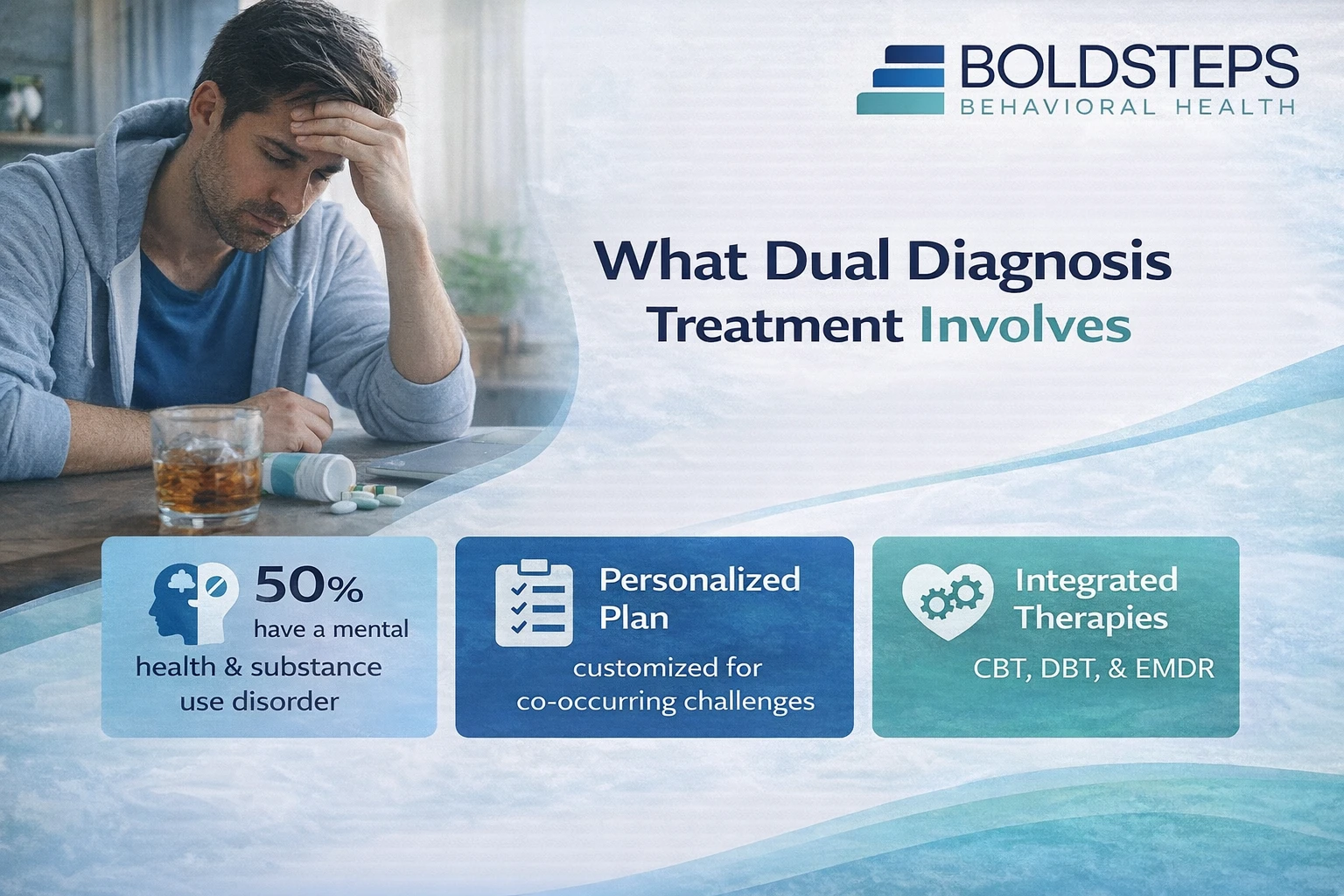
How Dual Diagnosis Treatment Helps You Heal for Real
At Bold Steps, we don’t treat you like a diagnosis—we treat you like a whole person who deserves to understand what’s going on underneath the substance use. Our dual diagnosis treatment model weaves together mental health and addiction recovery in a way that actually makes sense for your life.
1. Integrated, Not Fragmented
You won’t be bouncing between a therapist for your anxiety and a separate program for your drinking. Everything is coordinated, connected, and customized.
We treat:
- Depression, anxiety, PTSD, and mood disorders
- Trauma-related coping patterns
- Substance use that’s become unmanageable
You get a care team that looks at your whole story—not just your symptoms.
2. Evidence-Based, Emotionally Intelligent Care
Our clinicians use proven methods (like CBT, DBT, EMDR, and trauma-informed care), but we don’t just throw jargon at you. We walk with you—step by step, session by session—with the emotional intelligence to meet you where you actually are.
That means:
- No shame for where you’ve been
- No rushing you through “the process”
- No pretending healing is linear
We hold space for the truth and teach you how to stay present in your own life.
3. Real-World Tools for Real-Life Triggers
You won’t just “talk about it.” You’ll learn:
- How to regulate emotions without numbing
- How to recognize and interrupt thought spirals
- How to build routines that support—not sabotage—your healing
- How to stay grounded when everything in you wants to run
This is healing you can take home. Not a bubble. Not a performance. Real tools for your real life.
What It’s Like to Start Dual Diagnosis Treatment
We get that starting treatment can feel overwhelming. You might worry you’ll be judged. Or pushed too hard. Or not sick enough to “belong.”
But the truth? Most of our clients felt that way at first.
You don’t need to show up with all the answers. You don’t need to be “ready” in the way people think of it. You just need to be open to something different.
Here’s what the process looks like:
- You call or reach out—we listen.
- We schedule a consultation—no pressure, just understanding.
- We build a care plan—that fits you.
- You begin—at your pace, with support that grows as you do.
We offer both intensive outpatient programming (IOP) and other flexible options depending on your needs.
And yes, we work with people who are still using. Recovery isn’t a door you enter perfectly—it’s a path you walk, step by step.
You Deserve Support Where You Live
If you’re looking for dual diagnosis treatment in Harrisburg, Dauphin County, Lancaster County, or York County, we’re right here.
Bold Steps Behavioral Health provides accessible, stigma-free care that respects your pace and your pain. We’re not here to scare you. We’re here to support you—in your neighborhood, in your timing, in your truth.
Whether you’re new to the idea of treatment or you’ve tried before and didn’t feel seen, this might be the place where it finally clicks.
FAQs: What First-Time Clients Want to Know
What if I’ve never had a diagnosis?
That’s okay. Many people haven’t. We provide a thorough intake process to help you understand what’s happening and why.
Do I have to stop using before I start?
No. We’ll meet you where you are and help you create a plan that makes sense. Treatment isn’t about perfection—it’s about progress.
Will this affect my job or daily life?
Our programs are built to work with your life. Most clients attend programming in the mornings or evenings. We help you build structure, not disruption.
Is this only for people with severe addiction?
Not at all. Dual diagnosis treatment is for people struggling with the mix of mental health challenges and substance use—no matter how “bad” it looks from the outside.
How long does treatment last?
It varies. Some people stay for 6–8 weeks. Others need more time. We build treatment around your needs—not a stopwatch.
What if I’m scared?
Then you’re paying attention. Fear means this matters to you. And that’s often the best place to begin.
You’re Not Weak—You’re Awake
You’ve done the best you could with what you had. Now it’s time for something more. Something better. Something real.
You don’t need to be sicker. Or braver. Or more “ready.” You just need to want relief that lasts.
We can help you get there.
Call 717-896-1880 to learn more about our dual diagnosis treatment services in Harrisburg, PA.