

You’re not in crisis. But you’re not okay either.
Some nights you stop after one drink. Other nights… you don’t. The anxiety is getting louder. Sleep comes later. The things you used to shake off stay stuck now—ruminating, looping, spinning. You haven’t lost control, but you feel it slipping.
You’ve thought about therapy. You’ve thought about quitting. You’ve wondered if it’s really bad enough to ask for help.
If any of that sounds familiar, you’re in the right place. You’re sober curious. You’re starting to question the role substances play in your life—and you’re also wondering whether your mental health has more to do with it than you’ve admitted.
At Bold Steps Behavioral Health, we get it. We’ve worked with hundreds of people who didn’t wait for a rock bottom moment. People who stepped in early. Who asked questions instead of waiting for pain to get louder. Who chose healing over pretending.
This blog is built for you. Real answers. No scare tactics. No rehab stereotypes. Just clarity on what dual diagnosis treatment actually is, who it’s for, and how fast you can get started.
How fast can I start dual diagnosis treatment?
In most cases? Within 3 days or less.
At Bold Steps, we move fast—because once you’re ready, the clock starts ticking. Motivation can be fragile when fear, shame, or confusion get in the way.
Here’s how the timeline usually works:
- Day 0: You reach out (call or fill out our form). We contact you the same day or next.
- Day 1–2: We schedule your intake assessment.
- Day 2–3: You begin treatment, based on clinical fit and scheduling.
We also help with insurance verification and logistics—so the hardest part is the first call. We take care of the rest.
What is dual diagnosis treatment, really?
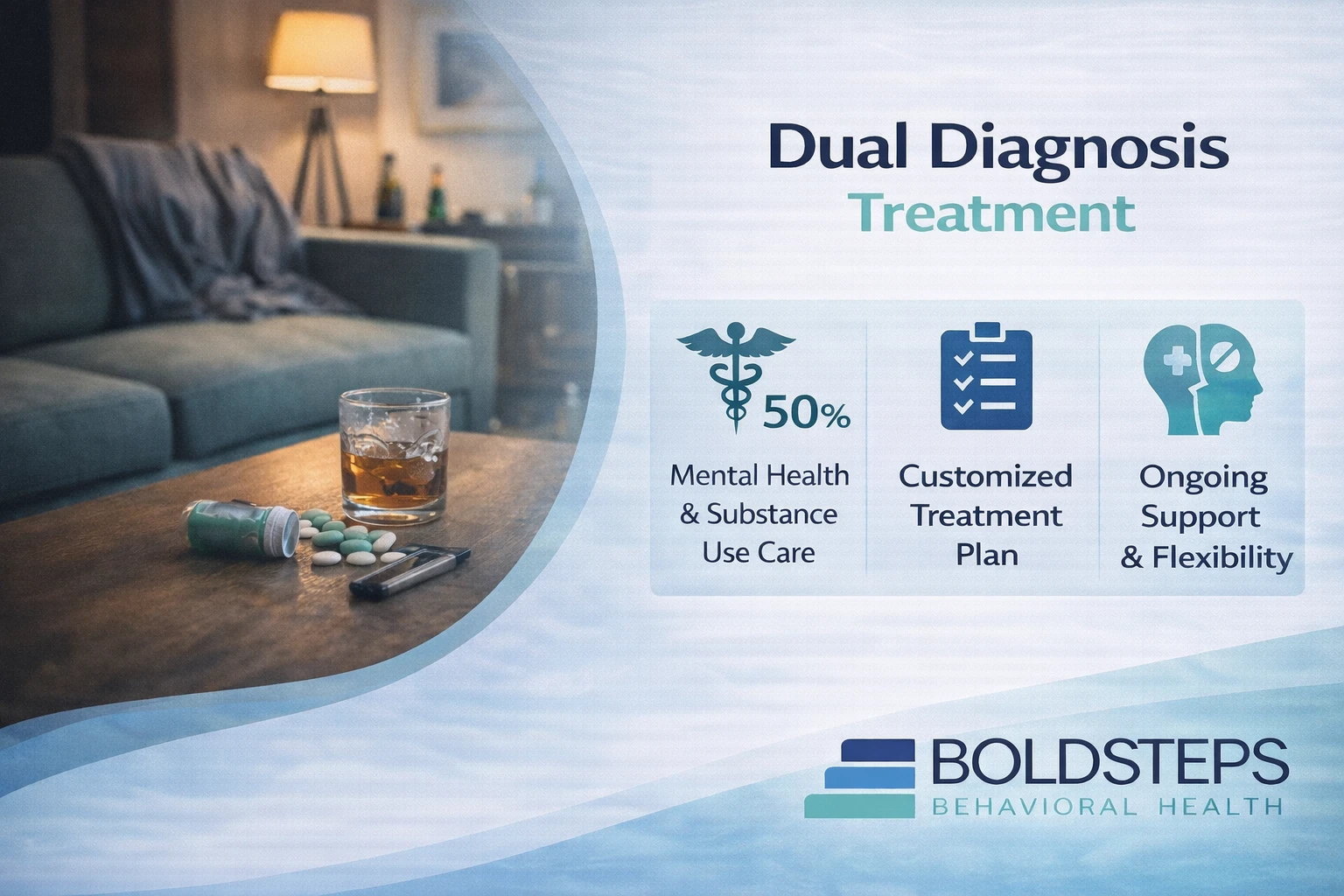
Dual diagnosis treatment is care for both your mental health and your substance use—at the same time, in one integrated plan.
It’s not just therapy. It’s not just recovery. It’s support for both why you use and how you use.
Many people don’t realize their anxiety, depression, trauma, or ADHD is tightly linked to their drinking, weed, or pills. You don’t have a discipline problem—you have unmet emotional needs that substances have temporarily soothed.
In dual diagnosis care, we:
- Identify your underlying mental health conditions
- Understand the function of your substance use (not just “stop it”)
- Teach healthier regulation, processing, and coping skills
- Support your nervous system, not shame it
- Help you slowly, safely reduce or eliminate substances if that’s your goal
This isn’t a 12-step clone or bootcamp rehab. It’s emotional care for people who are ready to stop escaping and start healing.
Do I have to be sober before starting?
No. That’s one of the biggest myths.
You do not have to be sober. You don’t need to “prove” your readiness by quitting cold turkey on your own.
We meet you where you are:
- Whether you’re using every weekend or every day
- Whether you want to cut back or stop completely
- Whether you’re still not sure how bad it is
Many people begin treatment while still using. That’s okay. You won’t be shamed or punished. We’ll help you taper safely if needed, set realistic goals, and build internal motivation without force.
You don’t need to come in perfect. Just come in honest.
What’s the actual treatment like?
At Bold Steps, our dual diagnosis treatment includes Intensive Outpatient Programming (IOP) and other flexible clinical tracks. It’s structured, supportive, and trauma-informed.
Here’s what your week might include:
- Group therapy: Skill-building, emotional processing, relapse prevention, mental health support
- Individual therapy: Private sessions with your assigned clinician
- Psychiatric support: If you need medication management or evaluation
- Education groups: Understand how mental health and substance use interact—and what to do about it
- Case management: Help with work leave, legal stuff, housing, or life logistics, if needed
Sessions are typically 3–5 days a week, a few hours per day. You don’t live at the facility. You go home. You live your life—just with more support than before.
What if I don’t fit the “addict” label?
Then we won’t use it.
We don’t push identity labels. You don’t have to call yourself an addict, alcoholic, or anything else. If a label helps you understand yourself, great. If not, leave it.
Many of our clients come in saying:
- “I’m not an addict, but…”
- “I can control it most of the time.”
- “I just don’t like who I am when I use.”
That’s enough.
You don’t have to prove you’re bad off to deserve help. You just have to want better.
What kind of support will I actually get?
Let’s be specific.
You’ll be supported by licensed clinicians, therapists, and case managers who specialize in co-occurring disorders—that’s the clinical term for what you’re dealing with.
That means we:
- Validate your mental health symptoms and treat them
- Understand the cravings, shame, and disconnect of substance use
- Provide structure without pressure
- Help you feel seen, not scrutinized
You’ll be surrounded by others who get it—often people who look and live just like you. You won’t be the youngest in the room. You won’t be the “least sick.” You’ll just be another human trying to feel better, and that’s enough.
How long is the program?
It depends on what you need.
Most IOP programs last 6 to 10 weeks, with step-down options and aftercare planning built in. If you need more time, we can adjust. If you stabilize faster, we celebrate that too.
We don’t rush you through a calendar. We walk with you until you’re ready to walk without us.
What if I live outside Harrisburg?
You’re still welcome.
We proudly serve people across Harrisburg, Dauphin County, Lancaster County, and York County—with flexible schedules and local accessibility. If you’re within driving distance or can manage remote transportation, we’ll help you make it work.
Can I keep my job or take care of my family while doing this?
Yes. In fact, that’s the whole point.
Our program is designed for people who live in the real world. People with jobs, kids, relationships, deadlines. You’ll attend sessions that fit your schedule and still have space for everything else.
Treatment shouldn’t feel like an interruption—it should feel like a breath.
What if I’m scared to make the call?
That’s exactly when to make it.
Being scared means something in you knows it matters. That something needs to change. That there’s a part of you ready to stop surviving and start healing.
When you call us, you’ll speak to someone kind. Human. Non-judgmental. No one will push you. We’ll just listen and help you take the next small step.
Last question: What if this doesn’t work?
Then you try again—with us, or somewhere else. Healing isn’t a straight line.
But here’s the truth: For most people who show up ready and willing, dual diagnosis treatment does work. You learn who you are without the mask. You understand your patterns. You stop spinning. You feel again—and then, eventually, you feel good again.
You’re Not Broken. You’re Ready.
If you’ve made it this far, you already know this matters.
You don’t need to spiral further. You don’t need to wait until you’re “ready” in some mythical, perfect way. You just need to stop trying to figure it out alone.
Call 717-896-1880 to learn more about our dual diagnosis treatment services in Harrisburg, PA.
The door is open. Walk through it.