

You didn’t mean to fall off. You didn’t plan to ghost your IOP group, miss another check-in, or stop responding to those “just checking in” messages. But here you are. And maybe now you’re wondering:
“Can I go back?”
“Will they judge me?”
“Does it even matter anymore?”
It does.
And yes—you can come back.
No long explanation needed.
At Bold Steps Behavioral Health, we work with people every day who paused their treatment, relapsed, or disappeared for a while. That doesn’t make you weak. It makes you human. And the good news? Recovery is always ready when you are.
Here’s how to restart your Intensive Outpatient Program with honesty, support, and zero shame—and how to rebuild momentum from wherever you are.
1. Name What Happened Without Beating Yourself Up
The first step back isn’t about getting everything “back on track.” It’s about telling the truth without punishing yourself for it.
Maybe life got too busy.
Maybe you didn’t feel like you belonged.
Maybe you used again and didn’t know how to talk about it.
Maybe you just got tired of trying so hard.
Whatever the reason, you’re not the only one. In fact, it’s so common to pause or drop out of treatment that we’ve built systems specifically to support people returning.
There’s no script. No apology required. Just honesty, at your own pace.
2. Reach Out—Even if You Feel Awkward
We know the hardest part is picking up the phone or writing that first message. You might be worried you’ll be met with coldness or a lecture.
You won’t. At Bold Steps, our first response is simple:
“Welcome back. We’re glad you reached out.”
You don’t need to rehearse what to say. We already understand. Whether you ghosted after one group or three months of progress, the door stays open. It’s not about making up for lost time—it’s about finding your footing again.
If you’re looking for an Intensive Outpatient Program in Harrisburg & Dauphin County, PA, we’ll help you return without pressure or shame. And if you live in nearby Lancaster County or York County, we serve those areas too.
3. Re-enter With Curiosity, Not Guilt
It’s easy to fall into “I should’ve” thinking. I should’ve stayed. I should’ve known better. I should’ve kept it together.
But guilt doesn’t build recovery—curiosity does.
What if you asked:
- “What do I need this time around?”
- “What made staying hard last time?”
- “What support felt missing—or too much?”
When you return with curiosity instead of self-blame, it becomes easier to work with yourself instead of against yourself.
Treatment isn’t about performing recovery perfectly. It’s about creating a space where it’s safe to ask questions and try again.
4. Use the Structure of IOP to Rebuild Stability
When life feels shaky, consistency becomes a kind of medicine. That’s one of the biggest gifts of an Intensive Outpatient Program—it gives you just enough structure to stabilize, without taking you out of your life.
At Bold Steps, our IOP includes:
- Group therapy multiple times per week
- Individual counseling sessions
- Coping and relapse-prevention skills
- Peer connection with people who get it
- Flexible scheduling to fit your real life
Whether you’re working, parenting, or healing from a relapse, IOP can meet you at your current energy level.
You don’t need to dive in with intensity. Just show up. Let the structure hold you while you learn to trust yourself again.
5. Let Go of the Timeline and Start From Today
A lot of people returning to treatment feel haunted by the question:
“Where would I be if I hadn’t left?”
That thought will trap you.
Try replacing it with:
“What’s possible if I start from here?”
Because here’s the truth: Recovery isn’t a straight line. It loops. It stumbles. It rests. The goal isn’t speed. It’s sustainability.
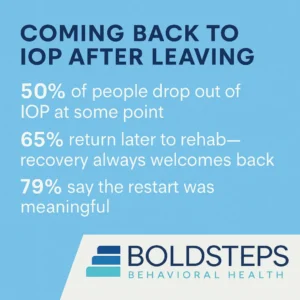
Some people return to IOP after one week away. Some come back after years. Both are valid. Both are brave.
Your timeline doesn’t define your worth. Your willingness to keep returning does.
6. Reconnect With a Recovery Community That Gets It
One of the most powerful parts of returning to IOP is realizing that you’re not alone—not in your dropout, your shame, your re-entry, or your hope.
People in group don’t look at you like you failed. They nod, because they’ve been there.
They say things like:
“I left last spring and just came back last week.”
“I disappeared for a bit. It happens.”
“Glad you’re back.”
That kind of welcome can be healing. Because when you’ve felt like a disappointment—even just to yourself—being accepted without explanation feels like a lifeline.
7. Give Yourself Credit for Coming Back
Starting is hard. Restarting is harder.
If you’ve made it this far—reading, considering, wondering—you’re already rebuilding something.
You might not feel proud yet. That’s okay. But take a second to notice that you’re still here. You’re still trying.
And that counts for more than you know.
FAQs: Coming Back to IOP After Leaving
Is it normal to drop out of IOP and come back later?
Very normal. Life gets complicated. People return to IOP all the time, sometimes after a week, sometimes after a year.
Do I have to start the whole program over?
Not necessarily. We’ll assess where you’re at emotionally and practically and help you resume in a way that supports your goals.
Will the staff or group be upset with me?
No. At Bold Steps, we understand the recovery process. You’ll be met with warmth, not disappointment.
Can I come back even if I relapsed while I was away?
Yes. In fact, that’s one of the reasons IOP exists—to help people regain stability after a relapse.
What if I’m embarrassed?
That’s okay. Most returning clients feel some discomfort. But the more people share, the more they realize they’re not alone.
Is re-enrollment difficult?
No. Our team makes it easy to rejoin. Just reach out and we’ll walk you through next steps with no pressure.
A Note for the Person Who’s Scared to Reach Out
Maybe you’re reading this and thinking, “This sounds good, but I don’t know if I can actually do it.”
That’s fair. Starting again takes courage. Especially when shame’s been whispering that you don’t deserve another shot.
But here’s the truth:
- You haven’t ruined your chance.
- You haven’t used up your worth.
- You don’t need to explain everything.
All you need to do is say, “I’m ready to try again.”
And we’ll say, “We’re ready when you are.”
Ready to Reconnect?
Call 717-896-1880 or visit to learn more about our Intensive Outpatient Program services in Harrisburg, PA.
No matter how long it’s been, you’re not behind—you’re still on the path. And your seat at the table is still here, waiting.