

The question “is addiction a choice?” is one of the most common — and most divisive — questions in public conversations about substance use. People in long-term recovery often resent the framing. Families struggle with it. Even people currently struggling with substance use sometimes aren’t sure how to answer it. This guide walks through what the science actually says, why the framing is misleading, and what it means for how we treat addiction.
What it means to call addiction “a choice”
When people ask whether addiction is a choice, they’re usually trying to answer one of two questions:
- Should we hold people with addiction accountable for their behavior?
- Should we treat addiction as a medical issue rather than a moral one?
Most people asking the question want to understand whether someone with addiction deserves sympathy, medical care, or consequences. The answer is — depending on the stage and severity — usually both.
The framing itself is misleading because it assumes addiction is one single thing. It isn’t. It includes:
- The initial choice to try a substance (which is genuinely a choice)
- The continuation of use despite negative consequences (which often is not a simple choice)
- The inability to stop despite repeated attempts (which is rarely a choice at all)
Treating these three as the same thing — calling all of addiction “a choice” or all of it “a disease” — obscures more than it clarifies.
What science says: addiction as a chronic brain disease
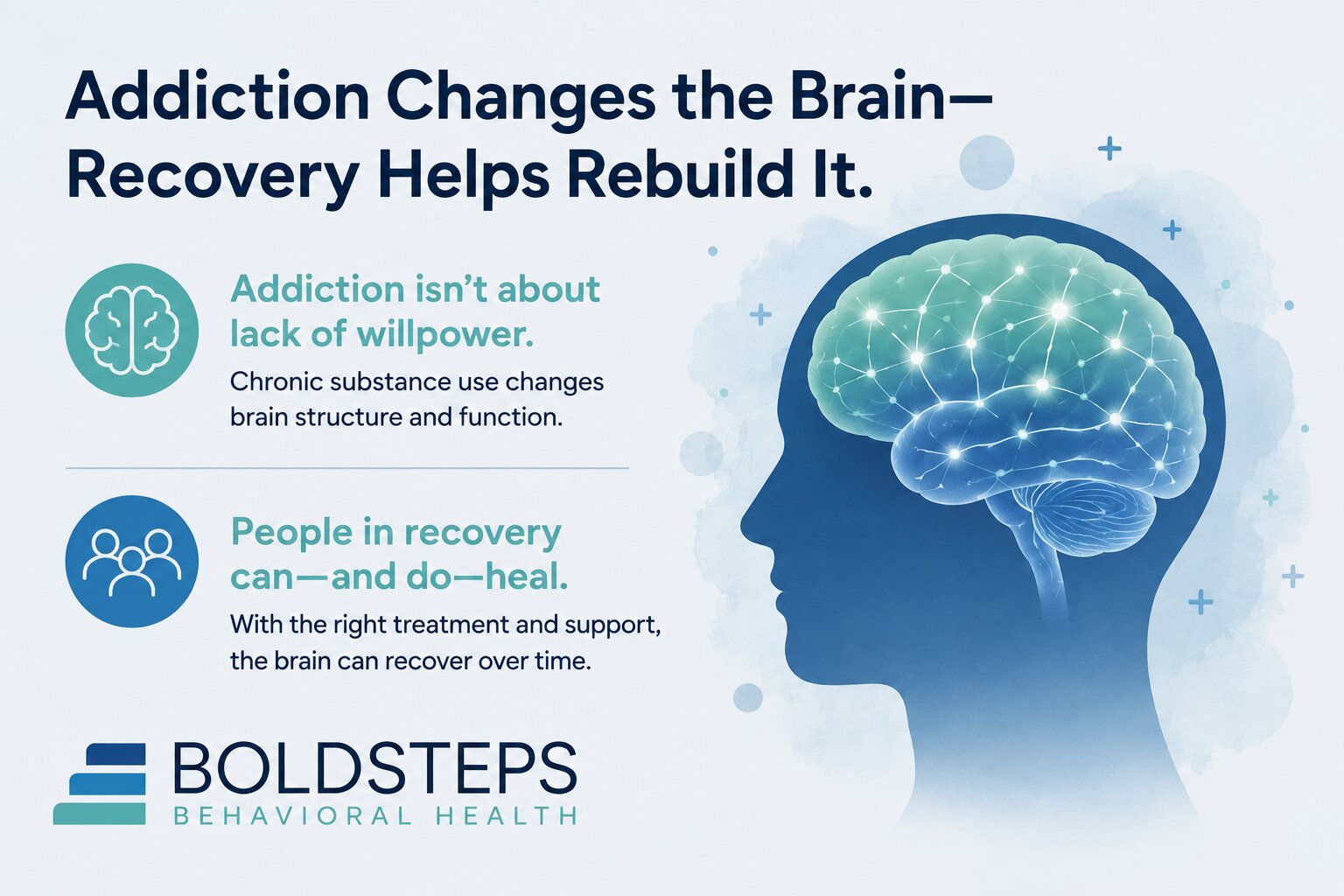
Decades of neuroscience research have established that sustained substance use changes the brain in measurable, lasting ways:
- Reward circuitry is rewired so that the substance becomes the brain’s highest priority, often above food, relationships, and self-preservation
- Prefrontal cortex function — the brain’s capacity for impulse control, judgment, and decision-making — is impaired
- Stress response systems are dysregulated, making the absence of the substance feel intolerable
- Memory and learning systems are altered so that cues associated with use become powerful automatic triggers
The American Society of Addiction Medicine (ASAM), the National Institute on Drug Abuse (NIDA), and the World Health Organization all define addiction as a chronic medical condition with biological, psychological, and social dimensions.
This doesn’t mean the initial use was inevitable. It means that once addiction has developed, the brain no longer responds to choice the way it did before.
Why the “choice vs. disease” framing is misleading
The framing fails both ways:
Calling addiction only a choice ignores the neurobiological changes that occur with sustained use. It implies that someone could simply decide differently if they wanted to. For people with moderate to severe addiction, this is not how the brain is functioning.
Calling addiction only a disease can imply that the person has no agency at all — that recovery happens to them rather than through them. This understates the real and substantial role of choice, effort, and support in recovery.
The most accurate framing is this: addiction is a chronic condition in which the capacity for choice is genuinely compromised, but never fully absent. Recovery requires both medical treatment for the underlying brain changes and active choices and effort from the person.
The role of choice in recovery
If addiction removes much of the choice to stop using, recovery is largely about rebuilding the capacity to choose differently. That includes:
- Choosing to enter treatment
- Choosing to stay in treatment when it gets hard
- Choosing to show up to appointments and groups
- Choosing honesty with a treatment team and family
- Choosing to do the things that are uncomfortable but necessary
- Choosing to ask for help when relapse risk is high
None of these choices are easy. Many of them are genuinely difficult. But they are choices, and they are how recovery happens.
How treatment addresses both sides
Effective treatment doesn’t ignore either side of the framing. It addresses:
- The medical side — medication-assisted treatment, withdrawal management, psychiatric care, dual diagnosis coordination
- The behavioral side — therapy, group work, skill-building, relapse prevention
- The social side — sober living, family therapy, peer support, mutual-help groups
- The motivational side — helping people find and sustain the choice to recover
When the underlying psychiatric conditions that often accompany addiction go unaddressed, the brain changes that drive use are reinforced by unmedicated anxiety, depression, or trauma symptoms. Coordinated dual diagnosis treatment is what allows the recovery process to actually take hold.
When the disease model still requires action
Understanding addiction as a chronic disease doesn’t mean waiting for a cure. It means treating it with the same seriousness we’d apply to any other chronic condition — with consistent care, ongoing monitoring, and support that adapts over time.
This is what Bold Steps’ Partial Hospitalization Program (PHP) is designed to provide: structured, intensive treatment that combines medical, therapeutic, and social support. PHP gives people the daily contact and care they need during the period when choice is most compromised and structure is most necessary.
Start your recovery
Whether you or someone you love is still asking “is addiction a choice?” or is ready to take the next step, the right next step is the same: a confidential conversation about what treatment could look like. Bold Steps provides individualized care for substance use and co-occurring mental health conditions, with programming designed to meet you where you are. Easily accessible from anywhere in Harrisburg, Lancaster County, York County and beyond.
Call 717.896.1880 any time, day or night. We’ll verify your insurance confidentially and help you figure out the right next step.