

It wasn’t that I didn’t want help.
It’s that I couldn’t leave. Not for 30 days. Not for a week. Not even overnight.
Because I’m a parent. And parenting doesn’t pause—even when your mental health is screaming for support.
Even when your substance use is starting to scare you.
Even when you know something has to change.
When I finally reached out, I was sure they’d tell me residential was the only real option. Instead, I found something else. Something that saved me without asking me to vanish.
I found an intensive outpatient program IOP that helped me stay in recovery while staying in my kids’ lives.
Here’s why I chose IOP over residential—and what I want other parents to know.
I Needed Structure—but I Couldn’t Disappear
I’d tried talk therapy before. I’d tried powering through. I’d tried cutting back on my own. None of it stuck. I knew I needed more. More structure. More support. More accountability.
But I couldn’t drop everything and go away.
Who would make the school lunches? Who would get them to soccer? Who would be there when they cried at bedtime or needed help with math homework?
It wasn’t about guilt—it was about logistics.
And that’s where IOP came in.
With IOP, I could get the structure I needed without leaving. I could attend group during school hours. I could do my individual therapy virtually during naptime. I didn’t have to pretend I didn’t have responsibilities. The program was built with people like me in mind.
Looking for intensive outpatient program IOP in Harrisburg & Dauphin County, PA? This is where I started.
IOP Let Me Show Up As a Whole Person
At first, I was self-conscious. I was the one in group who showed up in a hoodie with kid handprints on it. The one who sometimes had to mute mid-session because someone needed a snack or a band-aid. But no one rolled their eyes. No one acted like I didn’t belong.
In fact, the opposite happened.
People listened when I talked about parenting while trying to recover. When I cried about yelling during a tantrum. When I shared that my daughter had started asking if I was okay.
IOP didn’t just treat the addiction. It treated the life that addiction was wrapped around.
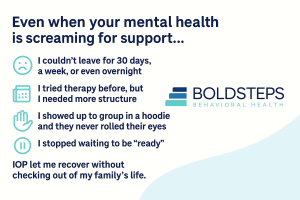
I Stopped Waiting to Be “Ready”
I used to think I had to have everything figured out before I started treatment.
That I needed a sitter lined up. That I needed a break from work. That I needed my schedule to magically open up.
But IOP taught me that recovery doesn’t wait for convenience.
I had to start before I felt ready. Because ready wasn’t coming.
The more I showed up, the more supported I felt. And not just by the staff—but by the other clients too. Some were parents. Some weren’t. But all of us knew what it felt like to carry too much and still feel like we weren’t doing enough.
IOP Let Me Recover Without Pretending
At home, I’d gotten good at looking okay.
I packed the lunches. I remembered birthdays. I laughed at cartoons and signed the permission slips. But inside, I was worn out. Disconnected. Using just enough to get by—and more than I wanted to admit.
In IOP, I didn’t have to pretend.
I didn’t have to have the perfect parenting plan.
I didn’t have to justify the nights I drank to fall asleep.
I just had to show up.
And when I couldn’t show up? They called. Gently. Consistently. Without judgment.
That’s what pulled me back the first time I disappeared for a week.
“When I ghosted, I was sure they’d be done with me. But they weren’t. They just said, ‘We missed you. Want to try again?’ That’s what kept me going.”
– IOP Return Client, 2023
I Realized My Kids Didn’t Need a Perfect Parent
They just needed me.
And not the version of me that was gritting her teeth through dinner or numbing out after bedtime.
They needed the one who could actually connect. Who wasn’t distracted by shame or anxiety. Who could stay present, even on the messy days.
IOP didn’t fix everything overnight. But it helped me:
- Learn to pause before reacting
- Regulate my emotions after tough parenting moments
- Ask for help when I needed it
- Say no when I was overwhelmed
Recovery wasn’t about doing more. It was about doing things differently—and letting that be enough.
Looking for intensive outpatient program IOP in Lancaster County, PA? There’s care close to home.
FAQs: IOP for Parents in Recovery
What if I don’t have childcare?
Some IOP sessions are virtual. Others happen during daytime hours when school or childcare may already be in place. Let the team know what you need—they’ll work with you.
Do I have to explain my whole parenting situation to get in?
No. You can share as much or as little as you want. All family dynamics are respected. The goal is to meet you where you are—not to judge your situation.
What if I start but can’t attend consistently?
That’s okay. Life happens. IOP teams understand parenting can be unpredictable. They’ll help you re-engage and stay connected without shame.
Will I be in group with people who aren’t parents?
Yes—but that’s not a bad thing. Many people bring different perspectives that help deepen the group’s connection. Parenting themes are always welcome in group discussion.
Can I talk about parenting stress as part of my recovery?
Absolutely. Parenting is part of recovery. You’ll never be asked to separate those pieces of your life.
You’re Allowed to Stay—and Still Heal
Too many parents believe they have to choose:
Get better or stay home.
Heal or hold it together.
Break the cycle or be there when school lets out.
IOP gives you another option.
You don’t have to disappear to recover.
You don’t have to check into a facility to deserve help.
You don’t have to wait until it all falls apart to say, “I need support.”
I’m not saying IOP is easy. But I am saying it’s possible.
And sometimes, possible is everything.
Call 717-896-1880 to learn more about our intensive outpatient program IOP services in Harrisburg, PA.
You don’t have to step away to step up. There’s room for you here.