

You didn’t think you’d be here again.
Not after the last treatment program. Not after they promised things were “different this time.” Not after all the support, the patience, the boundaries you built with trembling hands.
But here you are—staring at the familiar ache of watching your child struggle again. And now someone’s told you they might need dual diagnosis treatment, and all you can think is: Another label? Another file? Another thing they’ll carry?
That’s not what you want. What you want is for your child to feel okay in their own skin. You want to believe there’s a kind of care that sees who they are underneath the substance use and the shutdowns. And maybe, just maybe, you want someone to tell you it’s not your fault.
At Bold Steps Behavioral Health, we work with families walking this very road. And here’s what we want you to know:
Dual diagnosis isn’t a life sentence. It’s a flashlight. A way to see what’s really going on—and a path toward real, integrated healing.
What does “dual diagnosis” actually mean?
In clinical terms, it means your child is dealing with both a mental health condition and a substance use disorder. In real life, it means they’ve been trying to manage pain—internal, invisible, often unspoken—and somewhere along the line, they started using substances to cope.
It might look like:
- Weed for anxiety
- Alcohol for sleep
- Pills for focus or emotional numbness
- Vaping, eating, isolating, snapping—for no clear reason at all
Dual diagnosis treatment is designed to help your child understand not just what they’re doing, but why. That “why” is everything.
Because until that’s addressed, no amount of detox, discipline, or tough love is going to stick.
Is this just another label they’ll carry?
This is the heart of the question, isn’t it?
The fear that they’ll get stamped and sorted—diagnosed and dismissed. That people will see the label instead of your kid. That it’ll follow them into courtrooms, job interviews, relationships, family dinners.
But here’s what we’ve seen, time and again:
The right diagnosis doesn’t box people in—it gives them a door out.
A clear, accurate, compassionate diagnosis helps your child:
- Access appropriate care (no more mismatched or ineffective treatment)
- Understand their own patterns (and stop thinking they’re “crazy” or broken)
- Advocate for themselves in medical, legal, or academic settings
- Let go of shame by giving their suffering context
In other words, the label isn’t a weight. It’s a map.
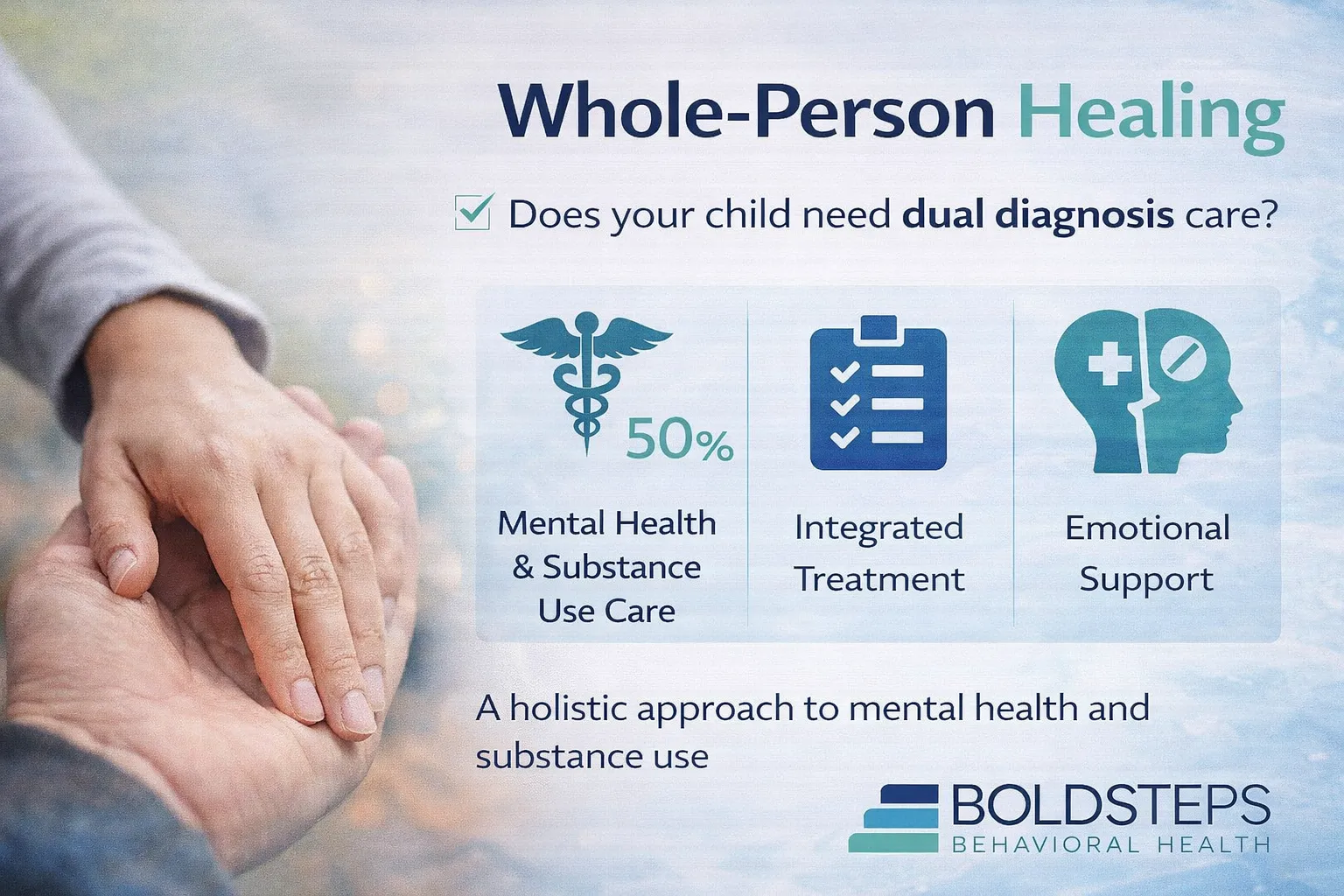
Why does dual diagnosis treatment often succeed when other programs haven’t?
Because it treats the whole person, not just the behavior.
Many treatment programs (especially those that aren’t trauma-informed) focus only on substance use: “Stop using, and you’ll be fine.” But if your child is using to survive overwhelming internal states—panic, depression, disassociation, trauma flashbacks—then sobriety without mental health care is like taking away someone’s only life raft without teaching them how to swim.
Dual diagnosis care understands that:
- Addiction isn’t the root problem—it’s the loudest symptom
- Mental health symptoms can hijack recovery if not addressed
- Emotion regulation is a teachable skill (but only with the right support)
At Bold Steps, we give your child the tools to actually feel safe in their body and brain. Without that, nothing sticks.
What if they’ve relapsed—or quit another program?
Then they’re still trying.
Relapse doesn’t mean failure. It means something in their system still believes that substances are safer than sobriety. And that’s not a moral failing—it’s a survival strategy they haven’t learned to replace yet.
And if they’ve left or ghosted another program? That may not mean they weren’t ready. It may mean the program wasn’t ready for them.
Many young adults with co-occurring disorders feel misunderstood, misdiagnosed, or mishandled by providers who don’t know how to:
- Support neurodivergent brains (like ADHD or bipolar)
- Create safety for trauma survivors
- Offer structure without shame
Dual diagnosis care isn’t about starting over. It’s about starting right.
How do I know if this is really what they need?
Here’s what we often see before families turn to dual diagnosis care:
- Your child’s behavior cycles between highs and lows that don’t make sense
- They use substances when emotions run high—or run empty
- You’ve heard diagnoses like anxiety, depression, PTSD, ADHD, or “mood issues”
- They say things like “I don’t know what’s wrong with me” or “I just don’t feel real”
- Other programs have focused on their using—but not their pain
If you’ve been thinking “we’re missing something”—you’re probably right.
What happens in dual diagnosis treatment?
At Bold Steps, we don’t use a one-size-fits-all model. We provide Intensive Outpatient Programming (IOP) and other flexible options to meet your child where they are.
Here’s what’s included:
- Comprehensive assessment to understand mental health and substance use
- Group therapy focused on coping skills, emotion regulation, and peer support
- Individual therapy with licensed clinicians trained in co-occurring disorders
- Medication support if needed (and only when appropriate)
- Family involvement when helpful—without blame or pressure
We focus on building resilience, emotional literacy, nervous system safety, and recovery tools that last longer than the program itself.
What if they’re not ready for full sobriety?
Then we meet them there.
We don’t demand instant abstinence as a condition for entry. Many of our clients are ambivalent, scared, or still using when they begin. That’s okay.
Readiness is a spectrum. And our clinicians are trained to support change—even if your child isn’t “all in” yet.
We focus on harm reduction, motivational interviewing, and compassionate accountability—not punishment or ultimatums.
Will this diagnosis stay with them forever?
Technically, diagnoses can remain part of a medical record. But in real life, your child is not defined by it.
Here’s what actually stays with them:
- The insight that comes from being truly seen
- The skills they build to manage emotions and stress
- The tools to create relationships that don’t collapse under the weight of shame
- The confidence of knowing their pain has a name—and a solution
A diagnosis isn’t a destiny. It’s just the start of telling the truth—so something new can begin.
Is this available where we live?
Yes. If you’re in or near Harrisburg, Dauphin County, Lancaster County, or York County, you can access our dual diagnosis services locally. We’ve designed our programs to support families right here in our community, with care that’s flexible, confidential, and deeply human.
What should I do next?
If your child is using again, if you’re watching them unravel, if your gut keeps saying this is more than addiction—you don’t have to keep guessing.
Here’s what you can do:
- Call us: We’ll walk you through what dual diagnosis treatment looks like, how to talk to your child, and what options exist.
- Ask questions: There are no wrong ones. We’ll give you honest, clear answers.
- Take one step: Even just learning more is movement.
You’re not too late. They’re not too far gone. You’re both just right on time.
Let’s Help Your Child Heal
You’ve carried their pain longer than anyone knows. You’ve hoped, prayed, cried, braced. And maybe now—it’s time to let someone else carry a little of it too.
We see your love. We see their struggle. And we believe in what’s still possible.
Call 717-896-1880 to learn more about our dual diagnosis treatment services in Harrisburg, PA.
This isn’t just another label. It’s a chance to begin again—with both eyes open.