

Sobriety can bring a kind of quiet. But for many, that quiet reveals something deeper—persistent anxiety, mood swings, or thoughts they hoped would fade with substance use. If you’ve stopped using but still don’t feel okay, you’re not broken. You might just need more than sobriety alone can offer.
That’s where dual diagnosis treatment comes in.
At Bold Steps Behavioral Health in Harrisburg, PA, we specialize in supporting people who are managing both mental health challenges and substance use. It’s not about labeling you—it’s about understanding your full story and offering care that respects your pace, identity, and needs.
Why Sobriety Doesn’t Always Mean Healing
You did the hard part. You stopped using. But if the emotional pain you used to numb is still there—or feels even louder—that’s not failure. It’s a sign your brain, body, and emotions are still asking for care.
Maybe your sleep is off. Maybe you’re irritable or distant. Maybe depression or anxiety, once masked by substances, now feel impossible to ignore.
This isn’t a step backward. It’s the next layer of truth. And dual diagnosis treatment is how we support it.
📊 Stat Block
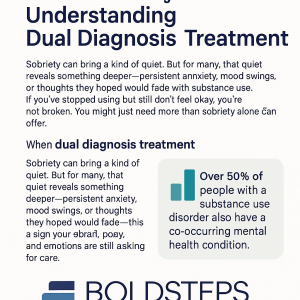
Over 50% of people with a substance use disorder also have a co-occurring mental health condition.
Yet many don’t receive integrated care—leading to relapse, frustration, and shame that never belonged to them.
What Dual Diagnosis Treatment Actually Looks Like
At Bold Steps, dual diagnosis care means you’re not treated as either “addicted” or “mentally ill.” You’re seen as a full person.
That can include:
- One-on-one therapy that connects your mental health to your recovery goals
- Medication support (only if and when you’re ready)
- Trauma-informed care that respects your history and identity
- Group therapy with others who get it
- Coordinated care between therapists, psychiatrists, and recovery specialists
This kind of treatment works best when it adapts to you—not the other way around.
What If I’m Not Ready for Medication?
It’s okay to have questions—or even fears—about medication. Many people worry they’ll feel numb, or lose their creativity, or not be “themselves.”
Dual diagnosis treatment doesn’t mean automatic meds. It means options. Conversations. Safety. You’re allowed to say, “I’m not sure.” We’ll never push you. But we will walk with you if and when you want to explore that part of healing.
🛠️ Quick Tips: Questions to Ask If You’re Considering Medication
- What are the possible benefits and side effects?
- Will this impact my recovery goals?
- Can we start with the lowest possible dose?
- How often will we check in and adjust?
- What other options are available?
The Risk of Treating One Without the Other
Trying to heal from addiction without addressing mental health is like trying to patch a roof during a storm. And treating mental illness without acknowledging substance use can leave critical patterns unaddressed.
Without a coordinated plan, the root causes often stay buried. Misdiagnosis becomes common. People feel like they’re cycling through providers who never fully understand them.
You deserve care that sees the whole picture—not fragmented fixes.
If you’ve been through treatment that didn’t “work,” it might not be you. It might be that it wasn’t complete.
That’s why Bold Steps offers integrated dual diagnosis treatment right here in Harrisburg, PA—because no one should have to choose between mental health and recovery.
Explore our mental health services in Harrisburg
Real Healing Feels Like Wholeness
Healing doesn’t have to flatten you. It doesn’t erase who you are. It builds safety around your most important parts—and gently strengthens the ones still hurting.
Whether you’re newly sober or years into recovery and still struggling, dual diagnosis care can help you feel like yourself with more support, not less freedom.
📞 Ready to talk it through?
Call Bold Steps Behavioral Health at (717) 896-1880. We’ll meet you where you are—and help you move forward with care that sees the full you.
FAQ: Dual Diagnosis Treatment
What does “dual diagnosis” mean?
Dual diagnosis refers to someone who has both a substance use disorder and a mental health condition, such as depression, PTSD, bipolar disorder, or anxiety.
Do I need to be sober to start dual diagnosis treatment?
Not necessarily. Treatment can begin even if you’re still using, especially if mental health symptoms are severe. The goal is to support your safety and stability while building toward recovery.
Will I be forced to take medication?
No. Medication is an option, not a requirement. Our approach is collaborative. We talk through your preferences, needs, and comfort level every step of the way.
Is this different from regular rehab?
Yes. Many traditional rehabs focus primarily on substance use. Dual diagnosis programs are designed to treat mental health and substance use as interconnected—not separate.
Can I do this outpatient, or do I need to live at a facility?
Bold Steps offers flexible options, including outpatient care, so you can receive treatment while still living at home and managing daily responsibilities.