

What if sobriety takes something away from you?
Not just the substances—but the spark. The chaos that somehow also felt like clarity. The voice in your head that only got brave after two drinks. The version of you that could be loud, weird, creative, magnetic. The person everyone noticed when you walked in the room.
If that’s part of what scares you about getting clean, you’re not alone.
Especially if you’ve heard the phrase medication assisted treatment and flinched a little. Maybe it sounds like sedation. Like surrender. Like the edge being filed down until there’s nothing left but a dull outline of who you used to be.
At Bold Steps Behavioral Health, we hear these fears more often than you’d think. And they’re real. Not dramatic, not selfish—just real.
But here’s something just as real: medication assisted treatment (MAT) doesn’t erase people. When it’s done right, it helps them come back to life.
Let’s talk about why MAT is misunderstood—and why that misunderstanding might be keeping you from something that could actually support your voice, not smother it.
It’s Not About Becoming a Different Person
Some people hear “MAT” and imagine a numbed-out, blank-faced version of themselves—shuffling through life without highs, without color, without connection.
But that image comes from fear, not fact.
The purpose of medication assisted treatment isn’t to shut you down. It’s to create enough internal safety that your brain and body can finally rest. It’s not about swapping one chemical for another. It’s about interruption—breaking the cycle of suffering long enough to build something steadier in its place.
MAT doesn’t erase emotion. It gives it room to breathe.
The Real Enemy Isn’t the Medication—It’s the Noise
Substances often become a way of coping with the noise in your head. The self-doubt. The overthinking. The storm of intensity that no one else seems to feel quite as much. Sometimes they’re also your way of turning the volume up—to feel more, connect more, access something deeper.
We see that. And we respect it.
But here’s the hard truth that MAT can help illuminate:
The substance isn’t where your creativity lived.
It was just the shortcut you used to get there.
And like all shortcuts, it eventually takes more than it gives. It burns through your mornings, your relationships, your clarity, your memory, your peace.
MAT isn’t a dead-end. It’s a longer, quieter road back to that place of feeling deeply—without breaking every time you go there.
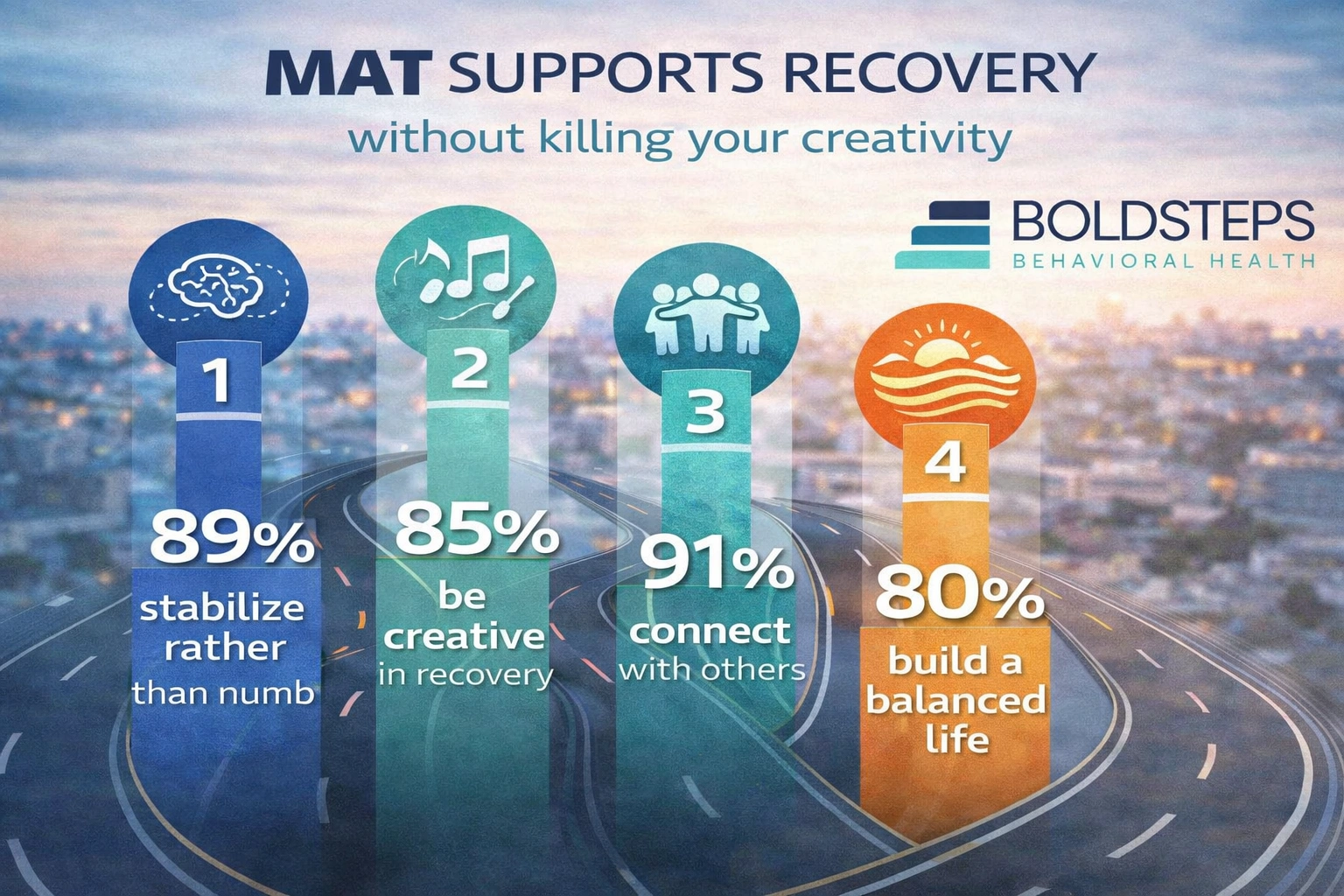
You Don’t Have to Choose Between Healing and Honesty
For creatives, feeling flat is terrifying. For performers, losing spontaneity can feel like losing identity.
We’ve worked with clients who feared MAT would ruin their rhythm, their fire, their art.
What they found instead?
Once they stopped fighting their own brain chemistry every day, the real work started flowing easier.
Ideas had room to land. Relationships had less chaos. And the performance wasn’t a survival strategy—it was a choice again.
MAT Looks Different for Everyone (And That’s the Point)
Here’s where the misunderstanding of MAT often kicks in:
People imagine a rigid program. A one-size-fits-all system where you either take the pill or you don’t get help.
That’s not how we do it at Bold Steps.
Our approach to medication assisted treatment is collaborative. It’s medically guided, yes—but it’s also creatively open. We look at your needs, your pace, your fears, your story.
It’s especially important in areas like Lancaster County, Pennsylvania, where access to individualized behavioral health support can be limited. We don’t believe in cookie-cutter treatment—because people here aren’t cookie-cutter. They’re farmers and artists, teachers and tattoo artists, introverts and social butterflies. We see all of it—and we build around you.
MAT Isn’t Weakness. It’s Rebellion Against the Cycle.
It takes guts to admit that what used to “work” doesn’t anymore. That the buzz isn’t doing its job. That the come-down is costing more than it ever did before.
Choosing MAT doesn’t mean you’ve failed. It means you’re tired of the game—and you’re ready for something different.
We’ve seen this especially in York County, Pennsylvania, where people are often balancing recovery with demanding jobs, family roles, or creative passions. Many are high-functioning. They’re showing up, doing the work—but inside, they’re unraveling. MAT gives them a chance to stay grounded without sacrificing their ambition or identity.
You Can Still Be Wild. You Can Still Be You.
Let’s be blunt: sobriety gets sold in weird ways.
“Find your best self.”
“Clear mind, clear life.”
“Finally feel peace.”
And maybe that sounds good on paper, but what if your “best self” is a little chaotic? A little unconventional? What if “peace” sounds boring?
We don’t want to make you peaceful.
We want to help you feel safe enough to be fully yourself—however weird, creative, intense, or unexpected that looks.
Because real MAT doesn’t dull you.
It stabilizes the foundation so you can build something authentic on top.
If You’re Scared, You’re Probably Paying Attention
Fear doesn’t mean MAT isn’t right for you.
It might mean it’s more important than ever to have a real conversation about it—with people who won’t dismiss your doubts or rush you into anything.
At Bold Steps, we talk openly about:
- What medications are actually used in MAT
- Whether MAT has to be permanent (it doesn’t)
- What it means if you’re already on psych meds
- How MAT works alongside therapy, creativity, community, and life
You don’t have to decide anything today. You’re allowed to be scared.
But you’re also allowed to ask questions. To stay curious. To wonder what it might feel like to feel steady, without disappearing.
FAQs About Medication Assisted Treatment
What is medication assisted treatment (MAT)?
Medication assisted treatment is the use of FDA-approved medications, alongside therapy and support, to treat substance use disorders. It helps reduce withdrawal symptoms, cravings, and relapse risk—especially in opioid and alcohol use.
Will MAT change my personality?
No. The goal of MAT is to support your brain’s natural balance, not overwrite it. When done thoughtfully, MAT helps you return to your authentic self—without the chaos or exhaustion of self-medicating.
Is MAT just replacing one drug with another?
This is one of the biggest misconceptions. The medications used in MAT are carefully dosed, medically supervised, and designed to stabilize—not intoxicate. It’s not about getting “high.” It’s about getting clear.
Can I still be creative or passionate on MAT?
Absolutely. In fact, many clients find that once their mental and emotional energy isn’t being burned up by addiction or instability, they actually become more creative, connected, and focused.
How long will I be on MAT?
It varies. Some people stay on MAT long-term. Others use it as a transitional support while they build up other tools. You’re not locked into anything—you’re in conversation with your provider the whole way.
Is MAT available near me?
Yes—Bold Steps Behavioral Health offers MAT support across central Pennsylvania, including programs and services for people living in Lancaster County and York County. Whether you’re commuting in, living nearby, or exploring telehealth options, we’re here to help.
You’re Not a Robot. And You Deserve a Plan That Honors That.
Medication assisted treatment has been misunderstood for a long time—especially by people who fear losing their fire.
But what if you could keep the fire—and stop getting burned?
What if the version of you that’s been buried under the chaos is still there, waiting for a little room to breathe?
If you’re wondering whether MAT might be a fit—not forever, just as a step—we’re ready to talk.
Call 717-896-1880 to learn more about our medication assisted treatment in Harrisburg, Pennsylvania. We’re here when you’re ready to feel like yourself again—no pressure, no pretense, just support.