

Medically reviewed by Lara Slimmer, Clinical Director
Trauma therapy can feel overwhelming when you’re already carrying the weight of anxiety, painful memories, or symptoms that don’t seem to go away. If you’ve been comparing brainspotting vs EMDR, you may be wondering whether one approach works better—or whether choosing the “wrong” therapy could slow your recovery.
If you’re exploring treatment options, learning about EMDR therapy can help you understand one of the most extensively researched trauma therapies available today.
Both Brainspotting and EMDR were developed to help people process distressing experiences without relying solely on talking through every detail of a traumatic memory. They also share an emphasis on eye position and the brain’s natural ability to heal. However, they differ in how sessions are structured, how treatment is guided, and—perhaps most importantly—the amount of scientific evidence supporting them.
Understanding those differences can help you make a more informed decision with your therapist.
Brainspotting vs EMDR: At a Glance
Feature |
Brainspotting |
EMDR |
|---|---|---|
| Developer | David Grand (2003) | Francine Shapiro (late 1980s) |
| Primary approach | Fixed eye position to access emotionally stored experiences | Eight-phase protocol using bilateral stimulation to process distressing memories |
| Bilateral stimulation | May be used, but not always | Core component of treatment |
| Session structure | Flexible and exploratory | Highly structured, standardized protocol |
| Therapist role | Collaborative discovery with client | Guides client through defined treatment phases |
| Research support | Growing but relatively limited | Extensive peer-reviewed evidence across decades |
| Clinical recognition | Increasing adoption | Recognized by organizations including WHO, the U.S. Department of Veterans Affairs, and the American Psychological Association for trauma-related care |
What Is Brainspotting?
Brainspotting is a relatively newer trauma therapy developed by Dr. David Grand in 2003.
The approach is based on the idea that specific eye positions—called brainspots—may correspond to emotionally significant experiences stored in deeper parts of the brain. During treatment, a therapist helps identify one of these eye positions while the client notices physical sensations, emotions, or memories that arise.
Rather than following a fixed protocol, Brainspotting often allows clients to remain focused on internal experiences while the therapist provides support and guidance.
Many people appreciate this approach because sessions may feel:
- Less structured
- More intuitive
- More client-led
- Focused on allowing the brain to process naturally
Brainspotting is used for trauma, anxiety, grief, performance anxiety, and other emotional concerns. Although many clinicians and clients report positive experiences, the scientific research supporting Brainspotting is still developing.
Studies published so far are encouraging, but the overall body of evidence remains much smaller than that available for EMDR.
What Is EMDR?
Eye Movement Desensitization and Reprocessing (EMDR) was developed by Dr. Francine Shapiro in the late 1980s and has become one of the best-studied trauma therapies available.
Rather than asking people to repeatedly relive traumatic experiences in detail, EMDR helps the brain reprocess distressing memories so they become less emotionally overwhelming.
Treatment follows a standardized eight-phase protocol, including:
- History taking
- Treatment planning
- Preparation and coping skills
- Identifying target memories
- Bilateral stimulation (often eye movements)
- Installing healthier beliefs
- Body scan
- Reevaluation
The structured nature of EMDR helps ensure important preparation and stabilization occur before difficult memories are processed.
Numerous randomized controlled trials have demonstrated EMDR’s effectiveness for PTSD, and many professional organizations—including the World Health Organization (WHO), the American Psychological Association (APA), and the U.S. Department of Veterans Affairs (VA)—recognize EMDR as an evidence-based treatment for trauma.
If you’d like a deeper overview of how treatment works, visit our EMDR therapy page.
Key Differences: Process, Evidence, and What to Expect
Although Brainspotting and EMDR share similarities, the experience of treatment can feel quite different.
Structure
One of the biggest differences between Brainspotting and EMDR is how structured each therapy is.
EMDR follows a clearly defined protocol that therapists are trained to use consistently. Every phase has a specific purpose, helping clients build emotional safety before processing traumatic memories.
Brainspotting is more flexible.
Instead of following predetermined phases, therapists often allow the client’s internal experience to guide the session. This flexibility appeals to some individuals who prefer a less structured therapeutic process.
Neither approach is inherently “better” because of its structure. Different people respond differently to different styles of therapy.
Bilateral Stimulation
Many people assume both therapies rely equally on bilateral stimulation.
That’s not entirely accurate.
In EMDR, bilateral stimulation—such as side-to-side eye movements, alternating taps, or tones—is a central part of treatment.
Brainspotting may incorporate bilateral stimulation, but it is optional rather than essential. The primary therapeutic focus remains maintaining attention on a specific eye position believed to activate deeper emotional processing.
Research and Evidence
This is where the largest distinction exists.
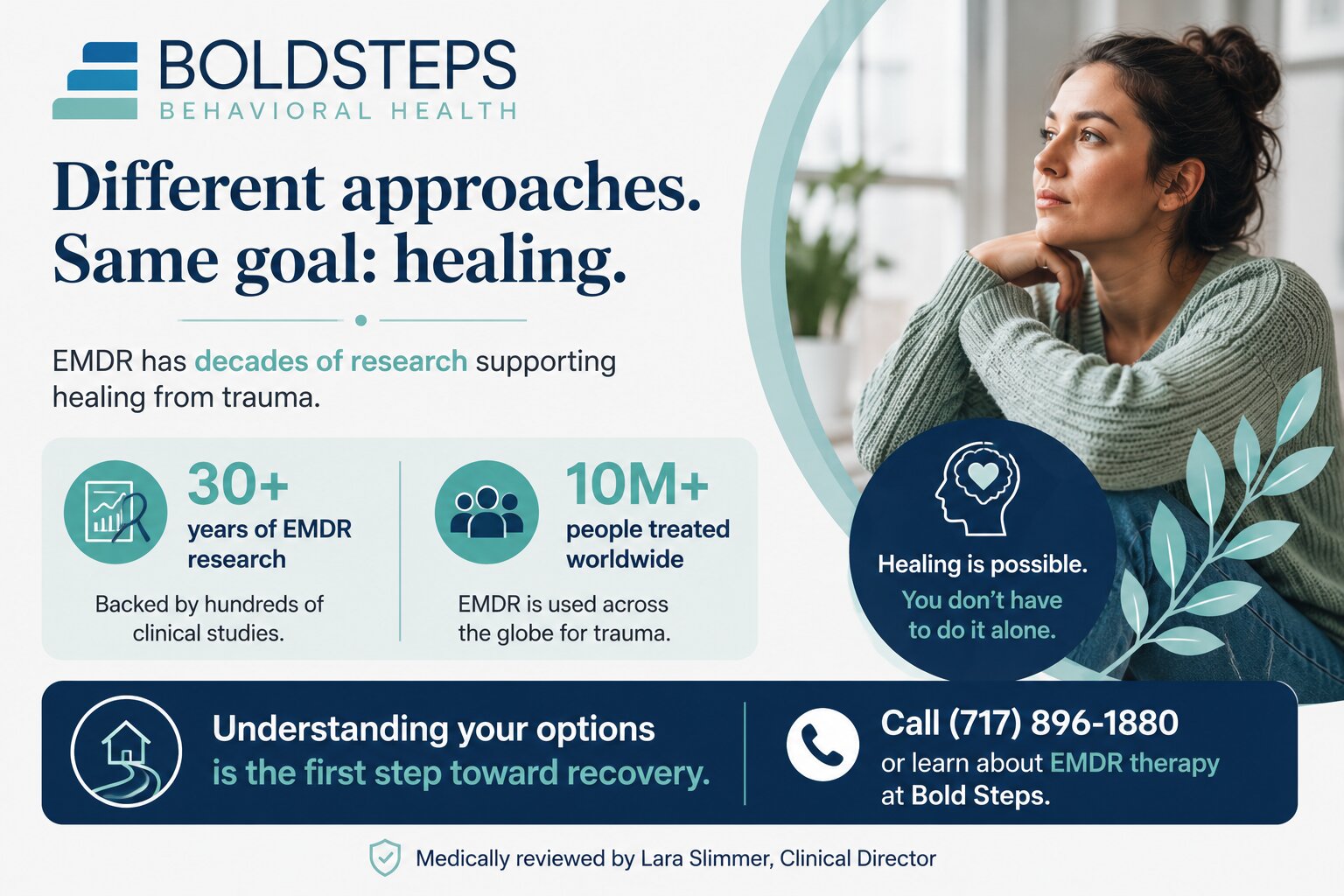
EMDR has been studied for more than three decades.
Researchers have conducted numerous randomized controlled trials involving thousands of participants. The therapy has been evaluated across military populations, survivors of assault, accident victims, children, healthcare workers, and many other groups.
As a result, EMDR has earned recognition from multiple international professional organizations as an evidence-based treatment for trauma.
Brainspotting’s research base is growing, but it is much newer.
Existing studies suggest Brainspotting may reduce trauma symptoms and emotional distress, but the number of high-quality randomized trials remains relatively limited. More research is needed before its evidence base reaches the depth currently available for EMDR.
That doesn’t mean Brainspotting is ineffective.
It simply means clinicians have considerably more scientific data supporting EMDR at this point.
Session Experience
Clients often describe the therapies differently.
EMDR sessions may feel:
- More guided
- More predictable
- Goal-oriented
- Organized around specific memories or treatment targets
Brainspotting sessions may feel:
- More open-ended
- Less directive
- More focused on internal awareness
- Slower and exploratory
Some people appreciate the structure of EMDR because they know what to expect.
Others prefer Brainspotting’s more fluid style because it allows emotional experiences to unfold naturally.
Which Is Right for Trauma?
When comparing brainspotting vs EMDR for trauma, it helps to think about two separate questions:
Can both therapies help people with trauma?
Yes.
Both approaches aim to reduce the emotional intensity of traumatic memories and improve day-to-day functioning.
Which has the stronger scientific evidence?
Currently, EMDR.
Its evidence base is substantially larger, spanning decades of clinical research, randomized controlled trials, and endorsements from respected healthcare organizations.
Brainspotting remains a promising therapy with growing support among clinicians, but its research is still in an earlier stage.
For many people choosing between the two, that evidence difference becomes an important part of the decision.
At Bold Steps Behavioral Health, our clinicians are trained in EMDR therapy because of its well-established effectiveness and strong research foundation. During an assessment, your therapist can discuss whether EMDR aligns with your symptoms, goals, and comfort level while helping you understand all appropriate treatment options.
Recovery isn’t about choosing the newest therapy or the most popular one. It’s about finding an evidence-based approach delivered by qualified professionals who tailor treatment to your individual needs.
Frequently Asked Questions
Is brainspotting better than EMDR?
Neither therapy is universally better for everyone. Some individuals respond well to Brainspotting, while others prefer EMDR’s structured approach. From a research perspective, EMDR currently has substantially stronger scientific evidence supporting its effectiveness for trauma.
Which has more research—brainspotting or EMDR?
EMDR has far more peer-reviewed research, including numerous randomized controlled trials conducted over more than 30 years. Brainspotting has a growing body of research, but considerably fewer high-quality studies have been published.
Can you do both brainspotting and EMDR?
In some situations, yes. Therapists who are trained in both approaches may integrate them when clinically appropriate. The decision depends on your symptoms, treatment goals, therapist’s training, and how you respond to therapy over time.
Choosing the Right Therapy Starts with the Right Conversation
If you’re comparing trauma therapies, it’s understandable to want reassurance that you’re making an informed decision. While both Brainspotting and EMDR are designed to help people heal from difficult experiences, EMDR currently has the stronger evidence base and one of the longest records of clinical research for trauma treatment.
The best next step is a thoughtful conversation with a qualified mental health professional who can explain your options, answer your questions, and recommend an approach based on your unique needs—not a one-size-fits-all solution. Easily accessible from anywhere in Harrisburg, Lancaster County, York County and beyond.
Call (717) 896-1880 or explore EMDR therapy at Bold Steps.